
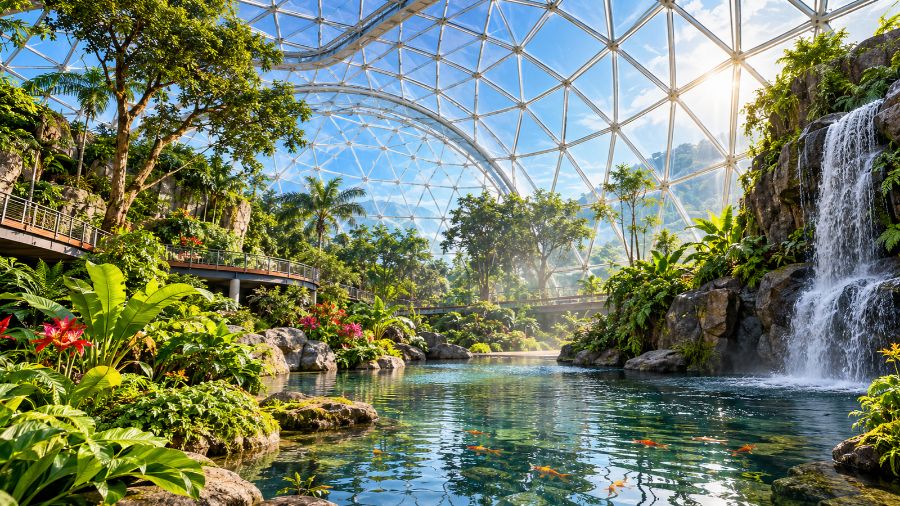
What Is a Biodome?
A biodome is an enclosed or partially enclosed, human-designed environment that represents or maintains an ecosystem under controlled conditions. Depending on its purpose, it may contain plants, animals, microorganisms, soil, water, and systems that regulate temperature, humidity, ventilation, and lighting. Some biodomes recreate particular natural habitats, while others serve as small experimental models for studying interactions between living organisms and their surroundings. The term is used in different contexts, so not every biodome has the same size, design, or level of environmental control. A public attraction might contain several habitats under one roof, whereas a classroom biodome could be a simple transparent container with soil, water, and small plants. The central idea is to bring ecological relationships into a defined space where they can be observed, studied, or maintained.
How Does a Biodome Work?
A biodome works by bringing together the biological and physical conditions needed to support a selected ecosystem. Designers determine which organisms the environment will contain, what resources they need, and which conditions must be maintained for their survival. Depending on the design, sunlight or artificial lighting supports photosynthesis, ventilation manages air exchange, and heating or cooling equipment maintains suitable temperatures. Water may circulate through ponds, filtration systems, irrigation equipment, or natural evaporation and condensation processes. Soil organisms and microorganisms can help break down organic matter and recycle nutrients, while plants absorb water and carbon dioxide during growth. Larger facilities may use sensors, pumps, automated controls, and specialist monitoring equipment to maintain appropriate conditions. The result is not necessarily an independent natural world; it is a managed environment whose complexity depends on its intended purpose.
The Role of Living Organisms
Plants, animals, fungi, and microorganisms contribute different functions within a biodome. Plants capture light energy through photosynthesis, produce organic matter, and provide food or shelter for other organisms. Animals may consume plants, prey on other animals, pollinate flowers, or disperse seeds, depending on the species involved. Decomposers, including fungi and bacteria, break down dead organic material and return nutrients to the environment. These relationships help scientists understand food webs, nutrient cycling, and ecological balance. However, introducing several species does not automatically create a stable ecosystem. Every organism has particular habitat requirements, and an unsuitable combination can lead to competition, disease, population decline, or the loss of important ecological functions.
The Role of Environmental Controls
Environmental controls help a biodome reproduce the conditions required by its organisms. Temperature, humidity, light intensity, water quality, soil moisture, and air circulation may all need careful management. A tropical habitat generally requires different conditions from a cool coastal environment, so a facility containing multiple ecosystems may need separate climate-control zones. Sensors can measure environmental variables and alert staff when readings move outside acceptable ranges. Automated systems may adjust ventilation, irrigation, lighting, or heating, but human oversight remains important because biological systems can change in unexpected ways. Environmental controls therefore support ecosystem management rather than guaranteeing that every species will thrive.
What Are the Main Types of Biodomes?
Biodomes vary according to the habitats they recreate, the organisms they contain, and their intended use. Some are designed for public education and conservation, while others support controlled experiments, plant cultivation, or engineering research. Their structures may include transparent glass, specialized plastic panels, metal frameworks, or other materials selected for strength, insulation, light transmission, and climate requirements. Understanding the different types helps explain why the word biodome can refer to anything from a small educational model to a large scientific facility.
Tropical Rainforest Biodomes
A tropical rainforest biodome recreates selected conditions found in warm, humid forest environments. It may contain dense vegetation, climbing plants, trees, streams, and animal species suited to tropical habitats. Maintaining these conditions requires careful management of humidity, temperature, lighting, water, and ventilation. Such biodomes can help visitors explore rainforest biodiversity without travelling to tropical regions, while researchers can observe selected plant and animal interactions in a managed setting. They can also demonstrate the importance of forest habitats and the pressures caused by deforestation and habitat fragmentation. Nevertheless, even a large indoor rainforest cannot fully reproduce the complexity, scale, or natural variation of an intact tropical forest.
Desert Biodomes
A desert biodome recreates selected features of arid environments, where water availability is limited and organisms have developed adaptations for surviving dry conditions. Plants may include cacti and other drought-tolerant species, while the habitat may represent reptiles, insects, or other animals suited to desert climates. Designers must manage water carefully and provide appropriate temperatures, light levels, and shelter. These environments can demonstrate how organisms conserve moisture, avoid extreme heat, and use limited resources. They also provide opportunities to investigate plant adaptations and the challenges of maintaining life under water-stressed conditions.
Aquatic Biodomes
An aquatic biodome focuses on freshwater, marine, or coastal environments. Depending on the design, it may include ponds, streams, aquariums, wetlands, or simulated coastal habitats. Water temperature, oxygen concentration, salinity, pH, filtration, and waste removal can be essential to maintaining suitable conditions. Aquatic systems often require more specialized equipment than simple plant-based biodomes because water chemistry can change rapidly and affect many organisms simultaneously. These facilities help visitors understand aquatic food webs, water quality, and the relationships between land and marine environments. They can also support research into animal behaviour and selected ecological processes.
Forest and Temperate Biodomes
Forest and temperate biodomes represent habitats that experience seasonal changes or cooler conditions than tropical environments. They may contain deciduous trees, conifers, shrubs, mosses, and animals associated with woodland ecosystems. Depending on the scientific or educational objectives, designers may reproduce seasonal light patterns, temperature changes, and moisture levels. These environments can help explain leaf fall, seasonal growth, animal behaviour, and the effects of climate on biodiversity. They also illustrate why a single set of environmental conditions cannot support every species equally well.
Educational and Experimental Biodomes
Educational biodomes are often small, affordable models used by schools, universities, and science programs. A simple example might contain soil, plants, moisture, and decomposing organic material inside a transparent container. Students can observe condensation, plant growth, and changes in moisture over time. More advanced experimental biodomes may be designed to test specific questions about plant growth, environmental conditions, or resource recycling. Their greatest value comes from allowing a clearly defined system to be observed repeatedly, although results from a small model should not automatically be treated as representative of a natural ecosystem.
Famous Biodome Examples Around the World
Real-world biodomes demonstrate how architecture, environmental engineering, ecology, and public education can work together. Some facilities focus primarily on plants, while others recreate complex habitats containing numerous animal and plant species. Their purposes also differ: a visitor attraction may prioritize immersive learning, whereas a research facility may focus on environmental processes and the challenges of maintaining life in controlled conditions. Examining established projects provides a clearer understanding of what biodomes can accomplish and where their limitations become apparent.
The Eden Project in Cornwall, England
The Eden Project is a well-known example of large-scale biome architecture located in Cornwall, England. Its distinctive structures contain a Rainforest Biome and a Mediterranean Biome, creating indoor environments for plants associated with different climatic regions. The rainforest environment represents humid tropical conditions, while the Mediterranean environment features plants adapted to warmer regions with different rainfall patterns. The project also combines gardens, educational experiences, and environmental interpretation to help visitors understand the relationship between plants, people, and natural resources. Its interconnected dome structures demonstrate how engineering can create substantial enclosed environments for horticulture and public learning. Although often discussed alongside biodomes, the Eden Project is particularly notable for its recreated plant habitats rather than being a completely closed ecosystem.
Biosphere 2 in Arizona, United States
Biosphere 2 is a major scientific research facility near Oracle, Arizona, designed to investigate interactions among ecological systems within an engineered environment. Its history includes an ambitious experiment in which people lived inside a substantially enclosed environment containing different habitat types. The experiment revealed the difficulty of maintaining stable environmental conditions when biological processes, atmospheric chemistry, and resource requirements interact in complex ways. Oxygen levels fell during the initial human-occupation experiment, requiring oxygen to be added, demonstrating that a system designed to be self-contained may not maintain the balance its designers expect. Today, Biosphere 2 is associated with scientific research and education concerning Earth systems, environmental change, and ecosystem processes. Its significance lies partly in showing that building an enclosed habitat is an engineering achievement, but keeping its biological and chemical systems balanced is a separate challenge.
Montréal Biodôme in Canada
The Montréal Biodôme, located in Quebec, Canada, recreates five ecosystems of the Americas under one roof. These include a tropical rainforest, the Gulf of St. Lawrence, a Laurentian maple forest, the Labrador Coast, and the Sub-Antarctic Islands. Visitors can explore contrasting habitats and observe how environmental conditions influence the plants and animals associated with each one. The facility also supports educational activities, research, and conservation initiatives, making it more than a conventional indoor attraction. Its design illustrates how several distinct environments can coexist within one building when their particular requirements are managed carefully. The Montréal Biodôme is especially useful for understanding the educational potential of biodomes because it connects habitat representation with explanations of biodiversity and the relationships between organisms and their surroundings.
What Are the Main Components of a Biodome?
The components of a biodome depend on its scale and objectives, but most designs bring together a physical enclosure, environmental management systems, living organisms, and resources needed to sustain them. The enclosure establishes the boundaries of the environment, while lighting, ventilation, irrigation, drainage, and climate-control equipment help maintain suitable conditions. Biological components may include plants, animals, soil organisms, and microorganisms, supported by water, nutrients, and appropriate habitats. Larger installations can require specialized filtration, water-treatment systems, monitoring equipment, and separate climate zones. A successful design must account for the relationships between these components rather than treating each as an independent feature. For example, changing the temperature can affect evaporation, humidity, plant growth, animal behaviour, and the operation of water systems. Biodome planning therefore involves understanding how physical infrastructure and biological processes influence one another.
Structure and Building Materials
The physical structure protects the organisms inside while allowing the required amount of light to enter. Glass and transparent polymers are common choices for enclosed growing environments, while steel or other engineered materials may provide structural support. Some large facilities use interconnected domes or geometric frameworks to create wide interior spaces without relying on numerous internal supports. Designers must consider wind loads, rainfall, insulation, condensation, corrosion, maintenance access, and the weight of equipment. Materials must also suit the intended climate because a tropical enclosure has different humidity and temperature requirements from a cold-climate habitat. Architectural design is consequently important not only for appearance but also for structural safety, energy efficiency, and the long-term management of the environment.
Water and Nutrient Cycles
Water and nutrients are essential to the functioning of a biodome. Plants absorb water through their roots, release some moisture through transpiration, and require mineral nutrients for growth. Evaporation and condensation may return water to surfaces or soil, while drainage and filtration systems can help manage excess water. Organic material can be broken down by microorganisms, returning some nutrients to the environment for reuse. However, these processes do not guarantee a complete or perfectly balanced cycle. Nutrients can accumulate, become unavailable, or leave the system when material is removed. Water may also require treatment to maintain appropriate chemical and biological conditions. Careful monitoring helps operators understand these changes and prevent problems from spreading through the ecosystem.
Lighting, Temperature, and Air Quality
Light, temperature, and air quality strongly influence the organisms that can survive in a biodome. Plants require suitable light intensity and duration for photosynthesis, while animals and microorganisms have their own temperature and oxygen requirements. Carbon dioxide concentrations can change as plants photosynthesize and organisms respire, making ventilation and air monitoring important in many enclosed environments. Large facilities may need heating, cooling, dehumidification, or supplementary lighting to reproduce local habitat conditions. These systems can consume substantial energy, especially when a building maintains a warm, humid environment in a cold climate. Designers therefore need to balance biological requirements with energy use, operational costs, and the practical limits of environmental control.
What Are the Benefits of Biodomes?
Biodomes provide a practical way to observe living systems in environments where selected conditions can be controlled and monitored. Their benefits include supporting environmental education, allowing researchers to investigate ecological relationships, protecting certain organisms in managed habitats, and demonstrating the challenges of resource management. They can make unfamiliar ecosystems accessible to people who cannot travel to the regions where those habitats naturally occur. Educational models can also help students investigate scientific concepts by observing changes over time rather than relying entirely on descriptions in textbooks. However, the benefits depend on how each facility is designed and operated. A biodome does not automatically conserve endangered species, reduce environmental damage, or operate sustainably simply because it contains plants and animals.
Supporting Environmental Education
Biodomes make ecological concepts easier to understand by showing how living organisms interact with their physical surroundings. Visitors can observe differences between habitats, recognize the importance of suitable environmental conditions, and learn how changes in one part of an ecosystem may affect other organisms. Schools can use smaller models to demonstrate germination, moisture movement, decomposition, and plant responses to light. These experiences encourage observation, comparison, and evidence-based reasoning. Public facilities can also explain broader issues such as habitat loss, climate change, pollution, and biodiversity decline. The strongest educational experiences connect what visitors see inside the structure with the ecological processes occurring outside it.
Helping Scientific Research
A biodome can give researchers greater control over selected environmental variables than they would have in an uncontrolled outdoor setting. Scientists may investigate plant growth, animal behaviour, water quality, nutrient cycling, or responses to different temperatures under carefully documented conditions. Monitoring equipment can help identify patterns that are difficult to observe directly in large natural ecosystems. Experimental facilities can also be useful for studying how several environmental factors interact, although separating individual effects can remain challenging. Findings must be interpreted in light of the model’s limitations because a controlled enclosure cannot reproduce every feature of a natural habitat. Biodome research is most valuable when experiments are carefully designed and results are compared with evidence from field studies and other scientific methods.
Contributing to Conservation Awareness
Biodomes can help visitors appreciate species and habitats that face environmental pressures. By presenting living organisms in the context of their habitats, they can explain why animals depend on food sources, shelter, suitable climates, and functioning ecological relationships. Some institutions also contribute to research and conservation initiatives, although the nature and impact of those programs vary. Maintaining organisms in a biodome is not equivalent to protecting their natural habitats, and successful conservation often requires action in the wild. Biodomes can nevertheless support broader conservation efforts by increasing public understanding, providing opportunities for selected research, and encouraging people to recognize the value of biodiversity.
Demonstrating Resource Management
A carefully designed biodome can illustrate how water, energy, nutrients, and waste need to be managed together. Recycling water or organic material may reduce the demand for some external inputs, while monitoring systems can reveal where resources are being lost or used inefficiently. These examples can help students and visitors understand the principles behind resource efficiency and environmental engineering. Yet the actual sustainability of a biodome depends on its construction materials, energy sources, maintenance requirements, water use, and operational practices. A facility that maintains tropical conditions using large amounts of energy may have a different environmental footprint from a small passive plant enclosure. Sustainability must therefore be assessed using the whole system rather than inferred from its appearance.
What Are the Disadvantages and Limitations of Biodomes?
Despite their educational and scientific value, biodomes can be expensive to build, difficult to operate, and challenging to keep biologically stable. Large facilities require suitable land, specialized construction, trained staff, equipment, energy, water, and regular maintenance. Even a small model can develop problems if it receives too much sunlight, retains excessive moisture, lacks suitable drainage, or contains organisms with incompatible requirements. Enclosed environments may also limit natural movement, migration, and ecological interactions that occur over much larger areas. These limitations mean that a biodome should be judged according to its purpose, the needs of its organisms, and the quality of its management. It is a useful environmental model or managed habitat, not a universal substitute for natural ecosystems.
High Construction and Operating Costs
Large biodomes can require significant investment in structural engineering, specialized materials, climate control, water systems, safety equipment, and habitat design. Operating expenses may continue throughout the facility’s lifetime because heating, cooling, lighting, filtration, repairs, and staff support remain necessary. The cost of maintaining different climate zones within the same building can be especially demanding. Smaller educational models are much more affordable, but their simplicity also limits the variety of organisms and ecological processes they can represent. Careful planning can help reduce unnecessary expenses, although long-term budgets must account for maintenance and the changing needs of living organisms rather than focusing only on initial construction.
Difficulty Maintaining Ecological Balance
An ecosystem contains many interacting processes, and small changes can produce effects that are difficult to predict. A population of one organism may grow rapidly, a disease may spread, or a nutrient may accumulate to harmful levels. Microorganisms can alter soil and water chemistry, while changes in temperature or humidity may affect several species simultaneously. Closed or partly closed systems are particularly challenging because waste products and gases may accumulate if the processes that remove or transform them do not work as expected. Effective management requires regular monitoring, a clear understanding of ecological relationships, and the ability to respond when conditions change. The history of Biosphere 2 demonstrates why a carefully engineered enclosure should not be assumed to maintain a stable balance without intervention.
Limited Representation of Natural Habitats
Even sophisticated biodomes represent only selected parts of the ecosystems they imitate. Natural habitats extend across large areas and include changing weather, seasonal cycles, migration, geological processes, and interactions with neighbouring environments. A tropical rainforest enclosure may display characteristic plants and conditions, but it cannot fully reproduce the diversity and complexity of a vast natural forest. Similarly, a simulated coastal habitat cannot represent every ocean current, food web, or disturbance found in the wild. Researchers and educators must acknowledge these differences when drawing conclusions from biodome observations. Protecting natural ecosystems remains essential because artificial environments cannot replace the full range of ecological functions provided by intact habitats.
How to Build a Simple Biodome at Home or School
A small biodome is a useful educational project for learning about plants, moisture, soil, and environmental conditions. A basic model can be created using a transparent container, clean soil, small plants, and a modest amount of water. The container should allow sufficient light to reach the plants without exposing them to excessive heat. After planting, students can observe condensation, changes in soil moisture, leaf development, and plant growth over several days or weeks. Recording observations helps distinguish what is actually happening from what students expect to happen. A transparent lid may reduce moisture loss, but the container should not be assumed to maintain a perfectly balanced ecosystem. Suitable ventilation, appropriate watering, and monitoring for mould are important, and animals should not be added casually because they require specific habitat conditions and welfare considerations.
Choosing Suitable Plants and Materials
Small plants that tolerate the available light, temperature, and moisture are generally appropriate for a beginner’s biodome. A clear container, suitable potting medium, small stones where useful for drainage, and a modest water supply may be sufficient for a simple demonstration. Plants should be selected for their compatibility rather than their appearance alone. A container that remains constantly saturated can encourage root problems and mould, while excessive sunlight may cause overheating. Adding too many plants can also create overcrowding as they grow. Students should record the materials used, the initial conditions, and subsequent changes so they can compare different designs and identify which factors appear to influence plant health.
Observing the Water Cycle
A plant-based biodome can demonstrate parts of the water cycle through evaporation, transpiration, condensation, and the return of water to the growing medium. Moisture enters the air from damp soil and plant leaves, and some of that water may condense on cooler surfaces before returning to the soil. Students can observe how condensation changes with temperature and light exposure. However, condensation on the container does not prove that the system is self-sustaining, and water may still need to be added. A useful experiment involves comparing two similar containers under different light or ventilation conditions while changing only one variable at a time. This approach encourages careful observation and helps students understand the difference between evidence and assumptions.
How Are Biodomes Different From Greenhouses and Ecosystems?
Biodomes, greenhouses, and natural ecosystems share some characteristics, but their purposes and structures differ. A greenhouse is primarily designed to create suitable conditions for growing plants, often for food production, horticulture, or research. A biodome is generally intended to represent or maintain an ecosystem, potentially including several types of organisms and their interactions. A natural ecosystem is not defined by a building or enclosure; it consists of organisms interacting with one another and with the nonliving environment in a functioning ecological unit. Some facilities can fit more than one description. For example, a large botanical greenhouse may recreate a habitat for educational purposes, while a biodome may rely on greenhouse technology to regulate its environment. The most useful distinction is therefore the facility’s purpose and ecological complexity, not simply whether it has a glass roof.
Biodome vs. Biosphere
The term biosphere usually refers to the global zone of Earth where life exists, including parts of the atmosphere, oceans, and land. A biodome, by contrast, is a human-designed environment that represents or maintains selected ecological conditions within a limited area. The name Biosphere 2 refers to a particular research facility, not to the Earth’s entire biosphere. The distinction matters because a small enclosed ecosystem cannot reproduce the full complexity of the global environment. Biodomes can help scientists study specific ecological questions, but conclusions about Earth’s biosphere must draw on evidence from many sources, including field research, laboratory experiments, and environmental monitoring.
Biodome vs. Terrarium
A terrarium is a small enclosure used to grow plants or maintain selected small organisms under particular environmental conditions. It may be open or closed and often serves decorative, educational, or horticultural purposes. A biodome is a broader concept that may involve a larger structure, multiple habitats, a wider range of organisms, or scientific research into ecosystem interactions. A sealed plant terrarium can function as a simple model of selected ecological processes, but it is not necessarily a complex or self-sustaining ecosystem. The terms sometimes overlap in educational contexts, especially when small models are used to investigate how living and nonliving components interact.
What Is the Future of Biodomes?
The future of biodomes will depend on advances in environmental engineering, ecological research, monitoring technology, and sustainable building design. Sensors and automated controls can help operators track temperature, humidity, light, water quality, and other environmental variables more consistently. Improved insulation, efficient lighting, heat recovery, and careful water management may reduce some operating demands, depending on the facility. Researchers may also use controlled environments to investigate how organisms respond to changing conditions, while educational institutions can use interactive exhibits to explain biodiversity and environmental change. However, technological improvements do not remove the biological complexity of enclosed ecosystems. Future designs will need to balance scientific objectives, animal welfare, resource consumption, long-term maintenance, and the limits of reproducing natural environments indoors.
Smart Monitoring and Environmental Automation
Modern monitoring equipment can help biodome operators identify changes before they become serious problems. Sensors can measure variables such as temperature, humidity, soil moisture, and water chemistry, while software can organize readings and highlight unusual patterns. Automated irrigation or climate-control systems may respond to specific conditions, reducing the need for some routine manual adjustments. More advanced systems can help staff compare environmental data over time and investigate relationships between changing conditions and organism health. Nevertheless, sensors can fail, measurements can be misleading, and automated systems require appropriate settings and maintenance. Human expertise remains essential for interpreting ecological changes and deciding when intervention is necessary.
Sustainable Architecture and Resource Efficiency
Sustainable biodome design involves more than selecting environmentally friendly building materials. Designers must consider energy demand, water use, construction impacts, equipment lifespan, transport, maintenance, and the resources required to support the organisms inside. Passive design strategies, efficient climate control, appropriate insulation, rainwater collection, and water reuse may help reduce environmental pressures when they suit the location and habitat. Renewable energy can also contribute to reducing operational emissions, although the overall benefit depends on the facility’s energy needs and energy supply. The most responsible approach is to assess performance over the building’s lifetime and compare it with realistic alternatives rather than assuming that every enclosed ecosystem is inherently sustainable.
Conclusion
A biodome is a human-designed environment that recreates selected features of a natural ecosystem for education, research, conservation awareness, or plant cultivation. From the large biomes of the Eden Project to the research facilities of Biosphere 2 and the diverse habitats of the Montréal Biodôme, these environments demonstrate how science and engineering can bring ecological processes into controlled spaces. They offer valuable opportunities to study living organisms, understand resource cycles, and explore environmental challenges, but they also require careful management, significant resources, and realistic expectations. Most importantly, biodomes help people appreciate the complex relationships that sustain life while reminding us that artificial habitats cannot replace the protection of natural ecosystems.
Also Read: MyBalanceNow: How to Check Your Visa Gift Card Balance Safely
FAQs
1. What is a biodome in simple terms?
A biodome is a human-made environment designed to recreate a natural habitat, allowing people to observe plants, animals, and environmental processes within controlled conditions.
2. What is the main purpose of a biodome?
The main purpose of a biodome is to recreate selected ecosystems for scientific research, environmental education, conservation initiatives, and the study of interactions between organisms.
3. Can a biodome sustain life without human help?
Some biodomes recycle resources, but complete independence is difficult. Many require external energy, supplies, environmental monitoring, and human intervention to maintain suitable conditions.
4. What is the difference between a biodome and a greenhouse?
A greenhouse primarily provides controlled conditions for growing plants, while a biodome may recreate a broader ecosystem containing plants, animals, and microorganisms.
5. What are some famous biodomes in the world?
Well-known examples include the Eden Project in England, Biosphere 2 in Arizona, and the Montréal Biodôme in Canada, each serving different purposes.
6. Can students make a biodome at home?
Yes, students can create a simple plant biodome using a transparent container, soil, small plants, and water to observe moisture movement and plant growth.