
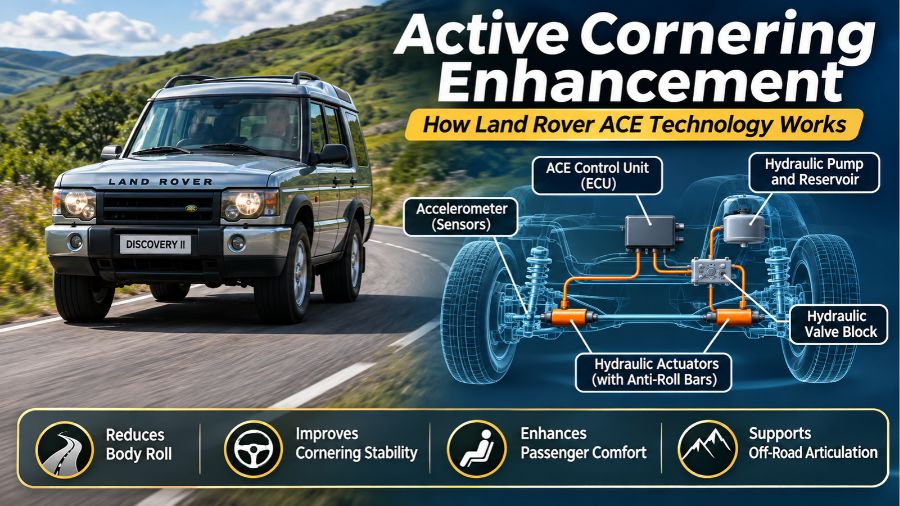
What Is Active Cornering Enhancement?
Active Cornering Enhancement, commonly abbreviated as ACE, is an electronically controlled hydraulic suspension system designed to control vehicle body movement during cornering. Land Rover introduced this technology in the Discovery Series II, which was launched in 1998. The system was developed to address an important challenge associated with large sport utility vehicles: their relatively high centre of gravity can cause noticeable body roll when changing direction. ACE uses electronic sensors, a hydraulic pump, control valves, and specially designed anti-roll bar assemblies to generate forces that counteract this movement. Its purpose is not simply to make the suspension stiffer but to provide a balance between comfortable straight-line driving, controlled cornering, and improved wheel articulation during off-road use.
The History and Development of Land Rover ACE
Land Rover developed Active Cornering Enhancement as part of its effort to improve the road handling and off-road capabilities of the Discovery Series II. The technology first appeared on the Discovery II, introduced in the final quarter of 1998, and represented an important development in electronically controlled suspension engineering for sport utility vehicles. Engineers wanted to reduce the traditional handling disadvantages of tall, heavy vehicles without sacrificing the suspension flexibility required for uneven terrain. The development was documented in an SAE International technical paper published in 2000, which discussed the engineering principles and design objectives behind the system. ACE was offered as an optional feature rather than being fitted to every Discovery II. Its distinctive approach combined hydraulic actuation with electronic monitoring to provide active control over body roll.
How Does Active Cornering Enhancement Work?
Active Cornering Enhancement works by continuously monitoring vehicle movement and adjusting hydraulic pressure to counteract forces that cause the body to lean during cornering. When a vehicle enters a bend, lateral acceleration creates a rolling force around its suspension axis. In a conventional vehicle, passive anti-roll bars resist this movement through mechanical torsion. ACE takes this principle further by using sensors and hydraulic actuators to apply additional controlled force when required. The system’s electronic control unit processes information from the sensors and operates hydraulic valves to regulate pressure at the front and rear roll-control assemblies. This allows the suspension to respond to changing driving conditions without requiring the driver to activate a separate control.
1. Electronic Accelerometers
Accelerometers are important components because they detect lateral acceleration and provide information about how strongly the vehicle is cornering. These sensors communicate movement data to the ACE electronic control unit, allowing the system to determine the level of corrective force required. The information helps distinguish between normal straight-line driving and situations where cornering forces are producing noticeable body movement. Accurate sensor readings are essential because the hydraulic system depends on electronic instructions to deliver appropriate roll control.
2. ACE Electronic Control Unit
The electronic control unit, commonly called the ACE ECU, acts as the central controller of the system. It receives signals from the accelerometers and other relevant inputs, evaluates vehicle movement, and controls the hydraulic valve block. Based on its programmed control strategy, the ECU determines how much hydraulic pressure should be directed towards the actuators. It also monitors system operation and can identify certain faults through diagnostic information and warning indicators. If the system detects an operating problem, it may reduce or disable active roll control depending on the nature of the fault.
3. Hydraulic Pump and Fluid Reservoir
The hydraulic pump generates the pressure required to operate the ACE actuators. It supplies hydraulic fluid through dedicated pipes to the control valve assembly, while the reservoir stores the fluid needed for system operation. Maintaining the correct hydraulic fluid level and system condition is important because insufficient pressure can affect the ability of ACE to control body roll. Hydraulic leaks, pump wear, contaminated fluid, or damaged pipes can reduce system performance and trigger warning lights.
4. Hydraulic Valve Block
The hydraulic valve block regulates the distribution of pressurised fluid throughout the system. It receives instructions from the ACE ECU and controls the pressure delivered to the hydraulic actuators. This component plays an important role in translating electronic commands into mechanical suspension adjustments. If the valve block develops an internal fault, the system may experience pressure-related problems, inconsistent operation, or reduced cornering enhancement.
5. Hydraulic Actuators and Anti-Roll Bars
Hydraulic actuators are connected to specially designed anti-roll bar assemblies and generate the mechanical force required to resist vehicle body roll. Conventional anti-roll bars rely mainly on their mechanical torsional resistance, whereas ACE-equipped vehicles use hydraulic force to provide additional control. The actuators adjust the forces acting between the axle and vehicle body, helping maintain a more level vehicle position during cornering. This arrangement allows the system to provide substantial roll resistance when needed while reducing unwanted suspension stiffness in other driving conditions.
Key Features of Active Cornering Enhancement
One of the most important features of ACE is its automatic operation. Drivers do not need to manually select a cornering mode or adjust hydraulic pressure because the electronic control system manages these functions continuously. The technology also provides different responses according to driving conditions, including cornering, straight-line travel, and off-road movement. At higher cornering forces, the system can progressively allow more body lean rather than attempting to eliminate every movement. This provides useful feedback to the driver about the vehicle’s handling limits. Another important feature is its ability to reduce anti-roll resistance at very low speeds, supporting greater axle articulation when travelling across uneven surfaces.
Benefits of Active Cornering Enhancement
Active Cornering Enhancement offers several advantages for vehicles with a high centre of gravity, particularly large SUVs designed for both road and off-road use. Its most noticeable benefit is reduced body roll during cornering, which can make the vehicle feel more stable and controlled when changing direction. By actively adjusting anti-roll forces, the system can maintain a comfortable suspension response during ordinary driving without relying on permanently stiff mechanical components. It also supports off-road performance by allowing greater suspension articulation under appropriate conditions. These characteristics make ACE an interesting example of how electronic control and hydraulic engineering can work together to improve vehicle dynamics. However, it does not eliminate the physical limits of tyres, suspension geometry, braking performance, or road grip.
Improved Cornering Stability
Reducing excessive body movement can make cornering feel more predictable, especially when driving a tall vehicle through bends or changing direction. ACE applies corrective forces to reduce the amount of body roll generated by lateral acceleration. This helps the vehicle maintain a more controlled position and can improve driver confidence during normal road driving.
Better Passenger Comfort
A suspension system that constantly relies on stiff anti-roll resistance can compromise comfort when one wheel encounters an uneven surface. ACE is designed to balance roll control with suspension flexibility, helping provide a more comfortable driving experience during straight-line travel and on rough tracks. Its adaptive operation is particularly relevant to vehicles expected to perform multiple driving roles.
Enhanced Off-Road Articulation
Off-road vehicles need sufficient wheel movement to maintain tyre contact with uneven terrain. At very low speeds, ACE can effectively reduce the coupling effect of the anti-roll bars, allowing greater axle articulation. This can help improve traction when crossing irregular surfaces, although actual performance also depends on tyres, ground clearance, differential arrangements, and other suspension characteristics.
Active Cornering Enhancement vs Conventional Anti-Roll Bars
Conventional anti-roll bars are mechanical components designed to resist differences in vertical wheel movement across an axle. When one wheel moves upwards relative to the other, the bar twists and generates resistance that reduces body roll. This arrangement is relatively straightforward and does not require a hydraulic pump or electronic control unit. ACE uses a more advanced arrangement in which hydraulic actuators apply additional controlled forces through active roll-control assemblies. The main difference is that conventional systems provide a largely fixed mechanical response, while ACE can vary its response according to driving conditions. This makes active roll control particularly useful for vehicles that need a balance between road handling and off-road suspension flexibility.
Common Active Cornering Enhancement Problems
Although ACE provides advanced suspension control, its hydraulic and electronic components can develop faults over time. Older vehicles may experience problems caused by ageing pipes, worn hydraulic seals, pump deterioration, electrical connections, sensor faults, or control valve issues. Hydraulic leaks are particularly important because a loss of fluid can affect operating pressure and system performance. Drivers may notice warning lights, unusual suspension noises, fluid leakage, or changes in vehicle body movement. A warning indicator should never be ignored, especially when accompanied by a warning chime or noticeable handling changes. Proper diagnosis is important because several different faults can produce similar symptoms.
Hydraulic Fluid Leaks
Hydraulic leaks are among the issues that owners of older ACE-equipped vehicles may encounter. Pipes, connections, seals, and actuator components can deteriorate with age and exposure to operating conditions. A leak can lower the fluid level and reduce the pressure available for active suspension control. Owners should have suspected leaks inspected promptly rather than repeatedly topping up the reservoir without identifying the underlying cause.
ACE Pump Failure
The hydraulic pump is responsible for supplying operating pressure to the system. Pump wear, internal damage, insufficient fluid supply, or related drive problems can affect its performance. Common warning signs may include hydraulic noise, pressure-related fault codes, or an illuminated ACE warning light. A technician should check the pump and associated hydraulic circuit before recommending replacement.
Sensor and Electrical Problems
The ACE system depends on electronic signals to determine how much corrective force is required. Faulty accelerometers, damaged wiring, poor electrical connections, or ECU-related problems can interfere with normal operation. Diagnostic equipment capable of communicating with the ACE control system is useful for identifying stored fault codes and checking relevant sensor readings.
Hydraulic Valve Block Problems
The valve block controls hydraulic pressure distribution to the actuators. Internal contamination, sticking valves, electrical faults, or pressure regulation problems can affect system operation. Because the valve block works closely with other hydraulic and electronic components, a proper diagnostic procedure should examine the entire system instead of assuming that the valve assembly is responsible for every warning.
Understanding ACE Warning Lights
The ACE warning light provides important information about the operating condition of the suspension system. According to the Discovery Series II owner’s handbook, the system performs an initial warning-light check when the ignition is switched on. An illuminated warning light while driving can indicate a malfunction that needs attention. The handbook distinguishes between red and amber warnings, with different instructions for each condition. A red warning indicates a potentially serious system fault and requires the driver to stop as soon as it is safe, switch off the engine, and seek qualified assistance. An amber warning indicates reduced ACE performance; the handbook advises reducing speed, driving carefully, and arranging professional inspection. Owners should always follow the instructions in the handbook applicable to their specific model year and market.
Active Cornering Enhancement Maintenance and Repair
Maintaining an ACE-equipped vehicle requires attention to both hydraulic and electronic components. Regular inspections should include the hydraulic fluid level, pipes, connections, pump condition, actuators, and visible signs of leakage. Any unusual noise or warning indicator should be investigated before it develops into a more serious problem. Repairs should be carried out by a technician familiar with Land Rover suspension systems and the correct diagnostic procedures. Hydraulic components may require specific bleeding procedures after repairs to remove trapped air, while electronic components may need diagnostic checks or calibration. Using the correct specified hydraulic fluid is also essential because unsuitable fluids can affect seals and system performance. Maintenance requirements should always be confirmed using the appropriate workshop documentation for the vehicle.
Is Active Cornering Enhancement Worth Having?
For drivers who value a combination of comfortable road handling and off-road capability, ACE offers an interesting engineering advantage. It can reduce excessive body roll without requiring the suspension to remain permanently stiff, which is particularly useful in a large SUV such as the Discovery Series II. However, the technology also introduces additional components that require maintenance, including hydraulic pipes, pumps, actuators, sensors, and electronic controls. Repair costs can become a consideration as these vehicles age, especially when multiple components need attention. Buyers considering a used ACE-equipped Discovery should check the warning lights, inspect the hydraulic system for leaks, and arrange a specialist diagnostic assessment. A properly maintained system can offer useful handling benefits, but its condition should be evaluated before purchase.
Conclusion
Active Cornering Enhancement represents an important development in automotive suspension technology, demonstrating how hydraulic engineering and electronic control can improve vehicle handling. Originally introduced on the Land Rover Discovery Series II, ACE was designed to reduce body roll, improve cornering stability, maintain passenger comfort, and support off-road suspension articulation. Its combination of accelerometers, an electronic control unit, hydraulic pressure, and active anti-roll bars provides capabilities beyond conventional passive suspension systems. Although the technology offers meaningful driving benefits, its long-term performance depends on proper maintenance and timely diagnosis of hydraulic and electrical faults. For automotive enthusiasts and Discovery owners, understanding ACE is essential for appreciating its engineering advantages and maintaining its performance.
Also read: Newslikeyou.com Review: Features, Content, Services, and Online Presence
FAQs
1. What does Active Cornering Enhancement mean?
Active Cornering Enhancement is a Land Rover hydraulic suspension technology that automatically adjusts anti-roll forces to reduce vehicle body movement during cornering.
2. Which Land Rover models feature Active Cornering Enhancement?
ACE is particularly associated with the Land Rover Discovery Series II, where it was available as an optional suspension feature.
3. How does Active Cornering Enhancement reduce body roll?
It uses accelerometers, electronic controls, hydraulic pressure, and actuators to apply corrective forces through specialised anti-roll bar assemblies.
4. Does Active Cornering Enhancement improve off-road performance?
Yes. At very low speeds, ACE reduces anti-roll bar resistance, allowing greater axle articulation and helping maintain traction across uneven terrain.
5. What causes the ACE warning light to illuminate?
Common causes include hydraulic leaks, insufficient pressure, pump problems, faulty sensors, electrical issues, and malfunctioning hydraulic control valves.
6. Can a Land Rover Discovery drive without Active Cornering Enhancement?
A vehicle may remain driveable after certain ACE failures, but safety depends on the fault. Follow warning-light instructions and obtain professional inspection.