
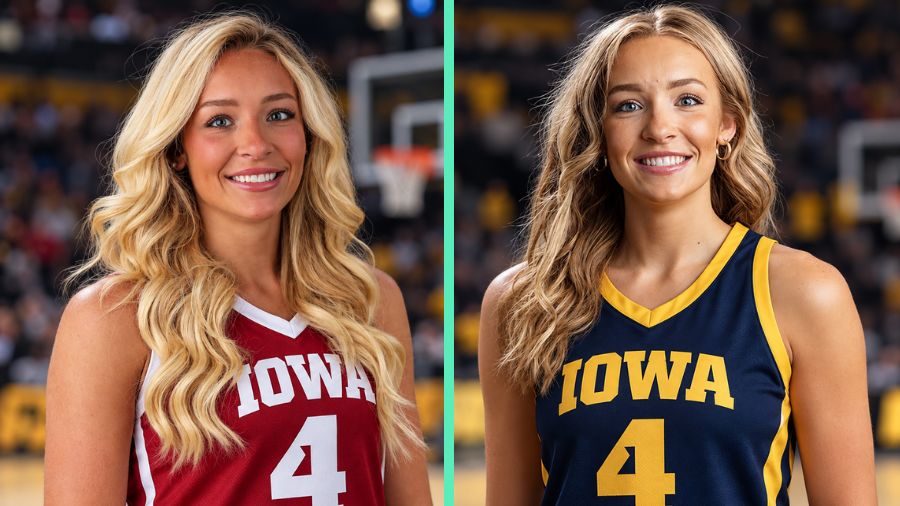
Kylie Feuerbach is an American basketball player recognized for her defensive versatility, determination, and contributions to the University of Iowa Hawkeyes women’s basketball program. After beginning her college career at Iowa State University, she transferred to Iowa and became a valuable member of a team that competed at the highest level of NCAA women’s basketball. Her journey includes a significant injury setback, a return to competitive play, appearances in major postseason tournaments, and recognition on the Big Ten All-Defensive Team. Fans searching for Kylie Feuerbach want to understand her background, playing style, college career, statistics, achievements, and the experiences that helped establish her reputation as a dependable guard in collegiate basketball.
Quick Bio
| Fact | Details |
|---|---|
| Full Name | Kylie Feuerbach |
| Known As | Kylie Feuerbach |
| Profession | Basketball player |
| Nationality | American |
| Hometown | Sycamore, Illinois, United States |
| Birth Year | Not independently confirmed in the official roster information reviewed |
| Height | 6 feet (183 cm) |
| Playing Position | Guard |
| High School | Sycamore High School |
| College Education | Iowa State University and University of Iowa |
| Previous College Team | Iowa State Cyclones |
| Iowa Team | Iowa Hawkeyes |
| Jersey Number at Iowa | No. 4 |
| Known For | Perimeter defense, versatility, and college basketball |
| Major Recognition | Big Ten All-Defensive Team, 2025–26 |
| Family Information | Detailed personal information is limited in publicly available biographical records |
| Professional Status | Her college career at Iowa concluded with the 2025–26 season; subsequent professional playing status is not confirmed here |
Who Is Kylie Feuerbach?
Kylie Feuerbach is a former Iowa Hawkeyes women’s basketball guard whose college career spanned two major programs in the Big 12 and Big Ten conferences. She first gained attention through her performances at Sycamore High School in Illinois, where she developed into a productive scorer and a promising defensive player. Her college journey began with the Iowa State Cyclones in the 2020–21 season before she transferred to the University of Iowa. At Iowa, she became part of a program that attracted national attention for its postseason performances and competitive standard. Although she was not always the team’s leading scorer, Feuerbach offered qualities that coaches value in a team-oriented guard: defensive commitment, awareness, passing ability, and a willingness to take on demanding assignments. Her later recognition on the Big Ten All-Defensive Team reflected the importance of those contributions. Her biography is therefore not simply a story about points and shooting percentages; it also illustrates how defensive specialists can become influential players within successful college basketball teams.
Background in Basketball
Feuerbach’s basketball background developed in Sycamore, Illinois, where she attended Sycamore High School and emerged as one of the school’s standout athletes. Her high school performances established a foundation for the transition to Division I college basketball, where the pace, physicality, tactical demands, and depth of competition are substantially different. Publicly reported high school statistics credited her with averaging approximately 19.9 points, 7.3 rebounds, and 4.5 steals per game during a standout period of her career. She also surpassed 2,000 career points, demonstrating that her abilities extended beyond defense. Her involvement with the All-Iowa Attack youth basketball program gave her additional experience against strong competition and helped prepare her for college recruitment. One notable achievement came in 2018, when she made a game-winning three-pointer in the Nike Elite Youth Basketball League championship game, helping her team secure the title. That moment illustrated her ability to contribute offensively under pressure. Her development from a high school scorer into a versatile collegiate guard would later become an important theme of her career, as her responsibilities increasingly included defending opposing perimeter players, moving the ball, and supporting the broader team strategy.
College Career at Iowa State University
Feuerbach began her collegiate career with the Iowa State Cyclones during the 2020–21 season. Adjusting to college basketball requires more than transferring high school scoring ability to a new level; players must learn complex defensive systems, manage demanding schedules, and compete against athletes with comparable physical tools and extensive experience. Feuerbach made an encouraging start, appearing in 28 games and starting 24 of them as a freshman. She averaged approximately 5.5 points and 3.1 rebounds per game, while also contributing defensively. These numbers describe a player who earned meaningful responsibility early in her college career rather than one who spent the entire season in a limited role. She also received Big 12 Freshman of the Week recognition twice, an indication that her performances attracted attention during her first year. Her experience at Iowa State provided valuable preparation for the next stage of her development. It exposed her to high-level conference competition and helped her build experience against experienced guards. After completing her freshman season, she decided to continue her college basketball journey elsewhere, eventually choosing a program that would place her in a different competitive environment while keeping her connected to the state where she had developed as a player.
Transfer to the University of Iowa
In April 2021, Feuerbach transferred to the University of Iowa, joining the Iowa Hawkeyes women’s basketball program. A college transfer can involve changes in coaching expectations, offensive responsibilities, teammates, defensive assignments, and personal routines, so adapting successfully requires patience and flexibility. Feuerbach entered a program that placed considerable emphasis on team chemistry, ball movement, perimeter shooting, and competitive intensity. During the 2021–22 season, she appeared in 32 games and contributed from the rotation. Her role developed over time, and her value increasingly extended beyond the number of shots she attempted. Guards are often required to balance multiple responsibilities, including defending quick opponents, helping initiate offensive possessions, making smart passes, and maintaining spacing around the court. Feuerbach’s willingness to handle these duties helped her remain useful in different lineups. Her Iowa career also coincided with a period of considerable national interest in the Hawkeyes, whose postseason performances brought greater attention to the program. While the team’s success was built on the work of many athletes, Feuerbach’s defensive contributions formed an important part of her individual identity. The transfer ultimately connected her to the program with which she became most closely associated in public basketball records.
Injury Setback and Return to Competition
One of the most significant challenges in Feuerbach’s college career came during the 2022–23 season, when an injury prevented her from playing. The official statistical record lists that campaign as a medical redshirt season, distinguishing it from a normal year of competition. An extended absence can be difficult for any athlete because it interrupts game preparation, reduces opportunities to develop through live competition, and requires patience during rehabilitation. However, it would be inappropriate to claim details about her private recovery experience without a reliable public account from Feuerbach herself. What the record establishes is that she returned to the court in the following season and continued contributing to Iowa’s rotation. In 2023–24, she appeared in 39 games, providing depth and defensive effort as the Hawkeyes advanced through another demanding schedule. Her return demonstrated that the injury did not end her college basketball participation. It also added context to her later career: her value was shaped not only by the seasons she played uninterrupted, but also by her ability to resume competition and remain involved in a program with high expectations. Her experience is a reminder that athletic careers rarely follow a perfectly straight path, and that official playing records should be considered alongside the circumstances that influence availability.
Life During Iowa’s NCAA Tournament Runs
Feuerbach played for Iowa during two consecutive seasons in which the Hawkeyes reached the NCAA women’s basketball Final Four, in 2023–24 and 2024–25. These postseason runs placed the program among the most closely followed teams in college basketball and gave its players experience in high-pressure tournament settings. NCAA tournament basketball differs from regular-season competition because each game carries greater immediate consequences, scouting becomes increasingly detailed, and opponents have little room for error. In such circumstances, a guard’s defensive assignments and decision-making can matter even when they do not produce a large scoring total. Feuerbach contributed to Iowa’s rotation during its 2024 Final Four campaign and returned for the following season, when she took on a more substantial role. In 2024–25, she appeared in 34 games and started all 34, averaging approximately 6.7 points, 2.1 rebounds, and 2.3 assists per game according to college statistical records. Her increased involvement reflected her experience and the trust placed in her within the team’s lineup. Although team achievements cannot be attributed to a single player, being part of consecutive Final Four teams formed an important part of Feuerbach’s collegiate résumé and helped distinguish her career from that of many other college guards.
Career Highlights and Public Recognition
Feuerbach’s career is best understood through a combination of individual recognition, statistical production, and team achievements. At Iowa State, she earned two Big 12 Freshman of the Week awards during her first college season. At Iowa, she gained experience in a competitive Big Ten environment and contributed to teams that reached the NCAA Final Four in consecutive seasons. Her individual recognition reached another milestone in March 2026, when the Big Ten named her to its All-Defensive Team for the first time in her career. Conference coaches and media voters recognized her defensive work, and Iowa’s official announcement highlighted her role in taking on difficult opposing guard assignments. That selection was particularly meaningful because defensive recognition rewards qualities that are not fully captured by points per game. Staying in front of a quick ball handler, contesting shots, anticipating passing lanes, communicating switches, and forcing opponents into uncomfortable decisions can influence a game without appearing prominently in a scoring summary. Her 2025–26 season also included personal statistical highs: she scored a career-best 17 points against Fairfield on November 30 and recorded a career-high 11 rebounds against FDU during the NCAA tournament on March 21. These performances demonstrated that she could contribute in several statistical categories while continuing to perform her primary defensive duties.
Playing Style, Strengths, and On-Court Role
Feuerbach played primarily as a guard, a position that demands both offensive awareness and defensive discipline. At six feet tall, she had the size to compete physically with many perimeter players, although height alone does not determine defensive effectiveness. Her reputation developed around her versatility and willingness to accept challenging matchups. A defender may be asked to pressure a ball handler, navigate screens, close out on shooters, help teammates when an opponent drives, and recover quickly to a passing option. Each task requires anticipation, balance, communication, and an understanding of the team’s defensive scheme. Feuerbach’s recognition by the Big Ten reflected the coaching and voting community’s assessment of her work in this area. Offensively, she was capable of scoring from the perimeter, finishing opportunities, and helping move the ball through the team’s offense. Her career statistics also document meaningful contributions as a passer, particularly during her later seasons at Iowa. Her role should not be described as that of a primary scoring star, because her importance was broader than scoring alone. Instead, she represented the type of guard whose contribution depends on how well she executes her assignment, makes sound decisions, and helps a lineup function as a unit. That balance between individual skills and team responsibilities helps explain why defensive recognition became a defining feature of her basketball profile.
Kylie Feuerbach’s Career Statistics and Final Iowa Season
Career statistics provide a useful overview of Feuerbach’s development, provided that figures from different teams and seasons are not confused. In her freshman season at Iowa State in 2020–21, she averaged 5.5 points and 3.1 rebounds per game across 28 appearances. After transferring to Iowa, she recorded approximately 3.4 points per game in 2021–22 and 2.6 points per game in 2023–24, with the latter season following her medical redshirt year. Her role expanded in 2024–25, when she averaged 6.7 points, 2.1 rebounds, and 2.3 assists over 34 games. In her final Iowa season, 2025–26, she appeared in 31 games and started 30, averaging 5.1 points, 2.1 rebounds, and 2.8 assists per game. The official Iowa career summary credits her with 136 appearances for the Hawkeyes, 66 starts, 595 points, 230 rebounds, 228 assists, and 121 steals. Her college totals across Iowa State and Iowa were higher because they include her freshman season at the earlier institution. These figures show why career analysis should consider more than scoring: her assists and steals illustrate the different ways she contributed to possessions. Her career-high 17-point performance against Fairfield and 11-rebound game against FDU also show that she could produce notable individual performances within her broader team role.
Education and Personal Background
Feuerbach’s public biography is closely connected to her education and athletic development in Illinois and Iowa. She attended Sycamore High School in her hometown of Sycamore, Illinois, before continuing her education and basketball career at Iowa State University and later the University of Iowa. Competing at two universities gave her experience in different collegiate environments while keeping her within the broader Midwestern basketball community. College athletes balance training, travel, games, recovery, and academic responsibilities, although the precise details of Feuerbach’s coursework, degree completion, and post-college plans should not be assumed without confirmation. Her public athletic records provide substantial information about her playing history, but they do not establish every aspect of her life outside the sport. Similarly, a complete account of her day-to-day routines, private interests, or personal ambitions is not available in the official information reviewed for this biography. Keeping those limits clear is important when writing about athletes whose public profiles are primarily professional or sports-related. What can be stated confidently is that her years in college basketball involved a sustained commitment to competitive athletics and participation in two established Division I women’s basketball programs.
Family Life and Relationships
Interest in Kylie Feuerbach’s family and relationships is understandable because fans often want to learn about the people who have influenced an athlete’s life beyond the court. However, her public basketball profile does not provide a sufficiently verified account of her romantic relationships, marital status, or children. There is no reliable basis in the information reviewed here to describe her as married, identify a spouse or partner, or claim that she has children. Her family background should therefore be treated with the same care as other personal details that have not been clearly documented in authoritative public sources. While biographical material sometimes includes names of relatives, those details should only be published when supported by reliable records and relevant to the subject’s story. Feuerbach’s most clearly documented public achievements concern her high school development, college transfers, performances, and defensive recognition. Respecting the distinction between confirmed career information and undisclosed personal matters produces a more trustworthy biography and avoids presenting speculation as fact. Readers interested in her story can learn considerably more from her athletic journey without needing unsupported claims about her private relationships or family circumstances.
Life After the 2025–26 College Basketball Season
The 2025–26 season marked the conclusion of Feuerbach’s college playing career at Iowa, where she finished with 136 appearances for the Hawkeyes and earned All-Defensive Team recognition from the Big Ten. Reaching the end of college eligibility often creates a transition point for student-athletes, who may consider professional basketball, coaching, further education, or opportunities outside competitive sport. However, those possibilities should not be confused with confirmed plans. As of October 2026, her subsequent professional playing status and specific career plans are not established by the information verified for this article. It would therefore be inaccurate to announce a professional contract, a new team, retirement from basketball, or a particular occupation without a reliable announcement. Her college record remains meaningful regardless of what direction she takes next. The experience gained through high-level competition, defensive preparation, team responsibilities, and tournament appearances can be relevant to many future paths, but the way she chooses to use that experience is a personal matter. Until further information becomes publicly verifiable, the most accurate description is that she completed her Iowa college career after the 2025–26 season, leaving behind a record of sustained participation and notable defensive recognition.
Why People Search for Kylie Feuerbach
Search interest in Kylie Feuerbach can be understood through several connected aspects of her public career. Basketball fans may look for her statistics, height, position, team history, or performances with the Iowa Hawkeyes, while others want to understand how she moved from Iowa State to Iowa. Her involvement in consecutive NCAA Final Four teams also connects her name with memorable periods in women’s college basketball. The Big Ten All-Defensive Team recognition in 2026 provides another reason readers may seek an updated biography, particularly if they want to know what made her an effective defender. Searches about her high school career, injury-related absence, and return to competition reflect a broader interest in the development of college athletes and the challenges they face along the way. Questions about her age, family, partner, and future may also appear in search results, but those subjects require careful verification rather than assumptions based on online repetition. A useful biography brings these questions together by explaining the established facts, putting statistics into context, and identifying information that has not been confirmed. In Feuerbach’s case, the clearest and most informative story is her progression from a productive high school player to an experienced collegiate guard recognized for defense.
Privacy, Accuracy and Public Information
A responsible biography distinguishes documented information from details that remain private or uncertain. For Feuerbach, official university athletic records provide a strong foundation for understanding her team history, appearances, playing position, major performances, and conference recognition. Statistical databases offer additional context, but figures should be checked carefully because season averages, career totals, and school-specific statistics represent different measurements. Personal information requires a separate standard of care. If a birth date, current residence, relationship status, degree, or post-college contract is not established by a reliable public source, it should not be presented as fact merely because a biography website or social media post repeats it. The same principle applies to claims about an athlete’s feelings, private motivations, or recovery experience. Public visibility as a basketball player does not mean every part of a person’s life is publicly documented. This article therefore focuses on verified milestones and clearly identifies important gaps rather than filling them with speculation. That approach benefits readers by making the biography more dependable, and it supports a useful distinction between what is known about Feuerbach’s athletic career and what has not been publicly confirmed.
Conclusion
Kylie Feuerbach’s basketball journey reflects the importance of versatility, resilience, and team contribution in collegiate sport. From her standout performances at Sycamore High School to her freshman season with Iowa State and subsequent years with the Iowa Hawkeyes, she built a career through consistent participation and an evolving role on the court. Her experience included a medical redshirt season, a return to competition, appearances on teams that reached consecutive NCAA Final Fours, and increased responsibility during her later Iowa seasons. The Big Ten All-Defensive Team selection in 2026 provided a significant individual milestone, recognizing the defensive work that became central to her reputation. Her career statistics also demonstrate that she contributed through passing, rebounding, steals, and scoring rather than relying on a single aspect of the game. Although some personal details and her post-college plans remain unconfirmed, her basketball record offers a clear account of her development and achievements. For readers exploring the story of this American basketball player, Feuerbach stands out as an example of how a guard can make a lasting contribution through defensive discipline, adaptability, and commitment to a team’s goals.
Also read: Sterre Meijer: The Rising Dutch Skateboarding Star Behind Surfsterre
FAQs
1. Who is Kylie Feuerbach?
Kylie Feuerbach is an American basketball player who played for Iowa State and the Iowa Hawkeyes, earning recognition for her defensive abilities and collegiate contributions.
2. How tall is Kylie Feuerbach?
Kylie Feuerbach is listed at six feet tall, approximately 183 centimeters, and played as a guard during her college basketball career.
3. Which college basketball teams did Kylie Feuerbach play for?
Feuerbach played for the Iowa State Cyclones during 2020–21 before transferring to the University of Iowa, where she completed her college career.
4. What is Kylie Feuerbach known for?
She is known for her perimeter defense, versatility, NCAA Final Four experience with Iowa, and selection to the 2025–26 Big Ten All-Defensive Team.
5. Did Kylie Feuerbach suffer a basketball injury?
Yes. An injury kept Feuerbach out of competition during the 2022–23 season, which was recorded as a medical redshirt year.
6. What is Kylie Feuerbach doing after college basketball?
Her Iowa college career concluded in 2026, but her subsequent professional basketball status and future career plans have not been independently confirmed.