What Is the Area Code for Texas, USA?
Texas does not have a single statewide telephone area code. Instead, it uses multiple three-digit area codes assigned to different geographic regions, including major metropolitan areas and smaller communities. These codes are part of the North American Numbering Plan, which serves the United States, Canada, and several other countries and territories. A typical US telephone number contains a three-digit area code followed by a seven-digit local number. For example, a number written as 214-555-0123 uses 214 as its area code. Because Texas has experienced population growth and increasing demand for telephone numbers, some regions have multiple area codes serving the same geographic area. Consequently, knowing the city or region is usually necessary to identify the most relevant Texas area code.
Texas Area Codes by Major City
The easiest way to identify a Texas area code is to start with the city you want to contact. Large metropolitan regions often use several area codes because additional codes have been introduced as the supply of available telephone numbers has changed. However, area codes do not always correspond to city boundaries, and a single code may serve several surrounding communities.
Dallas Area Codes
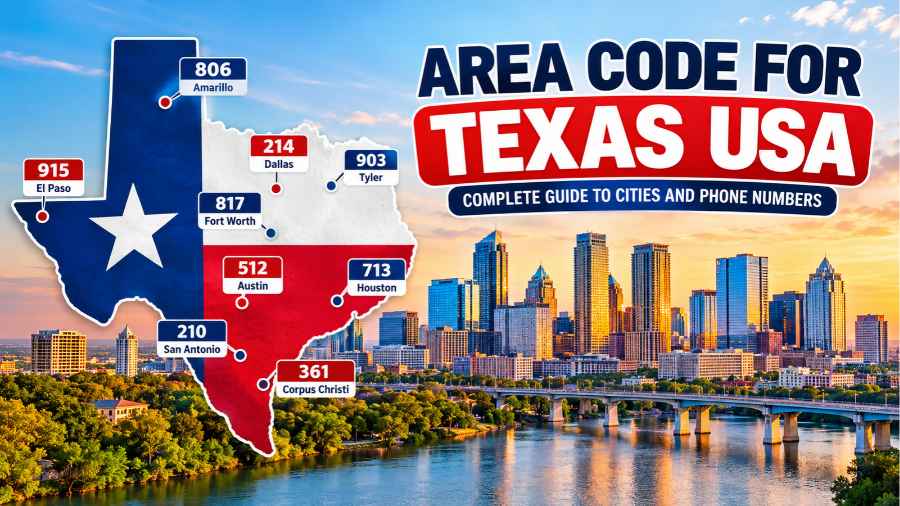
Dallas uses area codes 214, 469, 972, and 945. These codes serve Dallas and portions of the surrounding metropolitan region, including nearby communities within the broader Dallas–Fort Worth area. The original 214 code is historically associated with Dallas, while 469, 972, and 945 provide additional numbering capacity. Because these codes overlap geographically, the first three digits alone cannot reliably identify a caller’s exact neighborhood or current location.
Houston Area Codes
Houston uses area codes 713, 281, 832, 346, and 621. The 713 code is strongly associated with the city’s historic central numbering area, while the other codes expanded capacity across Houston and surrounding communities. These area codes can serve overlapping geographic areas, so two residents living in the same part of Houston may have different area codes. When contacting a Houston business, it is important to use its complete published telephone number rather than assuming that every Houston number begins with 713.
Austin Area Codes
Austin primarily uses area codes 512 and 737. The 512 code has a long association with Austin and parts of Central Texas, while 737 was introduced as an overlay to accommodate additional telephone numbers. Both codes can serve the same general region, meaning a newer Austin number may begin with 737 even when the caller lives or works in an area traditionally associated with 512. The city name alone is therefore insufficient to determine which of the two codes a particular person uses.
San Antonio Area Codes
San Antonio uses area codes 210 and 726. The 210 code has traditionally been associated with San Antonio and nearby communities, while 726 was added as an overlay to provide additional telephone numbers in the same general region. Residents and businesses may therefore have either code without being located in different parts of the city. When saving a San Antonio contact, retain the complete ten-digit number because the area code is an essential part of identifying the destination.
Fort Worth Area Codes
Fort Worth uses area codes 817 and 682. These codes serve Fort Worth and surrounding communities in North Texas, including areas within the broader Dallas–Fort Worth metropolitan region. Although Dallas and Fort Worth belong to the same large metropolitan area, they have different historical area-code groupings. Some nearby communities may use codes associated with either side of the metropolitan region, so it is best to verify the full telephone number instead of relying on a general regional label.
El Paso Area Code
El Paso is primarily associated with area code 915. Located in far western Texas near the US–Mexico border, El Paso has a different regional numbering history from major metropolitan areas farther east. The 915 code serves El Paso and surrounding communities in the region. It is useful when identifying a telephone number associated with El Paso, but it does not prove that a caller is physically located there because telephone numbers can be retained or used through mobile and internet-based services.
Complete List of Texas Area Codes
Texas has 29 active geographic area codes, covering metropolitan regions, smaller cities, rural communities, and border areas. The four original codes introduced in 1947 were 214, 512, 713, and 915. Over time, population growth and increasing demand for telephone numbers led to additional codes and overlays. The current statewide list includes 210, 214, 254, 281, 325, 346, 361, 409, 430, 432, 469, 512, 621, 682, 713, 726, 737, 806, 817, 830, 832, 903, 915, 936, 940, 945, 956, 972, and 979. Each code serves a designated geographic region or shares an existing region through an overlay arrangement. Area-code assignments can change, so official numbering-plan information is the best reference when checking the latest status.
Texas Area Codes by Region
Understanding Texas by region makes it easier to identify the area code associated with a city, town, or business. Although some codes serve large metropolitan areas, others cover broad geographic territories with smaller population centers.
North Texas
North Texas includes Dallas, Fort Worth, and numerous surrounding communities. Dallas uses 214, 469, 972, and 945, while Fort Worth primarily uses 817 and 682. Other parts of the region use codes such as 254 and 940, depending on the community. These codes reflect the different numbering areas established as the region expanded. Because metropolitan boundaries and telephone numbering boundaries are not identical, nearby towns may use different codes even when residents consider themselves part of the same metropolitan area.
Southeast Texas and the Gulf Coast
Southeast Texas includes Houston, Beaumont, Galveston, and surrounding coastal communities. Houston’s area codes are 713, 281, 832, 346, and 621. Area code 409 serves Beaumont and other communities in the southeastern part of the state, while 936 covers portions of East Texas, including areas around Huntsville and the Piney Woods. Area code 979 serves the Bryan–College Station region. These distinctions matter when searching for local businesses or determining whether a telephone number belongs to a particular community.
Central Texas
Central Texas includes Austin, Waco, Killeen, Temple, and Bryan–College Station. Austin uses 512 and 737, while Waco, Killeen, and Temple are associated with 254. Area code 979 serves Bryan–College Station and other nearby communities. The region combines major urban centers, university towns, and expanding residential communities. When searching for a local service provider, checking the area code alongside the city name helps narrow down the likely region without assuming that the number identifies a precise address.
South Texas
South Texas includes San Antonio, Corpus Christi, Laredo, and communities in the Rio Grande Valley. San Antonio uses 210 and 726, Corpus Christi is associated with 361, and Laredo and much of the Rio Grande Valley use 956. Area code 830 serves portions of the Texas Hill Country and surrounding areas outside San Antonio’s principal numbering region. These distinctions can help people identify the general region associated with a number, especially when contacting local companies or public services.
West Texas and the Texas Panhandle
West Texas and the Panhandle cover a large geographic area with relatively dispersed communities. El Paso uses 915, Midland and Odessa use 432, and Amarillo and Lubbock are associated with 806. Area code 325 serves Abilene, San Angelo, and nearby communities. The 432 region also extends across portions of the Permian Basin and Big Bend area. Because distances between towns can be substantial, a single area code may cover a broad territory rather than one major city.
East and Northeast Texas
East and Northeast Texas include Tyler, Longview, and numerous smaller communities. Area codes 903 and 430 serve overlapping areas in Northeast Texas, including communities around Tyler and Longview. Other neighboring areas use codes such as 936. These regions include residential communities, commercial centers, and rural areas, so the relevant code depends on the specific location. When looking up a telephone number, checking the city and full number provides more reliable context than using a regional label alone.
How Texas Telephone Area Codes Work
A telephone area code is the first three digits of a standard ten-digit North American phone number. It identifies a numbering area, while the next three digits identify a central-office code or exchange and the final four digits identify the individual number within that block. For example, in 512-555-0123, 512 is the area code, 555 is the exchange, and 0123 is the subscriber number portion. This structure helps telephone networks route calls to the correct destination. Modern phone systems also support mobile numbers, internet-based calling, and number portability, so the area code should not be treated as proof of a person’s present location.
What Is a Texas Area Code Overlay?
An area-code overlay occurs when a new area code is introduced into a region already served by another code. Instead of replacing existing numbers, the new code allows additional phone numbers to be issued in the same geographic area. Houston’s 621 code, for example, joins 713, 281, 832, and 346. Dallas also has multiple overlapping codes, including 214, 469, 972, and 945. Overlays help numbering administrators accommodate demand while allowing existing customers to retain their telephone numbers. They also mean that people living in the same neighborhood can have different area codes.
How to Dial a Texas Phone Number from Outside the USA
People calling Texas from another country generally need the US country calling code, which is +1, followed by the ten-digit Texas phone number. For example, a number in Austin might be written internationally as +1 512 XXX XXXX, where the X characters represent the remaining digits. Callers should follow their telephone provider’s international dialing instructions because some systems require an international access prefix instead of the plus sign. The country code +1 is not a Texas area code; it identifies the North American Numbering Plan. Keeping the country code and area code separate helps prevent confusion when saving contacts or making international calls.
Is +1 the Area Code for Texas?
No, +1 is the country calling code used for the United States and other participating regions in the North American Numbering Plan. Texas has its own three-digit geographic area codes, including 214 for Dallas, 713 for Houston, 512 for Austin, and 915 for El Paso. When a US number is written in international format, +1 appears before the area code and local number. Understanding this distinction is especially useful for people calling Texas from Pakistan, the United Kingdom, or another country. A complete international number includes the country code, area code, and subscriber number rather than the state name alone.
Can You Identify a Caller’s Location from a Texas Area Code?
A Texas area code can suggest the region originally associated with a telephone number, but it cannot reliably establish where the caller is currently located. Mobile phone users can move between cities and states while retaining their numbers, and many businesses use internet-based telephone services that support calls from different locations. Number portability also allows customers to keep eligible numbers when changing providers. Additionally, caller ID information can sometimes be spoofed, making a displayed number misleading. If an unfamiliar Texas number contacts you, consider the full context of the call and independently verify the caller before sharing personal or financial information.
Why Does Texas Have So Many Area Codes?
Texas has many area codes because its population, business activity, and demand for telephone numbers have grown over several decades. The state initially used four area codes, but additional codes were introduced as telephone numbering resources were divided or supplemented. Mobile phones, business telephone systems, internet calling, and the growing number of connected devices have contributed to continuing demand. Overlays provide a way to expand numbering capacity without requiring every existing customer to change numbers. The result is a system in which one metropolitan area can have several valid codes, while large rural regions may continue to use a single code.
How to Find the Correct Texas Area Code
The most reliable way to find a Texas area code is to begin with the specific city or community and then verify the associated numbering region using an authoritative area-code directory. The North American Numbering Plan Administrator maintains information about geographic area codes, numbering assignments, and dialing plans. You can also check a business’s official contact page or a person’s published telephone details. Be aware that a city may use multiple area codes, so a single search result should not be assumed to represent every number in that location. If you already have a full telephone number, its area code can help you identify the general numbering region, but additional verification may be needed to establish who owns it.
Are Texas Area Codes Important for Businesses?
Texas area codes can be useful for businesses that serve customers in particular cities or regions. A local number may make it easier for customers to recognize a business’s intended service area, while companies operating statewide may use numbers associated with multiple markets. However, an area code alone does not prove that a company has a physical office in that region. Businesses can use hosted phone systems, virtual numbers, and call-forwarding services to manage customer communications across different locations. Customers should therefore verify a company’s address, reputation, and contact details independently rather than treating its telephone number as definitive evidence of local presence.
Conclusion
Texas has 29 active geographic area codes, with different codes serving Dallas, Houston, Austin, San Antonio, El Paso, and many other communities. Multiple codes can cover the same metropolitan area because overlays expand the supply of available telephone numbers without forcing existing customers to change theirs. When calling Texas internationally, remember that +1 is the US country calling code, while the three-digit area code identifies a numbering region. Checking the city, complete telephone number, and current numbering information provides the clearest way to understand a Texas phone number and avoid common dialing mistakes.
Also read: Quantumrun Explained: Powerful Insights Into Future Trends and Technology
FAQs
1. What is the main area code for Texas, USA?
Texas does not have one main area code. The state has 29 active geographic area codes, assigned to different cities, regions, and overlapping metropolitan areas.
2. What is the area code for Houston, Texas?
Houston uses area codes 713, 281, 832, 346, and 621. These codes overlap geographically, so residents and businesses can have different codes within the same region.
3. What is the area code for Dallas, Texas?
Dallas uses area codes 214, 469, 972, and 945. These codes serve overlapping portions of the Dallas metropolitan region and its surrounding communities.
4. What is the country code for calling Texas?
The United States country calling code is +1. International callers should dial +1 followed by the Texas area code and the seven-digit local number.
5. How many area codes does Texas have in 2026?
Texas has 29 active geographic area codes in 2026. Area code 621, introduced in the Houston region in January 2025, is the newest.
6. Can a Texas area code tell me where someone lives?
Not reliably. Area codes indicate numbering regions, but mobile portability, virtual phone services, and caller ID spoofing mean they cannot confirm someone’s current location.