Dragon Boat Boat is a traditional watercraft best known for its distinctive dragon-shaped decorations, powerful team paddling, and connection to Chinese cultural heritage. Although the phrase may sound repetitive because a dragon boat is already a type of boat, it reflects an interest in understanding this remarkable vessel, how it is constructed, and why it has become popular around the world. From its ancient origins and traditional wooden designs to modern competitive racing, dragon boats combine cultural symbolism, teamwork, physical fitness, and sporting excitement. This guide explores their history, structure, different types, racing techniques, advantages, challenges, and continuing importance in international water sports.
What Is a Dragon Boat Boat?
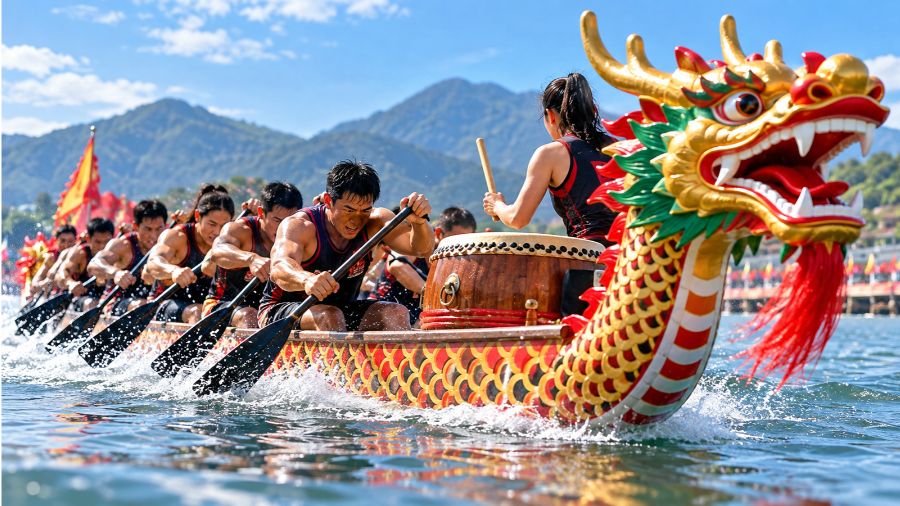
A dragon boat is a long, narrow, human-powered watercraft traditionally decorated with a dragon’s head at the front and a dragon’s tail at the rear. It is primarily associated with team paddling competitions and the traditional Chinese Dragon Boat Festival. Unlike ordinary recreational boats, dragon boats are designed to carry multiple paddlers who work together to move the vessel across the water using single-bladed paddles. A traditional racing crew may also include a drummer who establishes the paddling rhythm and a steerer who controls the boat’s direction. The dragon-shaped decorations are not simply ornamental features; they represent an important connection to Chinese traditions, water symbolism, cultural celebrations, and community identity. Today, dragon boats are used for recreational activities, organised sporting events, cultural festivals, and international competitions.
History and Origins of Dragon Boats
Dragon boating has historical roots in southern China, where communities developed traditions involving boats, water ceremonies, and seasonal celebrations. The practice is generally associated with a history extending more than 2,000 years, although its exact beginnings are difficult to establish because different regions developed their own customs. Dragons traditionally represented powerful forces connected with water, rainfall, rivers, and protection in Chinese culture. Boat races gradually became an important part of local celebrations, bringing communities together through ceremonies and competitive activities. One particularly famous historical association is the story of Qu Yuan, a Chinese poet and statesman whose death became connected with the Dragon Boat Festival. Over centuries, these traditions developed into a recognisable cultural and sporting activity that eventually spread beyond China.
The Legend of Qu Yuan
Qu Yuan was a respected poet and government official who lived during China’s Warring States period. According to the traditional story, he opposed political corruption and was eventually exiled after losing the confidence of the ruling authorities. When he learned that his homeland had fallen to an enemy state, he reportedly entered the Miluo River and drowned. Local people are said to have rushed onto the water in their boats to search for him, beating drums and splashing their paddles to frighten away fish. They also threw rice into the river as an offering. This story became closely associated with dragon boat celebrations, particularly in regions where Qu Yuan is honoured. However, it is important to understand that the festival has several regional traditions and historical associations, rather than one universally accepted origin story.
The Dragon Boat Festival
The Dragon Boat Festival, also known as Duanwu Festival, is traditionally observed on the fifth day of the fifth month of the Chinese lunar calendar. It is one of the best-known cultural occasions associated with dragon boating. Celebrations can include competitive races, traditional food, family gatherings, ceremonies, and local performances. Zongzi, a traditional food made with glutinous rice wrapped in bamboo or other leaves, is particularly associated with the festival. The celebrations differ across communities because local histories and customs influence how the occasion is observed. The festival was inscribed on UNESCO’s Representative List of the Intangible Cultural Heritage of Humanity in 2009, recognising its cultural significance and the traditions maintained by participating communities.
Main Features of a Traditional Dragon Boat
A traditional dragon boat has several distinctive characteristics that separate it from conventional rowing and recreational vessels. Its long hull provides space for multiple paddlers, while the dragon head and tail create its recognisable appearance. The front section commonly features a decorative dragon head with painted details, while the rear may have a stylised tail. The central section contains seats arranged for paddlers, generally in pairs in competitive boats. A drummer’s position is usually located near the front, allowing the crew to follow a consistent rhythm. At the rear, a steerer uses a long steering paddle or specialised steering equipment to maintain direction. Traditional boats were commonly made from wood, while contemporary competitive models may use fibreglass or other manufactured materials. Their precise construction and dimensions depend on the intended use and applicable sporting regulations.
Dragon Head and Tail
The dragon head is one of the most recognisable parts of a traditional dragon boat. It is generally attached to the front of the vessel and designed with features such as eyes, horns, scales, and an expressive mouth. Its appearance varies according to regional artistic traditions and the preferences of the boat builders. The dragon tail is positioned at the back and completes the symbolic design. Together, these decorative elements give the vessel its identity and distinguish it during festivals and races. Traditional dragon decorations also carry cultural meanings associated with strength, protection, good fortune, and water. Modern racing boats may use simpler or detachable decorations depending on competition requirements, transportation arrangements, and the organisation of an event.
Hull and Seating Arrangement
The hull is the main structural body of a dragon boat and plays an important role in its stability, movement, and overall performance. Traditional designs are long and relatively narrow, allowing several paddlers to sit along the length of the vessel. Seats are generally arranged in pairs so that paddlers can work on opposite sides. The hull must balance stability with efficient movement through the water, particularly when carrying a full racing crew. Its shape, depth, width, and construction materials influence how the boat responds to paddling and changing water conditions. Competitive vessels must also comply with the relevant technical rules, which may specify approved dimensions and construction requirements. Good hull design helps a crew maintain consistent movement without unnecessary resistance.
Drum and Steering Equipment
The drum is an important feature of traditional dragon boat racing because it helps establish a coordinated paddling rhythm. The drummer sits near the front and produces a regular beat that paddlers can follow during training and competition. The drummer does not replace the coach’s instructions or the paddlers’ individual judgement, but provides an audible reference that helps the crew maintain timing. Steering equipment is equally important because a dragon boat needs to travel along its intended course without drifting unnecessarily. A trained steerer works from the rear of the vessel, using a long steering paddle or appropriate helm arrangement. Effective steering reduces wasted movement and helps the team maintain a straight racing line.
Different Types of Dragon Boats
Dragon boats are available in different designs and sizes depending on their cultural purpose, recreational use, and competitive requirements. Traditional festival boats often feature detailed dragon decorations and may be constructed according to local customs. Modern racing boats are designed around standardised sporting requirements to provide consistency between competing teams. The International Dragon Boat Federation recognises standard and small racing boat categories, commonly associated with 20 and 10 paddlers respectively. Recreational versions may be used for introductory training, community activities, and informal competitions. Differences in construction, seating arrangements, weight, and decorative features can influence how each boat performs. Choosing an appropriate design requires considering the number of participants, water conditions, intended activity, available storage, and relevant competition regulations.
Standard Dragon Boats
A standard racing dragon boat, commonly identified as a DB22 under International Dragon Boat Federation regulations, accommodates between 18 and 20 paddlers at major international competitions, together with a drummer and steerer. A full crew therefore consists of 22 people. These vessels are designed for organised competitions where coordination, endurance, and consistent paddling technique are essential. Their long structure allows paddlers to sit in pairs and distribute their power along the hull. Standard boats are commonly used at international championships, national sporting events, and large organised festivals. The larger crew creates opportunities for powerful team performance, but it also requires careful coordination because differences in paddling timing can affect the boat’s balance and forward movement.
Small Dragon Boats
Small dragon boats are designed for crews that prefer a more compact competitive vessel. Under IDBF championship regulations, the small racing boat category generally accommodates 10 paddlers, one drummer, and one steerer, giving a total of 12 people. These boats provide an alternative for clubs and competitions that cannot accommodate larger crews. Although the number of paddlers is smaller, teamwork remains just as important. Each participant contributes a greater proportion of the crew’s overall paddling effort, making individual technique and consistent timing particularly valuable. Small dragon boats are also useful in certain recreational programmes and introductory activities, although the precise equipment and participant requirements depend on the organiser.
Traditional Wooden Dragon Boats
Traditional wooden dragon boats reflect the historical craftsmanship associated with the development of the vessel. Wood has been used for generations because it can be shaped into long, distinctive hulls and decorated with detailed cultural designs. Teak is among the woods traditionally associated with some dragon boat construction. Wooden vessels can provide an authentic appearance, particularly during cultural celebrations and ceremonial events. However, their maintenance requirements can be greater than those of modern manufactured boats. Exposure to water, sunlight, and changing temperatures can affect wooden components, so regular inspection and suitable maintenance are important. The construction methods and materials used in traditional boats can vary significantly between regions and individual builders.
Modern Fibreglass Dragon Boats
Modern fibreglass dragon boats are manufactured using composite materials that provide a practical alternative to traditional wooden construction. Fibreglass can be moulded into consistent hull shapes and is generally less demanding to maintain than many wooden designs. These qualities make it suitable for clubs, sporting organisations, and event organisers that operate boats regularly. Some modern vessels also use other composite materials depending on their construction specifications and intended performance. Their appearance can still incorporate traditional dragon decorations, allowing manufacturers to combine cultural identity with contemporary production techniques. However, fibreglass boats are not maintenance-free. Their hulls, fittings, and structural components require regular checks to identify cracks, damage, or deterioration.
How Dragon Boat Racing Works
Dragon boat racing is a team water sport in which crews propel their vessels over a defined course using single-bladed paddles. The objective is to complete the distance in the shortest possible time while following the competition’s rules. Racing normally takes place on a relatively straight course with designated lanes, although event formats can differ. At the starting line, teams position their boats and wait for the official starting signal. Once the race begins, paddlers work together to generate forward movement while following the drummer’s rhythm and the steerer’s direction. Competitive events may include short sprint races and longer endurance-oriented distances. International competitions commonly feature 200-metre, 500-metre, and 2,000-metre events, although the available distances depend on the governing body and event format.
The Role of Paddlers
Paddlers provide the power that moves the dragon boat through the water. They sit in pairs and use single-bladed paddles to generate forward movement through repeated strokes. Each paddler must coordinate body movement, paddle entry, pulling action, and recovery to maintain an efficient technique. A crew with strong individual athletes may still perform poorly if its members cannot maintain consistent timing. Experienced teams therefore spend considerable time developing synchronisation and communication. Paddlers also need to maintain suitable posture and avoid unnecessary movements that could disturb the boat’s balance. Their combined performance determines much of the vessel’s speed, making teamwork more important than relying entirely on individual strength.
The Importance of the Drummer
The drummer plays a valuable coordination role during dragon boat racing. By maintaining a consistent beat, the drummer gives paddlers an audible rhythm that helps them organise their strokes. The rhythm may change according to the team’s strategy, race conditions, and instructions from the coach. During a competition, the drummer must communicate clearly without distracting the crew. Although the drummer does not normally provide propulsion, their contribution can influence how consistently the team paddles. A reliable rhythm is particularly useful when athletes are tired or competing under pressure. Successful crews understand that the drummer is part of the overall team rather than simply someone responsible for making noise during a race.
The Responsibility of the Steerer
The steerer controls the direction of the dragon boat and helps keep it aligned with the designated racing lane. This responsibility requires experience, awareness of water conditions, and a good understanding of how the vessel responds to steering movements. Excessive steering can slow the boat or create unnecessary movement, while insufficient control may cause the crew to drift away from its intended course. The steerer must also communicate effectively with the paddlers and remain aware of nearby boats. During training, teams often practise maintaining straight movement and responding to directional instructions. In competitive racing, accurate steering can help preserve the crew’s effort and reduce avoidable disadvantages.
Important Dragon Boat Racing Rules
Dragon boat competitions operate under rules designed to maintain fairness, safety, and consistency between teams. The International Dragon Boat Federation publishes competition regulations covering crew composition, technical equipment, racing procedures, and safety requirements. Its 2025 Edition 9 regulations became effective on 1 January 2025. Standard international racing boats generally require between 18 and 20 paddlers, while small racing boats use 10 paddlers, with a drummer and steerer included in both configurations. Competitors must follow instructions from race officials, use permitted equipment, and remain within the designated course. Specific requirements can differ between national competitions, local festivals, and international championships, so participants should always check the regulations applicable to their particular event.
Racing Distances and Competition Formats
Racing distances influence how teams prepare and distribute their energy throughout a competition. Short races require a strong start, powerful strokes, and the ability to maintain high intensity over a limited distance. Longer races place greater demands on endurance, pacing, and efficient technique. The International Canoe Federation recognises dragon boat racing as a discipline featuring 10- and 20-paddler boat classes. Competition formats may include individual race heats, qualifying rounds, semifinals, and finals, depending on the number of participating crews. Festival events can also use different formats to accommodate local conditions and community participation. Understanding the race distance and event structure helps teams develop appropriate training strategies.
Equipment Requirements
Dragon boat racing requires suitable equipment for every participant. The most important items include a correctly sized single-bladed paddle, appropriate clothing, and a properly maintained vessel. Paddles must meet the technical requirements established by the relevant competition organiser. Personal flotation equipment may be required according to local water safety regulations and event procedures. Organisers should also provide suitable launch areas, trained officials, emergency arrangements, and access to appropriate rescue equipment. Equipment standards can differ depending on the event, so participants should avoid assuming that recreational equipment will automatically be accepted in formal competitions. Checking requirements before attending an event helps prevent unnecessary problems.
Benefits of Dragon Boat Racing
Dragon boat racing offers several physical, social, and recreational benefits when participants train appropriately and follow suitable safety practices. Paddling involves repeated movements that engage the upper body, shoulders, arms, back, and core muscles, while maintaining balance and posture requires additional muscular control. The sport also develops cardiovascular endurance because crews perform repeated physical efforts during training sessions and competitions. Beyond physical activity, dragon boating encourages communication, cooperation, discipline, and shared responsibility. It can provide opportunities for people from different professional and cultural backgrounds to participate in the same sporting activity. These benefits make dragon boating appealing to community clubs, recreational groups, universities, workplaces, and competitive sporting organisations.
Physical Fitness and Endurance
Regular dragon boat training can support general physical fitness by combining muscular activity with cardiovascular exercise. Paddlers repeatedly use their upper-body muscles while coordinating movement through their shoulders, arms, back, and torso. Maintaining a stable sitting position also requires core engagement and body control. Training sessions can improve endurance because participants gradually develop their ability to sustain repeated paddling efforts. However, the actual benefits depend on training frequency, intensity, technique, and individual fitness levels. Dragon boating should not be viewed as a guaranteed fitness solution or a replacement for a balanced exercise programme. Proper preparation, recovery, hydration, and suitable coaching remain important for participants at every experience level.
Teamwork and Communication
One of the strongest attractions of dragon boat racing is its emphasis on teamwork. Unlike individual water sports, the vessel depends on several people producing coordinated movements at the same time. Paddlers must listen to the drummer, follow instructions, communicate with teammates, and adjust their technique when necessary. The steerer also contributes by maintaining direction and providing relevant guidance. This shared responsibility can help participants develop trust, patience, and cooperation. Workplace and community teams sometimes use dragon boating as a group activity because it requires people to work toward a common objective. The experience demonstrates how consistent communication and collective effort can be more effective than individual performance alone.
Cultural Awareness and Community Participation
Dragon boating provides an opportunity to learn about Chinese cultural traditions while participating in an active sporting event. Its connection with the Dragon Boat Festival introduces participants to traditional stories, food, ceremonies, and regional customs. International events can bring together communities with different cultural backgrounds, helping the sport develop beyond its original geographical setting. Local clubs and cultural organisations may also arrange demonstrations and educational activities alongside competitions. These events preserve important traditions while encouraging younger generations to learn about their historical meaning. In this way, dragon boating serves both as a sporting activity and as a form of cultural exchange.
Challenges and Limitations of Dragon Boats
Despite its popularity, dragon boating involves practical challenges that participants and organisers should understand before getting involved. Purchasing or maintaining a boat can require a considerable investment, particularly for clubs that need multiple vessels and supporting equipment. Finding suitable waterways is another consideration because racing requires appropriate space, safe water conditions, and permission from relevant authorities. Training also demands coordination because teams need enough participants to operate their boats effectively. Weather, water temperature, strong currents, and visibility can affect event arrangements and safety. Beginners may initially struggle with paddling technique, timing, and maintaining consistent movement. These challenges do not make the sport inaccessible, but they highlight the importance of proper organisation, instruction, and preparation.
Physical Demands and Injury Risks
Dragon boat paddling involves repetitive movements that can place stress on the shoulders, wrists, elbows, and back. Poor posture, unsuitable paddle technique, excessive training, and insufficient recovery may increase the risk of discomfort or overuse injuries. Beginners should develop their technique gradually instead of attempting to match the intensity of experienced competitors immediately. Appropriate warm-ups, strength conditioning, mobility exercises, and recovery periods can help support safer participation. Coaches should also consider differences in participants’ fitness levels and experience when organising training sessions. Anyone experiencing persistent pain or an injury should seek appropriate professional assessment before returning to demanding paddling activities.
Weather and Water Safety
Water conditions are an important consideration for every dragon boat event. Strong winds, thunderstorms, poor visibility, high waves, and powerful currents can create dangerous situations for paddlers. Organisers should assess local conditions and establish clear procedures for postponing or cancelling activities when necessary. Participants should receive safety instructions before entering the water and understand how to respond if the boat capsizes or someone falls overboard. Suitable rescue arrangements, trained personnel, communication equipment, and appropriate flotation equipment are important parts of event planning. Safety requirements should always follow local regulations and the instructions of the responsible event authorities.
Maintenance and Storage
Dragon boats require regular maintenance to remain suitable for training and competition. Wooden boats may need additional attention to protect their surfaces and structural components from moisture and environmental damage. Fibreglass vessels also require inspections for cracks, impact damage, loose fittings, and deterioration. Paddles, steering equipment, seats, and decorative components should be checked periodically. Proper storage helps protect vessels from unnecessary exposure to harsh weather and physical damage. Clubs that operate several boats may need a maintenance schedule to record inspections and repairs. Although modern materials can reduce certain maintenance demands, no dragon boat should be considered completely maintenance-free.
Dragon Boats Compared with Ordinary Rowing Boats
Dragon boats and ordinary rowing boats both use human power to travel across the water, but their construction, techniques, and sporting purposes are different. Dragon boat crews generally sit facing forward and use single-bladed paddles, with multiple athletes working simultaneously along the vessel. Traditional rowing boats commonly use oars connected to the boat through fixed attachment points, and rowers generally face backward relative to their direction of travel. Dragon boat racing places considerable emphasis on synchronised team paddling, rhythm, and steering, whereas rowing competitions have their own specialised techniques and boat configurations. Dragon boats also have a distinctive cultural identity through their dragon decorations and connection with traditional Chinese celebrations. Although both activities demand strength and coordination, they represent different approaches to human-powered water sports.
Dragon Boat Racing Around the World
Dragon boat racing has expanded from its traditional Chinese cultural setting into an internationally recognised team sport. Clubs, national associations, universities, and community organisations now participate in events across Asia, Europe, North America, Oceania, and other regions. International competitions provide opportunities for crews to compete in different categories and represent their clubs or countries. The International Dragon Boat Federation plays a central role in developing international competition regulations and supporting the sport through its member organisations. The International Canoe Federation also recognises dragon boat racing within its sporting activities. This international development has helped the sport reach new audiences while maintaining its connection to traditional Chinese heritage.
International Dragon Boat Federation
The International Dragon Boat Federation, commonly abbreviated as IDBF, is an important international organisation responsible for developing and administering dragon boat competition standards. It publishes regulations concerning boat specifications, equipment, crew composition, racing procedures, and event organisation. These rules help establish consistency across sanctioned international competitions. The federation also supports the development of the sport through its international membership and championship activities. Its technical regulations are particularly useful for clubs, athletes, coaches, and organisers who want to understand how competitive dragon boating operates. Anyone planning to participate in a formal international event should consult the latest applicable regulations rather than relying on older descriptions of boat specifications.
Community and Festival Competitions
Community dragon boat competitions are an important part of the sport’s international growth. These events often welcome recreational paddlers, workplace teams, educational institutions, and local sporting clubs. Unlike elite championships, festival competitions may place greater emphasis on participation, cultural celebration, and community engagement. Participants can experience the sport without necessarily having extensive competitive backgrounds, although organisers still need to establish suitable training and safety arrangements. Some events also include cultural performances, traditional food, and educational activities connected with the Dragon Boat Festival. This combination of sport and cultural celebration makes dragon boating an accessible way to introduce new audiences to an established tradition.
How to Get Started with Dragon Boat Paddling
Getting started with dragon boating usually involves finding a recognised local club, community organisation, or organised introductory programme. Beginners should look for opportunities that provide basic instruction, suitable equipment, and qualified supervision. Initial sessions generally introduce participants to safe boarding procedures, paddle positioning, basic stroke movements, and coordination with other crew members. Learning how to follow the drummer’s rhythm and maintain a stable sitting position is particularly important. New paddlers do not need to master every technique immediately because consistent practice helps develop confidence and efficiency. Before joining an event, participants should understand its eligibility conditions, training requirements, equipment rules, and safety procedures.
Choosing the Right Club
Choosing a suitable dragon boat club can make a significant difference to the learning experience. Beginners should consider whether the organisation offers introductory sessions, experienced coaches, maintained boats, and clear safety procedures. Clubs with different participation levels may provide opportunities for recreational paddling as well as competitive development. It is also useful to ask about membership fees, training schedules, equipment availability, and event participation requirements. A welcoming environment can help newcomers become comfortable with team activities and learn at an appropriate pace. Prospective members should check the club’s background and confirm that its activities comply with relevant local regulations.
Basic Training and Paddling Technique
Learning correct paddling technique is essential for both performance and safety. Beginners normally start by understanding how to hold a paddle, position their bodies, enter the paddle into the water, and complete a controlled stroke. Effective technique involves coordinated movement rather than relying entirely on arm strength. Paddlers also need to understand how their position relates to the other members of the crew. Coaches can identify timing problems, posture issues, and inefficient movements during training. As participants gain experience, they can gradually develop stronger strokes, improved endurance, and greater consistency. Regular practice is more useful than attempting to increase paddling intensity too quickly.
The Future of Dragon Boat Racing
The future of dragon boat racing will likely involve continued international participation, improvements in equipment, and greater opportunities for recreational and competitive athletes. Modern manufacturing techniques can help produce consistent vessels with practical maintenance requirements, while improved coaching methods can support better paddling efficiency and athlete development. Sporting organisations also have opportunities to make events more accessible through inclusive programmes and appropriately designed competition categories. However, growth should not come at the expense of the cultural traditions that give dragon boating its distinctive identity. Preserving traditional festival practices, supporting local communities, and maintaining appropriate safety standards will remain important as the sport develops. Its combination of history, physical activity, and teamwork gives dragon boating a meaningful place in modern international water sports.
Conclusion
Dragon boat boats represent much more than distinctive watercraft decorated with dragon imagery. They connect centuries-old Chinese cultural traditions with modern team sports, bringing together athletic performance, cooperation, craftsmanship, and community participation. From traditional wooden vessels and ceremonial celebrations to internationally regulated racing boats, their development demonstrates how a cultural practice can become a recognised global sporting activity. Understanding their construction, crew roles, racing rules, benefits, and safety requirements helps explain why dragon boating continues to attract participants worldwide. Whether used for a cultural festival, recreational outing, or competitive championship, the dragon boat remains a powerful symbol of collective effort and shared heritage.
Also read: Trideltathon: History, Meaning, Events, and Charitable Mission
FAQs
1. What is a dragon boat boat?
A dragon boat is a long, narrow watercraft decorated with dragon features, traditionally used for Chinese cultural celebrations and competitive team paddling.
2. Where did dragon boats originate?
Dragon boats originated in southern China, where traditional water ceremonies, community celebrations, and racing customs developed over more than 2,000 years.
3. How many people can fit inside a dragon boat?
A standard international racing dragon boat accommodates 20 paddlers, one drummer, and one steerer, while small boats generally accommodate 12 people.
4. What materials are used to make dragon boats?
Traditional dragon boats were commonly constructed from wood, while modern competitive vessels frequently use fibreglass and other composite materials.
5. What is the purpose of the drummer in dragon boat racing?
The drummer establishes an audible paddling rhythm, helping team members coordinate their strokes and maintain consistent movement throughout the competition.
6. Is dragon boat racing an international sport?
Yes, dragon boat racing is an international team sport supported by organisations such as the International Dragon Boat Federation and International Canoe Federation.