Trideltathon is a name associated with a long-running charitable triathlon in Knoxville, Tennessee, that brought together swimming, cycling, running, university life, and community fundraising. The event was closely connected with the University of Tennessee and members of Delta Delta Delta, a national collegiate sorority often called Tri Delta. Unlike a conventional road race, Trideltathon challenged participants to complete three different athletic activities in a single event while supporting a charitable cause. Its distinctive indoor swimming stage, campus cycling route, and university-area running course helped establish its identity among local sporting events. Although historical records document the original triathlon, its more recent story also involves cancellation, changes in event format, and the emergence of a related running event. Understanding Trideltathon therefore requires looking at its meaning, athletic structure, charitable purpose, community involvement, and present-day status.
What Is Trideltathon?
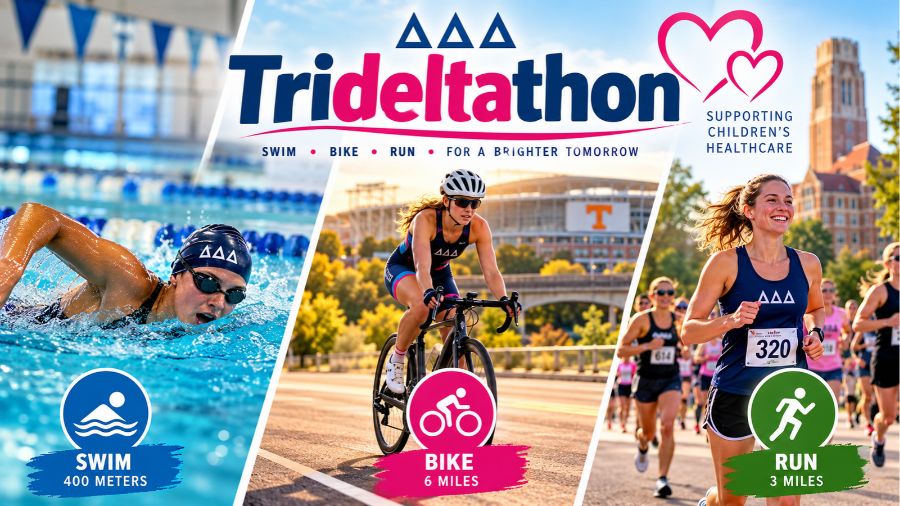
Trideltathon was a pool-based triathlon organized in Knoxville, Tennessee, around the University of Tennessee community. The name combines Tri Delta, the familiar name of the Delta Delta Delta sorority, with the word triathlon, which describes a multisport endurance competition. Historical event listings describe a format consisting of a 400-meter indoor swim, a six-mile bicycle ride, and a three-mile run. Participants could enter individually or take part through a relay team, allowing people with different athletic strengths to contribute to the overall competition. The event was designed around relatively short distances compared with longer triathlons, but completing three disciplines still required preparation, coordination, and physical endurance. Its combination of competitive sport and charitable fundraising made it different from an ordinary university fitness activity.
The History and Background of Trideltathon
Trideltathon developed a longstanding association with Knoxville’s university sporting community. Historical race advertisements described the 2019 edition as the event’s 35th year and the planned 2020 edition as its 36th year, indicating a tradition extending across several decades. However, these advertisements do not independently establish the exact date of the first race. Over time, the event became known for bringing together student volunteers, recreational athletes, experienced competitors, and local supporters. Its association with the University of Tennessee gave it a recognizable setting, while the involvement of Tri Delta members helped maintain its charitable and community-oriented identity. The event’s history demonstrates how a local sporting competition can develop significance beyond athletic performance when volunteers, participants, and fundraising activities contribute to a shared purpose.
The Three Stages of the Trideltathon Race
The original Trideltathon followed the familiar triathlon sequence of swimming, cycling, and running. According to archived race information, competitors began with a 400-meter swim in an indoor pool, continued with a six-mile bicycle course, and finished with a three-mile run. Each stage demanded a different set of physical abilities. Swimming required controlled breathing, efficient movement through the water, and an understanding of pool procedures. Cycling tested cardiovascular endurance, balance, pacing, and awareness of other road users. Running required participants to maintain their effort after completing the first two activities. Although the distances were shorter than those of many major triathlon events, the transition between disciplines added difficulty. Athletes needed to manage their energy carefully rather than treating each stage as an independent competition.
Understanding the Indoor Swimming Format
One of Trideltathon’s distinctive features was its indoor swimming stage. Instead of beginning in open water alongside a large group, participants entered the pool individually at short intervals. Historical race instructions described starts approximately seven seconds apart, with swimmers completing the required distance through a series of 50-meter lanes. At the end of each length, participants moved beneath a lane rope to continue into the next lane. Swimmers were arranged according to their estimated 400-meter completion times. This system helped organize competitors and reduced the need for a crowded mass start. For beginners, an indoor pool could offer a more controlled environment than a lake or open-water swimming venue. Nevertheless, participants still needed suitable swimming ability, familiarity with pool rules, and the stamina to complete the entire distance safely.
The Cycling Route and University Setting
The cycling stage added an outdoor component to the Trideltathon experience. Archived event descriptions identify a six-mile route around the University of Tennessee campus and along Neyland Drive. The course connected the athletic competition with recognizable parts of Knoxville and the university environment. Participants needed to maintain a consistent pace while remaining alert to turns, road conditions, and other cyclists. Safe cycling also required appropriate equipment, attention to race instructions, and the ability to control speed after the swimming stage. Because historical courses and traffic arrangements can differ between event editions, older route descriptions should not be treated as current cycling instructions. The campus setting nevertheless contributed to the event’s character by making it a local competition that incorporated the surrounding university landscape rather than taking place entirely inside a sports facility.
The Final Running Challenge
The final stage of the original Trideltathon was a three-mile run across the university area. Historical descriptions mention routes passing notable campus landmarks, including Neyland Stadium and Thompson-Boling Arena, now known as Food City Center. By the time participants reached the running stage, they had already completed both swimming and cycling, making pacing an important consideration. Starting too quickly could lead to fatigue, while maintaining a steady rhythm could help competitors finish more comfortably. Proper footwear, hydration, and suitable training were useful preparation measures. The running stage also created an opportunity for spectators and volunteers to encourage participants near the finish. For many athletes, completing the full course was an achievement in its own right, regardless of whether they won an award or recorded a particularly fast time.
Trideltathon and Delta Delta Delta
The connection between Trideltathon and Delta Delta Delta was central to the event’s identity. Delta Delta Delta is a collegiate sorority whose members participate in university activities, volunteer initiatives, and philanthropic projects. Historical Trideltathon descriptions identify members of the sorority as volunteers who supported the event. Their involvement helped connect athletic participation with community service. Volunteers are essential to multisport competitions because they assist with participant guidance, course organization, registration, and other practical responsibilities. A university charity event can also strengthen relationships between students and the surrounding community by creating a shared activity that welcomes people beyond the immediate campus population. Trideltathon illustrates how a student organization can help sustain a local tradition by combining volunteer participation with a sporting challenge and an identifiable charitable purpose.
The Charitable Mission Behind Trideltathon
Fundraising was an important part of the historic Trideltathon. Archived race information identified East Tennessee Children’s Hospital as the beneficiary of the original event. The hospital provides specialized healthcare services for children, making support for pediatric care a meaningful focus for a community fundraising activity. Charity races can raise awareness as well as financial contributions, giving participants a reason to take part beyond personal fitness goals. Some competitors may be motivated by the challenge, while others may join because they want to support a cause or participate with friends. It is important, however, to distinguish an event’s stated charitable purpose from a verified fundraising total. Without reliable financial records, it would be inappropriate to assign a specific amount of money raised to Trideltathon. Its documented connection with children’s healthcare remains a significant part of its historical identity.
Why the 2020 Trideltathon Was Canceled
The 2020 edition of Trideltathon was scheduled for April 19, 2020, but it was canceled during the COVID-19 disruption. The archived race announcement explained that the University of Tennessee had moved to an online academic model for the remainder of the academic year and that organizers could not secure a later date. Participants were offered options concerning their registration fees, including retaining the fee as a charitable donation, transferring registration under specified conditions, or requesting a refund. The cancellation marked an important interruption in the event’s documented history. However, it does not establish why the original swim-bike-run competition did not subsequently return in the same format. Claims that permanent changes resulted from costs, declining participation, safety concerns, or university restrictions would require additional evidence. The confirmed information is that the planned 2020 race was canceled.
TriDeltaRUN and the Related Event Tradition
A related event called TriDeltaRUN has continued the connection between Tri Delta, running, and charitable fundraising in Knoxville. Unlike the original Trideltathon, TriDeltaRUN is a 5K running event rather than a triathlon involving swimming and cycling. Its documented 2026 edition took place on April 19 near UT Gardens and the University of Tennessee Agriculture Campus, with much of the route using Third Creek Greenway. The event listing identified East Tennessee Children’s Hospital and Camp Eagle’s Nest as beneficiaries. Camp Eagle’s Nest provides a camp experience for children affected by cancer and rare blood disorders. The two event formats should not be confused: TriDeltathon was a multisport competition, whereas TriDeltaRUN focuses on running. The latest documented 2026 edition has already passed, and a future date for either event should not be assumed without a new announcement.
Preparing for a Triathlon Like Trideltathon
Anyone interested in participating in a similar pool-based triathlon can prepare by developing swimming, cycling, and running skills gradually. Beginners should first assess their comfort in the water and practice completing the required swimming distance without rushing. Cycling preparation can include short rides, safe braking, controlled turning, and checking the condition of the bicycle. Running training should build distance progressively, with rest days to allow recovery. Practicing transitions between activities can also help athletes understand how their bodies respond when moving from swimming to cycling and from cycling to running. Proper footwear, a suitable helmet, comfortable athletic clothing, and adequate hydration are useful considerations. Before entering any actual event, participants should read the current rules, eligibility requirements, course details, and safety instructions. Historical Trideltathon distances can help explain the original challenge, but they are not confirmation of a currently available race.
Conclusion
Trideltathon remains a distinctive part of Knoxville’s local sporting history because it combined a three-stage athletic challenge with university involvement, volunteer service, and charitable fundraising. Its historic format featured a 400-meter indoor swim, a six-mile cycling stage, and a three-mile campus run. Its connection with Delta Delta Delta and East Tennessee Children’s Hospital gave the competition a community purpose beyond individual results. The cancellation of the planned 2020 race interrupted its documented history, while the related TriDeltaRUN event introduced a running-only format that continued the local charitable tradition. The two events are connected through their community background, but they are not identical competitions. For readers researching Trideltathon today, the most useful distinction is between the original triathlon’s historical details and the current status of related events. Its legacy offers an example of how sport, student volunteering, and charitable giving can come together to support a local community.
Also read: Kylie Feuerbach: An Inspiring Basketball Player Known for Elite Defense
FAQs About Trideltathon
What is Trideltathon?
Trideltathon is a historic charity triathlon associated with the University of Tennessee and the Delta Delta Delta sorority in Knoxville, Tennessee.
What activities are included in Trideltathon?
The original event featured three activities: swimming, cycling, and running, completed consecutively as a multisport challenge.
How long are the Trideltathon race distances?
Historical race information lists a 400-meter swim, a six-mile cycling course, and a three-mile running course.
Where was Trideltathon held?
Trideltathon was held in Knoxville, Tennessee, in connection with the University of Tennessee campus and its surrounding areas.
What is the purpose of Trideltathon?
The event combined athletic competition with charitable fundraising and community participation, supporting causes associated with children’s healthcare.
Which charity benefited from Trideltathon?
Historical event information identified East Tennessee Children’s Hospital as a beneficiary of the original Trideltathon.
Who organized Trideltathon?
The event was associated with the University of Tennessee community and members of Delta Delta Delta, also known as Tri Delta.
Was Trideltathon canceled in 2020?
Yes, the planned 2020 event was canceled during the COVID-19 disruption, following changes to university operations.
Is Trideltathon the same as TriDeltaRUN?
No. Trideltathon was a multisport event involving swimming, cycling, and running, while TriDeltaRUN is a running-focused event associated with the same community tradition.
Can beginners participate in a triathlon like Trideltathon?
Beginners can prepare for similar events by gradually improving their swimming, cycling, and running abilities and following the event’s safety requirements.