
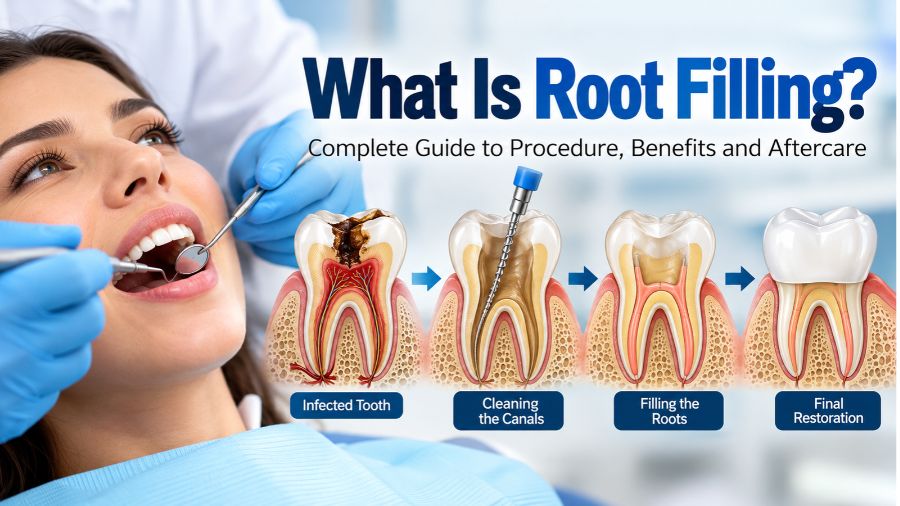
What is Root Filling is a common question among people experiencing persistent toothache, deep tooth decay, or dental infections. Root filling is an important part of root canal treatment that involves cleaning, disinfecting, and sealing the tiny canals inside a damaged or infected tooth to prevent further infection. The procedure helps preserve the natural tooth, relieve infection-related discomfort, and restore normal chewing function. Understanding how root filling works, why dentists recommend it, which materials are used, and what to expect during recovery can help patients make informed decisions about their dental health.
What Is Root Filling in Dentistry?
Root filling is a dental procedure in which the internal root canal spaces of a tooth are filled with a specialised biocompatible material after infected or damaged pulp tissue has been removed and the canals have been cleaned and disinfected. It is usually performed as part of root canal treatment, also known as endodontic treatment. Every tooth contains a soft inner tissue called dental pulp, which includes nerves, blood vessels, and connective tissue. When this tissue becomes infected or severely inflamed, the dentist may need to remove it to prevent the infection from spreading. The cleaned canals are then filled and sealed, commonly using a rubber-like material called gutta-percha and a dental sealer. A permanent filling or crown is subsequently placed to restore and protect the tooth.
Why Do Dentists Recommend Root Filling?
Dentists recommend root filling when the pulp inside a tooth has become irreversibly damaged, inflamed, or infected and the natural tooth can still be preserved. Deep untreated cavities are among the common reasons bacteria reach the pulp, but dental trauma, cracks, repeated dental procedures, and defective restorations can also cause internal damage. An infected tooth may develop persistent pain, sensitivity, swelling, or an abscess around its root. Root canal treatment removes the affected tissue and allows the dentist to clean and seal the internal canal system. Without appropriate treatment, the infection may progress, damage surrounding tissues, and eventually make extraction necessary. The decision depends on the condition of the tooth, the extent of infection, and whether sufficient healthy tooth structure remains for a successful restoration.
Common Signs That You May Need Root Filling
Recognising possible symptoms of pulp infection can help patients seek dental care before the condition becomes more complicated. However, symptoms alone cannot confirm that root canal treatment is necessary because several dental problems can produce similar discomfort. A dentist evaluates the tooth through clinical examination, dental imaging, and appropriate diagnostic tests before recommending treatment.
Persistent or Severe Toothache
Pain that continues for an extended period, occurs spontaneously, or becomes particularly uncomfortable at night may indicate inflammation or infection within the dental pulp. Some patients experience throbbing pain that makes eating, sleeping, or concentrating difficult. Discomfort may also become more noticeable when biting or applying pressure to the affected tooth. Persistent toothache does not automatically mean a root filling is required, but it should be evaluated by a dentist to identify the underlying cause.
Sensitivity to Hot and Cold
Temporary sensitivity to cold drinks or hot foods can occur for several reasons, including exposed dentine, tooth decay, and gum recession. However, sensitivity that lingers after the hot or cold stimulus has been removed may indicate significant pulp inflammation. Some teeth also become uncomfortable when exposed to sweet foods. A dental professional can perform appropriate tests to determine whether the pulp is healthy, inflamed, or irreversibly damaged.
Swollen or Tender Gums
Infection around a tooth root can cause swelling, tenderness, and sometimes a small pimple-like bump on the gum. This bump may release pus when pressure builds around the infected area. Such symptoms can indicate a dental abscess, which requires prompt professional assessment. Facial swelling, fever, difficulty swallowing, or difficulty breathing requires urgent medical attention, particularly if the swelling is spreading.
Tooth Discolouration
A tooth that gradually becomes darker, greyish, or yellowish compared with neighbouring teeth may have experienced internal pulp damage. Dental trauma and previous infection can affect the appearance of a tooth even when there is no obvious external cavity. Discolouration alone does not establish the need for root filling, but it is an important reason to arrange a dental examination.
Pain When Chewing or Biting
Pain when biting down can develop when inflammation affects the tissues surrounding a tooth root. Some patients notice discomfort when chewing hard foods or when their teeth come together. A cracked tooth, periodontal problem, or an uneven dental restoration can also produce similar symptoms. The dentist must identify the exact cause before deciding whether endodontic treatment is appropriate.
What Causes Tooth Pulp Infection?
Dental pulp infection generally develops when harmful bacteria gain access to the internal tissues of a tooth. The protective enamel and dentine normally prevent microorganisms from reaching the pulp, but decay, fractures, and other forms of damage can compromise these layers. Understanding the common causes helps explain why some teeth require root canal treatment even when the visible damage appears relatively small.
Deep Tooth Decay
Untreated cavities allow bacteria to gradually penetrate the enamel and dentine. As decay moves deeper into the tooth, it may eventually reach the pulp and cause inflammation or infection. Early dental fillings can repair many cavities before they affect the pulp, which is why regular dental examinations are important.
Cracked or Broken Teeth
A tooth may develop cracks because of an accident, biting hard objects, grinding, or other mechanical forces. Some cracks are difficult to detect without specialised dental examination. When a crack provides a pathway for bacteria to enter the inner tooth, pulp inflammation or infection may develop. Treatment depends on the location and severity of the damage.
Dental Trauma
A direct blow to the mouth during sports, falls, or accidents can damage the blood supply to the pulp. In some cases, the tooth remains intact externally but develops internal changes over time. A dentist may recommend monitoring, additional testing, or root canal treatment depending on the condition of the pulp.
Repeated Dental Procedures
A tooth that has undergone multiple restorations or extensive dental treatment may experience irritation or damage to its pulp. Although modern restorative procedures are designed to protect the tooth, repeated interventions can sometimes contribute to pulp inflammation. Treatment is based on clinical findings rather than the number of previous procedures alone.
How Is Root Filling Done? Step-by-Step Procedure
Root filling is usually completed as part of a structured root canal procedure. The dentist first identifies the affected tooth, removes infected tissue, and prepares the internal canal spaces before placing the filling material. The exact technique varies according to the tooth’s anatomy, the number of canals, the extent of infection, and the treatment plan.
Step 1: Dental Examination and X-Ray
The process begins with a dental examination to assess the tooth and surrounding tissues. The dentist may take an X-ray to evaluate the roots, identify signs of infection around the root tips, and understand the tooth’s internal structure. Additional diagnostic tests may be performed to assess pulp health and determine whether root canal treatment is appropriate.
Step 2: Local Anaesthesia
Local anaesthesia is generally administered to numb the affected tooth and surrounding area. This helps patients remain comfortable during the procedure. The dentist may also use a rubber dam, which is a protective sheet placed around the tooth to isolate it from saliva and help maintain a clean working environment.
Step 3: Creating an Access Opening
Once the tooth is numb and isolated, the dentist creates a small opening through the crown of the tooth. This provides access to the pulp chamber and root canals. The size and position of the opening depend on the tooth’s anatomy and the treatment requirements.
Step 4: Removing Infected or Damaged Pulp
The dentist uses specialised instruments to remove infected, inflamed, or dead pulp tissue from the pulp chamber and root canals. Removing this tissue helps eliminate the primary source of infection and prepares the canals for cleaning. The dentist carefully examines the internal structure to locate the canals, including any additional or unusually shaped spaces.
Step 5: Cleaning and Shaping the Root Canals
After removing the affected pulp, the dentist cleans and shapes the canals using small endodontic instruments and suitable disinfecting solutions. This stage helps remove remaining tissue, bacteria, and debris while preparing the canals for filling. Proper canal preparation is essential because untreated spaces can contribute to persistent infection or treatment failure.
Step 6: Drying and Filling the Canals
Once the canals have been cleaned and shaped, they are dried using specialised paper points. The dentist then fills the prepared spaces with gutta-percha and a root canal sealer. This procedure is called obturation. Its purpose is to create a close seal within the root canal system and reduce the possibility of bacterial re-entry.
Step 7: Sealing the Tooth
After the root canals have been filled, the access opening is closed with a temporary or permanent dental restoration. If treatment requires multiple appointments, a temporary filling may be placed between visits. The dentist will arrange the appropriate final restoration to protect the tooth and restore its function.
Step 8: Final X-Ray and Restoration
A final dental X-ray may be taken to assess the position and extent of the root canal filling. The dentist then determines whether the tooth requires a permanent filling, an onlay, or a dental crown. Proper restoration is essential because a root-filled tooth can remain vulnerable to fracture, particularly when substantial tooth structure has been lost.
What Materials Are Used for Root Filling?
Root canal filling materials are selected according to their ability to seal the prepared canals, remain compatible with surrounding tissues, and support successful treatment. Gutta-percha is the most commonly used core filling material in conventional root canal procedures. It is generally combined with a dental sealer that helps fill small spaces between the filling material and canal walls. Temporary restorative materials may be used when treatment is completed over multiple appointments, while composite resin, glass ionomer, or other suitable restorative materials may be used to close the access opening. In some cases, a dentist may recommend a dental post and crown when additional support is needed. The choice of material depends on the tooth’s condition, the canal anatomy, and the dentist’s clinical judgement.
What Is Gutta-Percha?
Gutta-percha is a rubber-like material widely used to fill cleaned and shaped root canals. It is designed for use inside the tooth and is generally combined with a suitable sealer to improve the seal between the filling and the canal walls. It is available in different sizes and forms to accommodate variations in root canal anatomy. Gutta-percha does not replace the outer tooth structure; it specifically fills the internal canal spaces after the infected pulp has been removed.
What Is Root Canal Sealer?
Root canal sealer is a dental material used alongside the main filling material to help create a close seal within the canal system. It can occupy small spaces between gutta-percha and the prepared canal walls. Different types of sealers are available, including epoxy resin-based, calcium silicate-based, and other formulations. The dentist selects an appropriate product according to the clinical situation and treatment technique.
Different Techniques Used for Root Canal Filling
Dentists use different obturation techniques to place filling materials inside prepared root canals. The choice depends on canal shape, available equipment, clinical experience, and the characteristics of the selected materials. The goal of each technique is to achieve an appropriate seal throughout the prepared canal space.
Cold Lateral Condensation
Cold lateral condensation is a traditional root canal filling technique that uses a main gutta-percha cone and additional accessory cones. A sealer is applied, and the cones are compacted laterally using specialised instruments. This method is commonly used because it is relatively straightforward and can provide satisfactory results when performed correctly.
Warm Vertical Compaction
Warm vertical compaction involves softening gutta-percha with heat and compacting it within the root canal. The softened material can adapt to irregularities in the prepared canal space. The technique requires appropriate equipment and careful control because the dentist must avoid damaging surrounding tissues or overextending the filling material.
Single-Cone Technique
The single-cone technique uses one appropriately sized gutta-percha cone together with a root canal sealer. It is often used with modern canal preparation systems that produce shapes compatible with corresponding filling cones. The final result depends on accurate canal preparation, material selection, and adequate sealing.
What Are the Benefits of Root Filling?
The main benefit of root filling is that it allows many infected or severely damaged teeth to be preserved instead of removed. By eliminating infected pulp tissue and sealing the cleaned canals, root canal treatment helps control the source of infection and maintain the natural tooth. Preserving a natural tooth can support normal chewing, maintain the existing bite, and reduce the need for replacement treatments such as dental implants or bridges. It can also help prevent neighbouring teeth from shifting into the space left by an extracted tooth. Another important advantage is that successful treatment can relieve pain caused by pulp infection. However, the final outcome depends on accurate diagnosis, effective canal cleaning, appropriate filling, and a durable restoration.
Is Root Filling Painful?
Root filling is generally performed under local anaesthesia, so patients should not experience significant pain during the procedure. Modern dental techniques are designed to make root canal treatment manageable and comfortable. Some patients may feel pressure, vibration, or movement while the dentist works on the tooth, but these sensations are different from sharp pain. After the anaesthesia wears off, mild tenderness around the treated tooth can occur for several days because the surrounding tissues may remain irritated. The level of discomfort varies depending on the original infection, the condition of the tooth, and individual sensitivity. Patients who experience severe pain, increasing swelling, or symptoms that do not improve should contact their dentist for further assessment.
How Long Does Root Filling Take?
The time required for root filling depends on the type of tooth, the number of root canals, the complexity of its internal anatomy, and the severity of infection. Some treatments can be completed in one appointment, while others require two or more visits. Front teeth often have simpler canal anatomy than molars, which may contain multiple canals and more complicated internal structures. If infection or inflammation requires additional management, the dentist may place medication inside the tooth and close it temporarily before completing the permanent filling. Each appointment may take approximately one to two hours, although treatment times vary. Your dentist can provide a more realistic estimate after examining the tooth.
What Is the Difference Between Root Filling and Normal Dental Filling?
Root filling and ordinary dental filling are two different procedures designed to address different levels of tooth damage. A normal dental filling repairs a cavity by removing decayed material from the outer part of the tooth and restoring the missing structure with a suitable material. Root filling, on the other hand, is performed inside the root canals after infected or damaged pulp has been removed. It is part of a more extensive endodontic procedure that also involves cleaning, disinfecting, and sealing the internal canal system. A normal filling is generally sufficient when decay has not irreversibly damaged the pulp. When the pulp becomes infected or irreversibly inflamed, root canal treatment may be necessary before the tooth can receive its final restoration.
Is a Dental Crown Necessary After Root Filling?
A dental crown is not required in every root-filled tooth, but it is frequently recommended when the tooth has lost a significant amount of its natural structure. Root canal treatment removes the pulp but does not automatically make the remaining tooth incapable of functioning. However, teeth weakened by extensive decay, large previous fillings, or fractures may be more vulnerable to breaking during chewing. A crown covers and protects the remaining tooth structure, helping restore its shape and function. Back teeth, particularly molars and premolars, often require stronger restorations because they experience substantial chewing forces. Some teeth may be adequately restored with a permanent filling or another suitable restoration. The dentist decides based on the amount of remaining tooth structure, the location of the tooth, and its overall condition.
Possible Risks and Complications of Root Filling
Root canal treatment has a good clinical track record, but no dental procedure guarantees success. Some teeth may continue to experience infection because bacteria remain in complex canal spaces or because the final restoration does not provide an adequate seal. Other complications can include instrument separation inside a canal, perforation of the root, persistent inflammation around the root tip, and damage to the tooth structure. A tooth may also fracture if it has been significantly weakened by previous decay or treatment. In some cases, a failed root canal can be managed through retreatment or endodontic surgery, while extraction may be necessary if the tooth cannot be saved. Careful diagnosis, appropriate technique, follow-up examinations, and timely restoration help reduce these risks.
What Happens If Root Filling Is Not Done?
When a tooth has irreversible pulp damage or an established infection, delaying recommended treatment can allow the condition to worsen. Bacteria may continue spreading through the root canal system and contribute to inflammation or an abscess around the root. Patients may experience persistent pain, swelling, or drainage from the affected area. In more advanced cases, infection can spread into surrounding facial tissues and become a serious health concern. Some infected teeth eventually become impossible to restore and require extraction. Antibiotics may be appropriate in certain situations involving spreading infection or systemic symptoms, but they do not replace the dental treatment needed to address the source of a root canal infection. A dentist should assess the tooth and recommend the appropriate treatment without unnecessary delay.
How to Care for Your Tooth After Root Filling
After root filling, proper dental care helps protect the treated tooth and supports long-term oral health. Patients should follow the dentist’s specific instructions because recovery needs can differ depending on whether the tooth has received a temporary filling, permanent filling, or crown. Avoid chewing hard or sticky foods on the treated tooth until the dentist confirms that it is adequately restored. Brush twice daily with fluoride toothpaste and clean between the teeth regularly. Attend scheduled follow-up appointments, particularly when a temporary restoration has been placed. Continue routine dental examinations because root-filled teeth can still develop new cavities, gum disease, and other dental problems. If pain becomes severe, swelling develops, or a temporary filling comes out, contact the dentist promptly.
How Long Does a Root-Filled Tooth Last?
A root-filled tooth can remain functional for many years, and some properly treated and restored teeth last for the remainder of a person’s life. However, there is no guaranteed lifespan because several factors influence the long-term outcome. These include the quality of the original root canal treatment, the amount of healthy tooth structure remaining, the strength of the final restoration, oral hygiene, and regular dental care. A tooth that receives an appropriate crown or other protective restoration when needed may have a better chance of avoiding fracture. Patients should also remember that root-filled teeth are not immune to decay. Regular check-ups allow dentists to identify restoration problems, new cavities, or signs of recurring infection before they become more complicated.
Can Root Filling Fail?
Yes, root filling can fail when bacteria remain inside the canal system, new decay develops, or the tooth becomes contaminated through a damaged restoration. Some canals may also be difficult to locate or clean because of unusual anatomy. A failed treatment may cause recurring toothache, swelling, tenderness, or an abscess, although some cases have few noticeable symptoms. The dentist may recommend another examination and dental imaging to identify the reason for the problem. Depending on the condition of the tooth, treatment options may include nonsurgical root canal retreatment, endodontic surgery, or extraction. A previously treated tooth should not be assumed to be healthy simply because the original pain has disappeared.
Who Performs Root Filling Treatment?
Root filling is performed by a general dentist with appropriate training and experience in endodontic procedures or by a specialist known as an endodontist. Endodontists receive additional specialist training focused on diagnosing and treating diseases of the dental pulp and tissues surrounding tooth roots. Patients with complicated root canal anatomy, previous treatment failure, severe infection, or difficult dental cases may benefit from referral to an endodontist. The choice of practitioner depends on the complexity of the case and the available clinical facilities. Before treatment, patients should discuss the diagnosis, expected appointments, possible complications, and final restoration requirements with their dental professional.
How Can You Prevent the Need for Root Filling?
Although not every pulp injury can be prevented, good oral hygiene and timely dental care can reduce the risk of problems that commonly lead to root canal treatment. Brushing twice daily with fluoride toothpaste helps remove plaque and strengthen enamel, while daily cleaning between the teeth reduces bacterial buildup in difficult-to-reach areas. Regular dental check-ups allow early cavities to be identified and treated before they reach the pulp. Patients should also avoid biting hard objects, wear an appropriate mouthguard during contact sports, and seek dental assessment after an injury. Reducing frequent sugary snacks and drinks can further support oral health. These preventive habits cannot eliminate every risk, but they can help preserve natural teeth and reduce the likelihood of advanced dental disease.
Conclusion
Root filling is an important part of modern dental treatment that helps preserve natural teeth affected by deep decay, pulp infection, or internal damage. The procedure involves removing infected tissue, carefully cleaning and disinfecting the root canals, and sealing them with suitable materials such as gutta-percha. Although some patients may experience temporary tenderness afterward, successful treatment can relieve infection-related pain and restore normal dental function. The final filling or crown plays an equally important role in protecting the treated tooth from further damage. Understanding the procedure, recognising warning signs, and maintaining good oral hygiene can help patients make informed decisions and protect their long-term dental health.
Also read: Tan Crab: Complete Guide to the Tan Crab Spider, Habitat and Behaviour
FAQs
1. What is root filling in simple words?
Root filling is a dental procedure that seals cleaned tooth canals after infected pulp has been removed, helping prevent reinfection and preserve the natural tooth.
2. How many appointments are needed for root filling?
Most root canal treatments require one or two appointments, although complicated infections, unusual canal anatomy, or additional treatment may require more visits.
3. Can I eat immediately after root filling?
It is best to wait until local anaesthesia wears off and avoid hard or sticky foods until your dentist confirms adequate restoration.
4. Does a root-filled tooth need special cleaning?
No special cleaning routine is usually necessary. Brush twice daily, floss regularly, and attend dental check-ups to protect the treated tooth.
5. Can a root-filled tooth develop cavities again?
Yes. Root-filled teeth can develop new cavities around exposed tooth surfaces or restorations, making regular brushing, fluoride toothpaste, and dental examinations important.
6. Is root filling better than tooth extraction?
When a tooth can be successfully treated and restored, preserving it through root canal treatment is generally preferable to extraction and replacement.