
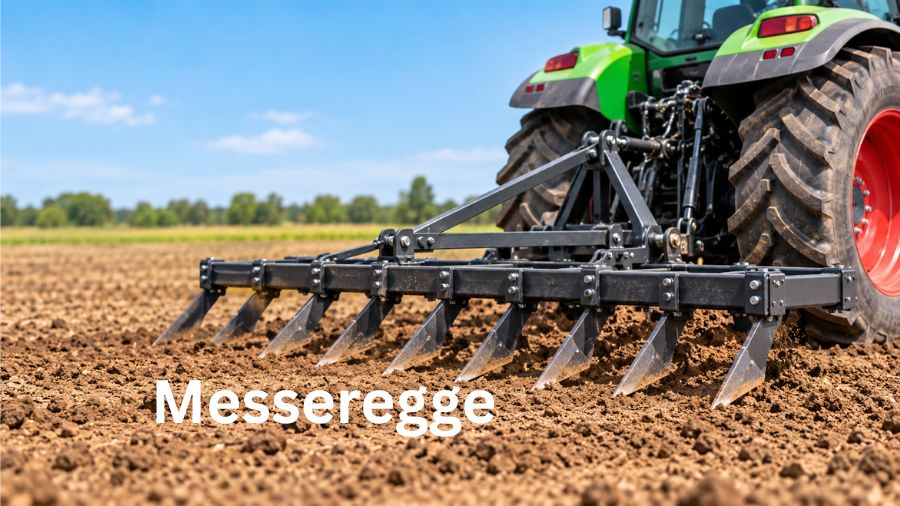
Messeregge is an unusual German agricultural term that may look confusing at first, but its meaning becomes much clearer once the word is broken down. In farming, it generally refers to a knife harrow or blade-based harrow used for shallow soil preparation. The name comes from the German words “Messer,” meaning knife or blade, and “Egge,” meaning harrow. Agricultural references and machinery descriptions place the term firmly within soil-working and field-preparation equipment.
For farmers, the value of a Messeregge is fairly straightforward. It is designed to work near the soil surface rather than performing deep cultivation. Depending on its construction, it can help break surface clods, level uneven ground, cut through light residue, and prepare the field for the next stage of planting. The exact design can vary between machines, so it is better to think of Messeregge as a category of knife-style agricultural equipment rather than one standardized machine.
What Is a Messeregge?
A Messeregge is an agricultural harrow associated with knife-like or blade-shaped working elements. Its primary purpose is shallow soil preparation, particularly when a farmer wants to improve the condition of the upper soil layer without carrying out aggressive deep tillage. The implement may be used independently or as part of a larger soil-preparation system, including combinations with front packers and other field-working equipment.
The concept is easier to understand when compared with a traditional harrow. A conventional harrow may use teeth, tines, chains, or other elements to loosen and level soil. A Messeregge instead emphasizes knife or blade action. This gives it a particular role in surface cultivation, where cutting and shallow disturbance are more important than turning over large amounts of soil.
Because agricultural machinery manufacturers can use different frame designs, blade arrangements, and combinations of attachments, there is no single appearance that defines every Messeregge. Some versions are positioned at the front of a tractor, while others can be integrated with other soil-working implements.
What Does the Word Messeregge Mean?
The word itself provides a useful clue about its function. In German, “Messer” means knife, while “Egge” means harrow. Together, the agricultural term can therefore be understood as a knife harrow or blade harrow. Langenscheidt lists Messeregge in an agricultural context and gives “scarifier” as an English translation.
This linguistic detail is important because Messeregge is sometimes incorrectly interpreted online. One common mistake is confusing “Messer” with the German word “Messe,” which can mean a trade fair or exhibition. These are completely different words. In the agricultural term Messeregge, the relevant word is Messer, meaning knife or blade.
Understanding this distinction also helps separate genuine agricultural information from unrelated descriptions that have appeared online. When Messeregge is discussed in connection with soil, seedbeds, tillage, tractors, or agricultural machinery, the knife-harrow interpretation is the one that fits the established terminology.
How Does a Messeregge Work?
The basic idea behind a Messeregge is simple: knife-like working elements move across the upper part of the field and perform controlled surface work. Instead of relying primarily on deep penetration, the implement concentrates its action where the soil needs light conditioning.
As the blades pass through the surface, they can break or cut through compacted material, reduce larger clods, and help create a more uniform field surface. This can be useful after previous cultivation has left uneven areas or when the farmer wants to refine the seedbed before planting.
The actual performance depends on factors such as blade design, working depth, soil condition, tractor speed, field moisture, and the particular machine configuration. For that reason, a Messeregge should not be treated as a machine that produces exactly the same result in every field.
Main Uses of a Messeregge
One of the most important uses of a Messeregge is seedbed preparation. A good seedbed needs a suitable surface condition so that seeds can be placed consistently and establish properly. If the soil contains large clods or has an uneven surface, additional preparation may be necessary before sowing.
A knife harrow can help refine the upper soil layer and create a more consistent surface. Agricultural descriptions of the equipment associate it with shallow loosening, crumbling, leveling, and general soil preparation.
Another possible use is managing light surface residue. Blade-type working elements can cut through certain plant remains and help distribute or condition material near the surface. However, residue handling depends heavily on the crop, quantity of residue, soil condition, and machine design.
A Messeregge may also be useful when a field has developed a surface crust or has become uneven after weather and previous operations. Rather than immediately resorting to heavier cultivation, a farmer may use a shallow implement when only the surface needs attention.
Messeregge and Seedbed Preparation
Seedbed preparation is one area where the design of a Messeregge makes practical sense. Seeds generally benefit from reasonably uniform soil conditions, and an uneven surface can make planting more difficult.
A knife harrow can be used as part of a sequence of field operations. Primary tillage may first loosen or turn the soil, while later equipment works on the surface. A Messeregge can fit into this secondary or finishing stage when the objective is to condition the upper layer rather than perform major soil movement.
It is worth remembering that seedbed preparation is not simply about making soil look smooth. Farmers also have to consider moisture, soil structure, compaction, residue, seed placement, and weather. The right tool depends on the specific field rather than on appearance alone.
Messeregge vs. Disc Harrow
A Messeregge and a disc harrow can both be used for soil preparation, but they do not necessarily perform the same job. A disc harrow uses rotating discs that cut into the soil and move material more aggressively. It is commonly associated with broader tillage operations.
A knife harrow, by contrast, focuses on blade-based surface work. Its purpose is generally more controlled and shallow. This makes the two implements complementary in some farming systems rather than direct replacements for one another.
Choosing between them depends on the condition of the field and the desired result. If substantial soil movement or deeper cultivation is required, a disc-based machine may be more appropriate. If the field mainly needs surface conditioning, a knife-style harrow can be a more targeted option.
Messeregge vs. Tine Harrow
Tine harrows use teeth or tines to penetrate and work the soil. Depending on their configuration, they can be useful for loosening, leveling, seedbed preparation, and other cultivation tasks.
The main difference is the working element. A Messeregge uses knife or blade-style components, while a tine harrow depends on teeth or tines. That difference affects how the implement interacts with soil and residue.
Neither design is automatically better. The right choice depends on soil type, crop requirements, field condition, moisture, residue levels, and the desired working depth. Experienced operators typically select equipment according to the specific job instead of choosing a machine simply because it is considered more advanced.
Why Shallow Soil Work Matters
Shallow cultivation can be useful when only the upper soil layer needs correction. Deep disturbance is not always necessary, and unnecessary tillage can consume additional fuel, time, and tractor capacity.
A surface-working implement allows the operator to target a specific problem without automatically disturbing the entire soil profile. This can be particularly relevant in farming systems where maintaining soil structure and reducing unnecessary passes are important considerations.
However, shallow tillage should not be presented as a universal solution. Some fields require deeper cultivation because of compaction, heavy residue, drainage issues, or other agronomic conditions. A Messeregge is best viewed as a specialized tool within a larger soil-management strategy.
What Are the Benefits of Using a Messeregge?
The biggest advantage of a Messeregge is its focused approach to surface preparation. When conditions are appropriate, it can help produce a more even seedbed without requiring the same level of soil movement associated with heavier equipment.
Another benefit is versatility. Depending on the design, the machine can be incorporated into different stages of field preparation and may be combined with other implements. Some current machinery descriptions specifically associate knife-harrow sections with front packers and related equipment.
The implement can also be useful for breaking surface clods and improving field uniformity. These relatively simple tasks can make later planting operations easier, particularly when the field has been left with an inconsistent surface.
Still, the benefits depend on proper adjustment and suitable conditions. A poorly selected machine or incorrect working depth can produce disappointing results regardless of how capable the equipment is.
Factors to Consider Before Using a Messeregge
Soil condition should be the first consideration. Working soil when it is excessively wet can cause smearing or compaction, while extremely dry conditions may make surface work less effective. The operator needs to consider the moisture level and physical condition of the field before entering it.
Working depth is another important factor. Because the Messeregge is generally associated with shallow soil preparation, it should be adjusted according to the intended task rather than being forced deeper simply to increase its apparent impact.
Blade condition also matters. Since the implement relies on knife-like working elements, worn or damaged components can affect performance. Regular inspection can help identify damaged blades, loose connections, frame problems, and other mechanical issues before they become larger problems.
Tractor speed should also be matched to the implement and field conditions. Going faster is not automatically better. Excessive speed can affect soil movement, residue handling, surface finish, and overall machine stability.
Is Messeregge a Modern Agricultural Tool?
The word itself has traditional German agricultural roots, but that does not mean the concept is irrelevant to modern farming. Modern machinery continues to use knife- and blade-based soil-working systems, including equipment configurations designed for front-mounted or combined operations.
What has changed is the engineering around the basic concept. Modern manufacturers can combine different working elements, adjustable frames, packers, and other components to create machines suited to specific field conditions.
This is a common pattern in agricultural machinery. An old basic principle can remain useful while the engineering, materials, adjustability, and tractor integration improve over time.
Why Is Messeregge an Uncommon Word?
For English-speaking readers, Messeregge is unfamiliar largely because it is a specialized German agricultural term. It is not the kind of word most people encounter in everyday conversation.
It is more likely to appear in agricultural machinery catalogs, German farming discussions, equipment listings, technical documents, or searches related to soil preparation. This explains why someone encountering the word for the first time may struggle to understand what it means.
The unusual spelling also encourages incorrect interpretations. Once a rare word begins appearing on different websites, inaccurate definitions can easily be copied from one page to another. Looking at the German components and agricultural context provides a much more reliable way to understand it.
Common Misconceptions About Messeregge
One misconception is that Messeregge refers to a normal kitchen or hand knife. It does not. The word’s second component, Egge, identifies it with an agricultural harrow, making the farming interpretation quite specific.
Another misconception is that the word is connected to trade fairs because of its similarity to “Messe.” That is a linguistic error. Messer and Messe are separate German words, and the agricultural term uses Messer.
It is also inaccurate to assume that every Messeregge has exactly the same design. Agricultural machinery manufacturers can create different configurations, and current equipment listings show variations in how knife-harrow sections are incorporated into field systems.
Finally, a Messeregge should not be described as a replacement for every other cultivation implement. Its usefulness comes from its particular role in shallow soil preparation.
How Farmers Can Get the Most From a Messeregge
The best results usually come from matching the machine to the actual field requirement. Before operating the equipment, the farmer should examine soil moisture, surface condition, residue, previous tillage, and the intended crop.
Machine adjustment is equally important. Blade position, working depth, operating speed, and the interaction with other implements can all influence the final result. A setting that works well in one field may not be appropriate in another.
It is also useful to evaluate the field after the pass rather than assuming the machine has worked correctly simply because it has covered the entire area. The goal is a suitable soil surface, not merely a completed tractor pass.
This practical approach helps prevent unnecessary tillage and allows the farmer to use the Messeregge for what it does best: controlled surface preparation.
Also read: Keibann Explained: Meaning, Uses, Kanban Connection, and Key Facts
Conclusion
Messeregge is a good example of how a single unfamiliar word can reveal a surprisingly specific area of agricultural technology. Built from the German words for knife and harrow, the term describes equipment designed to work the upper layer of soil using knife-like or blade-based elements.
Its usefulness comes from controlled surface preparation. Rather than replacing ploughs, disc harrows, or cultivators, a Messeregge occupies its own place within the broader range of agricultural implements. It can help farmers refine seedbeds, break surface clods, level fields, and manage certain types of light surface residue.
Ultimately, the value of a Messeregge depends on using it at the right time, at the appropriate depth, and under suitable field conditions. When those factors are considered carefully, this relatively specialized agricultural tool can become a practical part of an efficient soil-preparation system.