
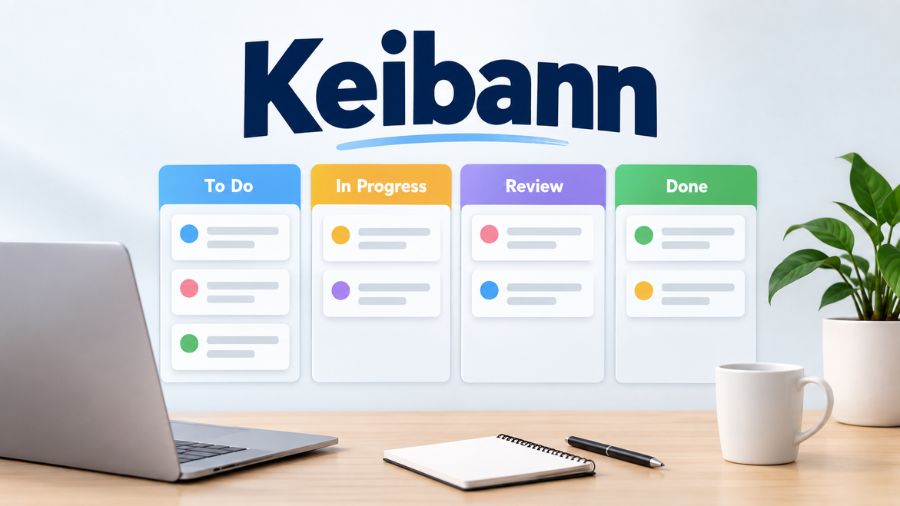
Keibann is a curious term that has started appearing across the internet, especially in discussions about productivity, workflow organization, task management, and digital work. At first glance, it sounds like the name of an established system, software platform, or Japanese concept. However, the reality is more complicated. Current online sources do not provide one universally accepted definition of Keibann, and different websites use the word in slightly different ways.
The most common modern interpretation connects Keibann with visual task organization. In this interpretation, tasks are placed on a board and moved through stages such as To Do, In Progress, Review, and Done. That description naturally reminds people of Kanban, which is a well-established workflow and production concept. However, Keibann should not automatically be presented as another official name for Kanban.
What Is Keibann?
Keibann is best understood as an emerging and somewhat ambiguous online term associated with visual workflow management. Recent articles commonly describe it as a way of making tasks visible so that individuals or teams can easily understand what needs to be done, what is currently being worked on, and what has already been completed.
A typical Keibann-style workflow may contain several columns. A basic version could include Ideas, To Do, In Progress, Review, and Done. Each task is represented by a card, note, or digital item. As the task progresses, the card moves from one column to another.
The concept itself is straightforward. Instead of keeping work hidden inside emails, notebooks, messages, spreadsheets, or memory, everything is displayed in one visual space. This can make a busy project easier to understand at a glance.
However, there is currently no strong evidence of an official Keibann organization, universally accepted methodology, recognized certification system, or single software product defining the term. That distinction is important when researching or writing about it.
Why Is Keibann Suddenly Appearing Online?
The unusual spelling is one reason Keibann attracts attention. People searching for the term may find multiple recent articles explaining it as a productivity or workflow concept. Some describe it confidently as a modern management system, while others acknowledge that its exact origin is uncertain.
This creates a familiar problem on the modern web. Once several websites publish similar explanations, those explanations can begin to look like established facts even when there is no primary source confirming them.
Current search results show exactly this pattern with Keibann. Many recent pages associate the term with visual task management, but they do not point to a documented founder, original organization, formal specification, or clearly established historical origin.
For that reason, it is safer to describe Keibann as an emerging online term rather than claiming that it is already a formally recognized productivity methodology.
How Does a Keibann-Style Workflow Work?
The basic workflow is easy to understand. Imagine a digital board divided into several columns. The first column might contain ideas or upcoming tasks. The next could contain work that is ready to begin. Another column shows tasks currently being handled, followed by review and completion.
For example, a simple board might look like this in concept:
Ideas → To Do → In Progress → Review → Done
A task starts in one area and moves forward as its status changes. If a writer needs to create an article, the card might begin under To Do. Once writing starts, it moves to In Progress. After the first draft is complete, it could move to Review. Once approved, it reaches Done.
This visual approach can make workflow status much easier to understand. A manager does not necessarily need to ask every team member for an update because the board provides an immediate overview.
The value is not really in moving cards around. The value comes from creating visibility around the work.
What Are the Main Features Associated With Keibann?
The most commonly described feature is a visual board. A board provides a central location where tasks can be organized according to their current status. This is especially useful when a project contains many activities that are happening at the same time.
Another common feature is the use of task cards. Each card can contain information such as a task title, description, owner, deadline, priority, checklist, or comments. The amount of information depends on the tool or workflow being used.
Progress stages are another important element. Instead of simply having a large list of unfinished tasks, users can see which activities are waiting, active, under review, or completed.
Some interpretations also emphasize limiting the amount of work happening simultaneously. This idea is closely associated with established Kanban practices and can help prevent people from starting too many tasks without finishing existing ones.
Finally, a visual workflow can make bottlenecks easier to spot. If dozens of tasks are sitting in a Review column while only a few are being completed, the problem becomes visible instead of remaining hidden inside individual conversations.
What Are the Benefits of Using a Visual Workflow?
The biggest advantage is visibility. When work is represented visually, people can understand the overall situation without reading a long list of messages or checking multiple documents.
Clarity is another benefit. Every task has a visible position, which can reduce confusion about what is waiting, what is active, and what has already been completed.
A visual workflow can also improve prioritization. When all active tasks are visible together, it becomes easier to decide which work deserves attention first.
Teams may also benefit from better communication. Instead of repeatedly asking, “What is the status of this task?”, members can check the board and discuss specific issues when necessary.
Another advantage is identifying bottlenecks. If work repeatedly becomes stuck at the same stage, the team has a useful signal that the process needs attention.
For individuals, the same principle can make personal work easier to manage. A freelancer, student, developer, writer, or business owner can use a simple board to separate planned work from active work and completed tasks.
Is Keibann the Same as Kanban?
Keibann and Kanban are frequently compared because the modern online descriptions of Keibann often resemble Kanban-style boards. However, they should not automatically be treated as identical.
Kanban is an established concept with documented roots in Japanese manufacturing and the Toyota Production System. Its principles have since been adapted for areas such as software development, project management, service delivery, and personal productivity.
Keibann, on the other hand, does not currently have the same level of documented history or standardized definition. Current online sources mainly describe it as an emerging term associated with visual task and workflow organization.
The practical distinction is simple: if someone is referring to the established methodology with a documented history and recognized practices, Kanban is the more accurate term. If a website specifically uses Keibann to describe a particular visual workflow concept, its meaning should be understood from that context.
Why Do People Confuse Keibann With Japanese Terms?
The spelling makes Keibann look Japanese, which has led to additional confusion. Similar-looking Romanized words can refer to completely different Japanese terms.
One example is “keijiban,” written 掲示板, which means a bulletin board, notice board, or message board. Another expression, “keiban,” can appear in Japanese as 携番 and is associated with a mobile phone number. These are not automatically the same thing as the internet keyword “Keibann.”
This is why spelling alone should not be used to establish a word’s origin. A Romanized term can look convincing while having a completely different meaning depending on the original Japanese characters.
Current online discussions also sometimes connect Keibann with Japanese vehicles or other unrelated subjects. This further demonstrates why context is necessary when researching the term.
Can Keibann Be Used for Project Management?
Yes, a Keibann-style visual workflow can certainly be used for project management, regardless of whether the word itself becomes an established methodology.
For a small software project, for example, a board could contain Backlog, To Do, Development, Testing, Review, and Done. Each feature or bug could become a separate card.
A marketing team might use columns such as Ideas, Planned, Writing, Design, Scheduled, and Published. A freelancer could create a simpler board with Leads, Active Projects, Waiting for Client, and Completed.
The important point is that the workflow should reflect the actual process. Adding unnecessary columns simply because they look organized can make a system harder to use.
A good board should answer basic questions quickly: What needs attention? What is currently being worked on? What is blocked? What has been completed?
How Can Someone Create a Simple Keibann Board?
Starting does not require complicated software. A physical whiteboard with sticky notes can demonstrate the basic idea just as effectively as a digital application.
Begin with three simple columns: To Do, In Progress, and Done. Add individual tasks to the To Do column. When work begins, move the relevant card into In Progress. When the task is finished, move it to Done.
Once this basic workflow feels comfortable, additional stages can be introduced where they genuinely improve visibility. For example, a software team might need Testing and Code Review columns, while a personal task board may not need them.
It is also useful to keep task descriptions clear. A card saying “Website” is vague. A card saying “Write homepage introduction” provides a much clearer action.
The simpler the board is, the more likely people are to keep using it.
Common Mistakes When Using a Visual Workflow
One common mistake is creating too many columns. A board with ten or fifteen stages may look detailed, but it can become difficult to understand. Most workflows benefit from a small number of meaningful stages.
Another mistake is putting too many tasks into the active-work column. Starting everything at once can create the illusion of productivity while actually slowing completion.
Ignoring blocked tasks is another problem. If a task is waiting for information, approval, or another person, that situation should be visible.
Teams should also avoid treating the board as a goal in itself. Moving cards does not automatically create productivity. The objective is to complete useful work efficiently.
Finally, workflows should be reviewed periodically. If the same stage constantly becomes overloaded, the team should investigate the underlying cause instead of simply adding more tasks to the board.
Is Keibann a Real Productivity Method?
The answer depends on what is meant by “real.” The visual workflow concept described by many current articles is practical and understandable. However, the term Keibann itself does not currently have the same established status as Kanban.
There is no broadly recognized official Keibann standard that defines exactly how the system must operate. Current web sources vary in how they describe its meaning, and some explicitly acknowledge that its origin and definition remain uncertain.
Therefore, it would be misleading to present every claim about Keibann as established fact.
A more accurate approach is to say that Keibann is an emerging online term commonly associated with visual workflow organization, while recognizing that much of the terminology surrounding it remains informal.
Should You Use the Term Keibann?
That depends on your purpose. If you are simply looking for an easy way to visualize work, the underlying board-and-card approach can be useful.
If you are writing professional documentation, however, it is worth being precise. If your system follows established Kanban principles, calling it Kanban may provide readers with a clearer and more recognizable reference.
If you have encountered Keibann on a particular website or platform, check how that source defines it rather than assuming the word has one universal meaning.
This approach avoids unnecessary confusion and helps distinguish a new internet keyword from a documented methodology.
Also read: BrumeBlog com: Exploring Its Content, Categories, and Online Presence
Conclusion
Keibann is an interesting example of how a new or unusual term can gain attention online before its meaning becomes firmly established. Today, the word is most commonly associated with visual task organization, workflow management, boards, cards, and progress stages. However, there is no strong evidence that it represents a universally recognized productivity methodology with its own official rules.
Its close resemblance to Kanban is also important. Many descriptions of Keibann use ideas that look very similar to Kanban, but Kanban has a much stronger documented history and established body of practice.
For anyone researching Keibann, the best approach is to remain practical and cautious. Use the visual workflow ideas where they make sense, but do not repeat uncertain claims about the term’s origin as established fact. As online usage develops, Keibann may eventually acquire a more consistent meaning. For now, context is the key to understanding it.