
What Is KPV Peptide?
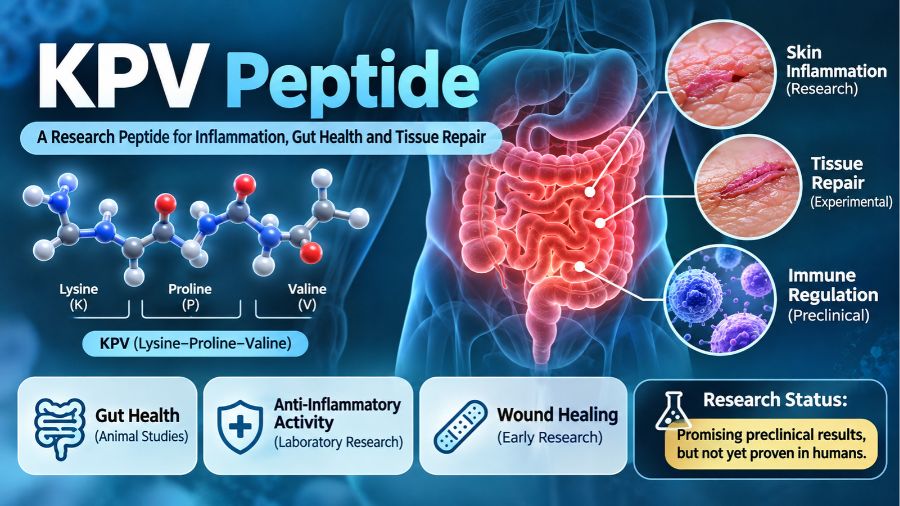
KPV is a naturally inspired synthetic tripeptide consisting of three amino acids: lysine (K), proline (P), and valine (V). It represents the final three amino acids of alpha-melanocyte-stimulating hormone, a peptide involved in several biological processes, including pigmentation and immune regulation. Scientists have investigated KPV separately from the complete hormone because this small fragment appears to retain interesting anti-inflammatory properties. Unlike larger proteins, a tripeptide contains only three linked amino acids, giving it a relatively simple molecular structure. KPV is therefore studied as a potential research compound for understanding inflammation and cellular signalling rather than as an established medication.
Understanding Its Connection to Alpha-MSH
Alpha-MSH belongs to the melanocortin peptide family and participates in biological pathways associated with pigmentation, appetite regulation, and inflammatory responses. KPV corresponds to amino acids 11–13 of this larger molecule. Researchers have investigated whether this small sequence can produce anti-inflammatory effects without requiring the complete alpha-MSH molecule. Experimental findings suggest that KPV can influence inflammatory responses through mechanisms that are not necessarily dependent on the classical melanocortin receptors. This distinction is scientifically important because it may help researchers understand how individual peptide fragments interact with immune and intestinal cells.
How Does KPV Peptide Work?
KPV has been investigated for its ability to influence intracellular inflammatory signalling rather than simply blocking one inflammatory substance. Research involving intestinal epithelial cells and immune cells has demonstrated that KPV can affect pathways associated with NF-κB and mitogen-activated protein kinase (MAPK). These pathways help regulate inflammatory gene expression and the production of signalling molecules called cytokines. By modifying their activity in experimental settings, KPV may reduce certain inflammatory responses. Researchers have also investigated its relationship with PepT1, a transporter that moves small peptides across cellular membranes. These mechanisms provide a scientific basis for further investigation, but their clinical importance in humans remains uncertain.
The Role of NF-κB Signalling
NF-κB is a major transcription factor involved in regulating immune responses, inflammation, and cellular stress. When activated, it can promote the expression of genes associated with inflammatory cytokines and other immune-related molecules. In laboratory experiments, KPV has been shown to reduce NF-κB activation under certain inflammatory conditions. This finding is particularly relevant to research involving intestinal inflammation because excessive inflammatory signalling can contribute to tissue damage. Nevertheless, reducing NF-κB activity in cultured cells does not automatically mean that administering KPV will produce a meaningful therapeutic effect in people.
Understanding PepT1 Transport
PepT1 is a membrane transporter responsible for absorbing many dipeptides and tripeptides in the small intestine. Researchers have identified this transporter as one possible route through which KPV enters intestinal epithelial cells. A foundational study published in the journal Gastroenterology in 2008 investigated PepT1-mediated KPV uptake and its effects in experimental intestinal inflammation. The researchers reported reduced inflammatory signalling in cellular experiments and improvements in two mouse models of colitis. This research helped establish KPV as a subject of interest in intestinal inflammation studies, although it did not demonstrate clinical effectiveness in human patients.
Potential Benefits of KPV Peptide
The potential benefits of KPV primarily relate to its experimental anti-inflammatory activity. Researchers have explored its effects on intestinal inflammation, inflammatory cytokines, immune-cell signalling, and skin-related biological processes. These areas are attracting attention because chronic inflammation contributes to numerous health conditions and can affect different organs and tissues. However, the available evidence is largely preclinical, meaning it comes from laboratory experiments and animal studies rather than adequately controlled human trials. Consequently, claims that KPV improves digestive health, treats inflammatory disorders, accelerates healing, or provides systemic immune benefits should be treated as unproven.
Gut Health and Intestinal Inflammation
Gut inflammation is one of the most extensively investigated areas of KPV research. The intestinal lining acts as a protective barrier between the digestive tract and the body’s internal environment. Inflammatory conditions can disrupt this barrier and affect normal intestinal function. In experimental studies, KPV has demonstrated the ability to influence inflammatory responses in intestinal epithelial cells. Animal research has also examined its effects in chemically induced colitis models. These findings have generated interest in its possible relevance to inflammatory bowel diseases, including Crohn’s disease and ulcerative colitis. However, KPV has not been established as a treatment for either condition in humans.
Potential Effects on Inflammatory Cytokines
Cytokines are signalling proteins that help coordinate immune responses. Some cytokines promote inflammation, while others help regulate or resolve it. Excessive inflammatory signalling can contribute to tissue damage and persistent immune activation. Experimental KPV research has reported reductions in certain pro-inflammatory cytokines under specific laboratory conditions. This suggests that the peptide may influence communication between immune cells and surrounding tissues. However, cytokine changes observed in experimental models cannot establish that KPV reduces inflammation throughout the human body or provides protection against inflammatory diseases.
Skin Inflammation and Tissue Repair
Researchers have also shown interest in KPV for skin-related applications because inflammatory signalling plays an important role in several dermatological conditions. Laboratory research has explored melanocortin-derived peptides and their interactions with inflammatory processes in skin cells. KPV has consequently attracted attention in discussions about topical formulations and potential skin applications. However, evidence supporting claims that it treats acne, eczema, psoriasis, or other skin conditions in humans remains insufficient. Its possible role in wound healing also requires properly designed clinical research before any therapeutic benefit can be established.
KPV Peptide Research and Scientific Studies
Scientific interest in KPV is supported by several preclinical investigations, particularly research published in gastroenterology and inflammatory bowel disease journals. These studies provide information about its biological activity, possible cellular mechanisms, and effects in experimental disease models. However, the number and type of studies matter when evaluating a research compound. Positive findings in mice or cultured cells are early evidence, not proof of clinical effectiveness. A careful assessment of KPV therefore requires examining what researchers actually tested, which outcomes they measured, and whether those findings have been reproduced in human clinical trials.
The 2008 Gastroenterology Study
One important investigation, published in 2008 in Gastroenterology, was titled PepT1-Mediated Tripeptide KPV Uptake Reduces Intestinal Inflammation. Researchers examined KPV in human intestinal epithelial cell lines and immune-cell experiments, alongside two mouse models of colitis. Their findings indicated that KPV could enter cells through PepT1 and influence NF-κB and MAPK inflammatory signalling. Oral administration also reduced inflammatory indicators in the experimental mouse models. The study provided an important foundation for subsequent interest in KPV, but its findings should not be interpreted as evidence that oral KPV treats inflammatory bowel disease in humans.
Research on Inflammatory Bowel Disease
Another relevant investigation, published in 2008 in Inflammatory Bowel Diseases, examined the anti-inflammatory potential of KPV in mouse models of intestinal inflammation. Researchers studied dextran sodium sulfate-induced colitis and a T-cell transfer model. The findings suggested that KPV treatment was associated with improvements in certain disease-related measurements, including inflammatory changes in intestinal tissue. This research strengthened scientific interest in KPV as a possible candidate for further investigation. Nevertheless, animal models cannot reproduce every feature of human Crohn’s disease or ulcerative colitis, and these findings do not establish a clinical treatment.
Nanoparticle-Based KPV Research
Researchers have also explored nanoparticle delivery systems as a way to investigate the behaviour of KPV in the digestive tract. Peptides can face challenges when delivered orally because digestive enzymes and gastrointestinal conditions may affect their stability and availability. Encapsulation approaches are being studied to protect experimental compounds and improve their delivery to targeted tissues. KPV-loaded nanoparticle research has produced promising findings in experimental intestinal inflammation models. However, specialized delivery systems introduce additional formulation and manufacturing considerations, and their experimental success does not demonstrate that commercially available oral KPV products have equivalent properties.
KPV Peptide Administration and Formulations
KPV has attracted interest in several formulation approaches, including oral and topical preparations, because researchers are investigating its potential interactions with intestinal and skin tissues. The choice of formulation can influence peptide stability, absorption, distribution, and exposure to biological systems. Oral delivery may involve challenges related to digestion, while topical delivery raises questions about skin penetration and local concentration. Importantly, the fact that a formulation has been studied experimentally does not establish an appropriate human dose or administration schedule. KPV should not be treated as a routine supplement or self-directed treatment, particularly when its human pharmacological profile remains insufficiently established.
Oral KPV
Oral KPV is frequently discussed in connection with intestinal inflammation research because the digestive tract is a major focus of its experimental applications. The 2008 Gastroenterology investigation reported anti-inflammatory effects after oral administration in mouse colitis models. Other research has examined delivery technologies intended to improve peptide stability and intestinal exposure. However, the absorption, metabolism, bioavailability, and appropriate formulation of KPV in humans have not been adequately established. An experimental oral formulation should therefore not be considered interchangeable with an ordinary supplement or an approved treatment for digestive disorders.
Topical KPV
Topical KPV is another formulation of interest because researchers have investigated its potential relevance to inflammatory processes in skin tissue. Applying a compound locally may offer a different exposure profile from taking it orally or administering it through an injection. However, the effectiveness of topical KPV depends on factors such as formulation quality, skin penetration, stability, and the biological concentration reaching the intended tissue. Reliable human clinical evidence establishing its benefits for particular skin conditions is lacking. Products marketed for cosmetic or dermatological purposes should not be assumed to have proven therapeutic effects.
Injectable KPV
Injectable KPV is discussed in the broader research-peptide market, but it is important to distinguish commercial availability from established medical use. There is insufficient human evidence to determine the safety, pharmacokinetics, optimal dosage, or long-term consequences of injectable KPV. In addition, injection introduces risks associated with sterility, contamination, incorrect concentration, and adverse reactions. Injectable products purchased through unverified research-peptide suppliers may have uncertain identity and purity. Injectable KPV should not be self-administered on the basis of online protocols or anecdotal reports.
KPV Peptide Side Effects and Safety Concerns
The safety profile of KPV in humans remains inadequately characterized because comprehensive clinical studies have not established its tolerability, adverse-event frequency, or long-term effects. Laboratory and animal findings cannot provide a complete picture of how the compound behaves in people with different medical conditions or medication histories. Potential concerns include allergic reactions, immune-related effects, contamination, impurities, and formulation-related problems. The absence of well-documented human side effects should never be interpreted as proof that a substance is harmless. Anyone considering an experimental peptide should understand that its safety cannot be assumed simply because its molecular structure is relatively small.
Potential Adverse Reactions
Possible adverse reactions to an experimental peptide may depend on its formulation, route of exposure, purity, and individual biological response. For KPV specifically, reliable human data are insufficient to establish a definitive list of common or rare side effects. Injectable products raise additional concerns about infection and local tissue reactions, while topical formulations may cause irritation or sensitivity. Oral preparations may have different gastrointestinal tolerability and absorption characteristics. These are safety considerations rather than confirmed KPV-specific adverse-event rates, and further research is necessary to understand its actual risk profile.
Product Purity and Contamination
Product quality is an important concern in the research-peptide market. Products sold online may not undergo the same regulatory review, manufacturing controls, identity verification, and quality testing expected of approved medicines. Incorrect peptide identification, impurities, residual solvents, microbial contamination, and inaccurate concentration can create significant risks. A certificate of analysis may provide useful information, but its reliability depends on the testing laboratory, methods, sample traceability, and manufacturing standards. Consumers should not assume that a product labelled KPV has been independently verified or is suitable for human use.
KPV Peptide FDA Status and Regulatory Developments in 2026
KPV is not an FDA-approved drug, and its regulatory position requires careful distinction between drug approval and pharmacy compounding policies. In July 2026, KPV-related bulk drug substances were among those considered by the Pharmacy Compounding Advisory Committee for potential inclusion on the FDA’s 503A bulks list. On October 30, 2026, the Department of Health and Human Services published a notice concerning an interim enforcement-discretion policy for certain peptide compounding. KPV was included among six peptides covered by the policy. This development is significant, but it does not constitute FDA approval, establish clinical effectiveness, or mean that unrestricted commercial sales are authorized.
What the October 2026 HHS Policy Means
The HHS policy describes circumstances in which the department does not intend to take enforcement action against certain state-licensed pharmacies, federal facilities, and licensed physicians compounding specified peptide products while the 503A bulks list continues through rulemaking. KPV acetate is identified for oral and topical dosage forms under the policy. The approach is conditional and applies to covered compounding activities rather than every product sold online. The policy also states that compounded medicines are not FDA-approved and may carry safety and quality risks. It should therefore not be interpreted as confirmation that KPV is an established or approved treatment.
Is KPV Legal to Buy?
The legal position depends on the country, product classification, intended use, supplier, and applicable medicines and compounding regulations. In the United States, the October 2026 HHS policy provides limited enforcement discretion for specified compounding circumstances, but it does not authorize every seller or every formulation. Other countries may apply different rules to experimental peptides and unapproved medicines. Buyers should distinguish legitimate, regulated pharmacy compounding from products marketed as research chemicals or dietary supplements without appropriate authorization. In Pakistan and other jurisdictions, local medicines regulators and qualified healthcare professionals should be consulted before purchasing or using an experimental peptide.
KPV Peptide vs BPC-157 and TB-500
KPV, BPC-157, and TB-500 are frequently discussed together in online research-peptide communities because all three have attracted interest for possible effects on inflammation or tissue repair. However, they are different compounds with different molecular structures and research histories. KPV is a three-amino-acid fragment derived from alpha-MSH, BPC-157 is a synthetic peptide consisting of 15 amino acids, and TB-500 is associated with thymosin beta-4-related research. Their proposed applications should not be confused with proven medical benefits. None should be assumed to have established safety and effectiveness for routine human treatment.
Key Differences Between the Three Peptides
The primary research interest in KPV concerns inflammatory signalling and experimental intestinal inflammation. BPC-157 has been investigated in preclinical studies involving tissue repair, gastrointestinal injury, and other biological processes. TB-500 is marketed in connection with tissue recovery, although claims about its benefits require careful examination of the underlying evidence and product identity. These compounds are not interchangeable, and research findings involving one peptide cannot be used to establish the effectiveness of another. Comparing them requires evaluating the quality of individual studies rather than relying on promotional claims or online popularity.
Challenges and Future Research on KPV Peptide
The biggest challenge facing KPV research is the gap between promising preclinical findings and reliable human clinical evidence. Researchers still need to establish how the peptide behaves in the human body, which formulations provide meaningful exposure, what adverse effects may occur, and whether any potential benefits outweigh the risks. Future investigations would need carefully designed clinical trials with appropriate controls, measurable outcomes, validated manufacturing standards, and adequate follow-up. Research should also distinguish between different routes of administration and specific medical conditions. Until these questions are answered, KPV remains an experimental research compound rather than an established therapeutic option.
Conclusion
KPV peptide is an interesting subject in modern peptide research because of its potential influence on inflammatory signalling, intestinal immune responses, and tissue-related biological processes. Studies published in scientific journals have demonstrated promising results in laboratory experiments and animal models, particularly those investigating intestinal inflammation. However, the absence of established human clinical evidence remains a major limitation. Recent HHS regulatory developments in October 2026 have also brought additional attention to KPV, although limited enforcement discretion for certain compounding activities does not represent FDA drug approval. For now, KPV should be understood as an experimental peptide with potential research applications, not a proven treatment for inflammatory or other medical conditions.
Also read: Tooth Fairy: Fascinating History, Origins and Traditions Around the World
FAQs
1. What is KPV peptide used for?
KPV is researched for potential anti-inflammatory effects, particularly in experimental studies involving intestinal inflammation, immune signalling, skin inflammation, and tissue-related biological processes.
2. Does KPV peptide help with gut inflammation?
Animal studies suggest KPV may reduce certain intestinal inflammatory responses, but clinical evidence has not established its effectiveness for human digestive disorders.
3. Is KPV peptide FDA approved?
No, KPV is not FDA-approved as a medicine. A 2026 HHS enforcement-discretion policy addresses specific peptide compounding circumstances without granting drug approval.
4. What are the possible side effects of KPV peptide?
Human safety data remain insufficient. Potential concerns include allergic reactions, contamination, impurities, and formulation-related complications, particularly with unregulated injectable products.
5. Is KPV peptide better than BPC-157?
Neither peptide has established clinical superiority. KPV research focuses heavily on inflammation, while BPC-157 research investigates several experimental tissue-repair applications.
6. Is KPV peptide available in oral and topical forms?
Oral and topical KPV formulations have been investigated experimentally. Their human safety, effectiveness, appropriate dosage, and long-term outcomes remain insufficiently established.