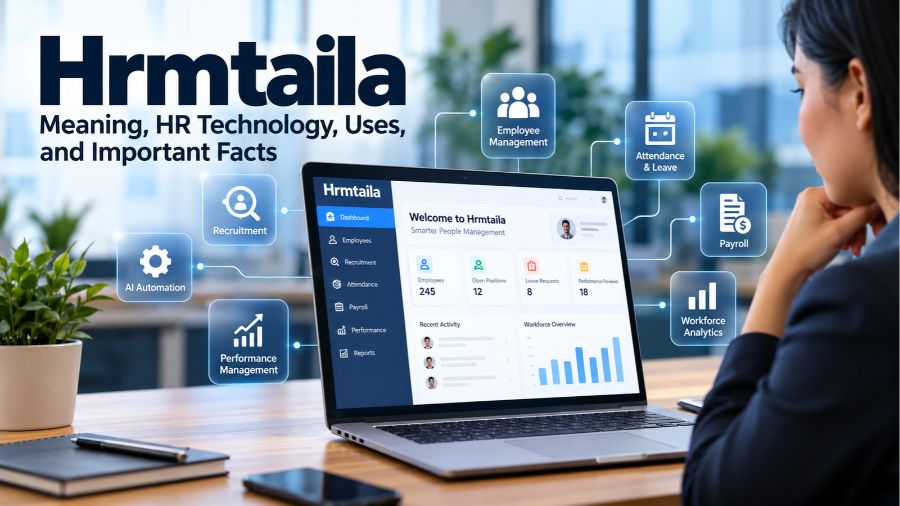
Hrmtaila is an unfamiliar term appearing in online discussions about technology, business operations, and human resource management. Some descriptions associate it with digital HR solutions, workplace automation, and employee management, but publicly verifiable information about its identity remains limited. This distinction matters because an interesting technology-related keyword does not automatically represent an established product, company, or software platform. For readers researching Hrmtaila, understanding what is actually known is more useful than accepting unsupported claims about advanced features or business benefits. This article explores the term’s possible connection to HR technology, explains the systems commonly associated with that field, and examines the practical questions businesses should consider before trusting an unfamiliar digital solution.
What Is Hrmtaila?
Hrmtaila is a term whose precise definition, origin, and commercial identity have not been reliably established through authoritative public documentation. Online descriptions sometimes connect it with human resource management technology, suggesting a relationship with software used to organize employee information, automate administrative processes, and support workforce decisions. However, these descriptions should not be treated as confirmation that Hrmtaila is an operational HR management platform. An identifiable software product would ordinarily have supporting information such as a developer or company name, official documentation, a product website, a privacy policy, or independently verifiable customer references. Without such evidence, the most responsible interpretation is that Hrmtaila remains an insufficiently documented term with a possible association with digital HR management. Readers can still learn about the broader technology concepts connected to the keyword, but they should distinguish established industry practices from features that have not been demonstrated for Hrmtaila itself.
Understanding the Possible Meaning of Hrmtaila
The association between Hrmtaila and human resource management is understandable because modern businesses increasingly rely on digital systems to coordinate recruitment, employee records, payroll information, attendance, and workforce planning. Human resource management, commonly abbreviated as HRM, refers to the organizational practices used to recruit, support, develop, and manage employees. When these activities are supported by software, businesses often use terms such as human resource management system (HRMS), human resource information system (HRIS), or human capital management (HCM). These categories overlap, although their capabilities and intended audiences vary. The spelling of Hrmtaila alone does not establish that it belongs to any of these categories, and there is no verified basis for expanding the term into a particular acronym or brand name. Its relevance to HR technology is therefore best understood as a topic of online discussion rather than a confirmed product classification.
Why Hrmtaila Is Associated With Digital HR Technology
Digital HR technology provides a plausible context for understanding why Hrmtaila appears in technology-oriented content. Businesses use HR platforms to replace fragmented spreadsheets, paper documents, and disconnected administrative workflows with more structured information systems. A typical HR solution might centralize employee profiles, manage leave requests, support hiring activities, or provide reporting tools for management. More advanced products may integrate analytics, automation, and artificial intelligence to assist with repetitive tasks. These capabilities can improve consistency and reduce manual administration when implemented appropriately. Nevertheless, the existence of these technologies does not prove that Hrmtaila offers them. A useful distinction is between describing what modern HR software can accomplish and attributing those accomplishments to an unidentified service. Until reliable technical documentation becomes available, Hrmtaila should be discussed as an uncertain term within a well-established technology landscape rather than as a verified example of a specific HR platform.
How Modern Human Resource Management Systems Work
A modern human resource management system generally operates by collecting authorized workforce information, storing it in structured records, and making relevant functions available through controlled software interfaces. Employees may use self-service portals to update personal details, request leave, or review documents, while HR administrators handle recruitment records, policy workflows, and employment changes. Managers may receive access to team information, approval requests, and operational reports according to their responsibilities. Behind these interfaces, the system applies business rules, access permissions, and integrations with other applications. Some platforms connect with payroll providers, identity management services, accounting systems, or collaboration tools. The effectiveness of such a system depends on data quality, security, configuration, and organizational processes rather than the number of advertised features. This general operating model helps explain the technology category sometimes associated with Hrmtaila, without assuming that any particular architecture or functionality has been implemented under that name.
The Role of Artificial Intelligence in HR Management
Artificial intelligence has become an important area of development within HR software, particularly where organizations need assistance processing large volumes of information or handling repetitive workflows. AI-supported systems may help categorize employee questions, summarize policy documents, identify missing application information, or generate draft communications for human review. Machine learning can also support workforce analytics by detecting patterns in historical data, although its predictions are subject to data limitations and potential bias. In recruitment, automated screening requires particular care because employment decisions can significantly affect individuals. An AI system that appears efficient may still produce unfair or inaccurate results if its training data, evaluation methods, or operating rules are unsuitable. Human oversight, transparency, and appropriate safeguards remain essential. Although online descriptions may associate Hrmtaila with AI-driven HR processes, no verified technical evidence establishes that it uses artificial intelligence, machine learning, or any particular automated decision-making model.
Key Capabilities Commonly Found in HR Software
The features associated with contemporary HR platforms vary substantially according to the vendor, pricing model, intended business size, and regional requirements. Some systems concentrate on maintaining employee records, while others offer extensive modules covering recruitment, onboarding, payroll coordination, performance management, and reporting. An organization evaluating HR software should identify which capabilities are genuinely necessary instead of assuming that every platform includes a complete collection of tools. Integration support, usability, security controls, and reliable vendor documentation can be more important than a long feature list. This is especially relevant when researching an unfamiliar term such as Hrmtaila, where promotional descriptions may create expectations without supplying independent confirmation. Understanding the main functions of established HR technology provides a practical framework for assessing future claims about the term.
Employee Information Management
Employee information management is a foundational function of many HR systems. It involves maintaining organized records such as employment dates, job titles, reporting relationships, work locations, and authorized contact information. A centralized database can reduce inconsistencies that arise when departments maintain separate versions of employee records. However, centralization also increases the importance of access restrictions, retention policies, and data accuracy. Businesses should collect only information they genuinely need and ensure that sensitive records are available exclusively to authorized users. Some platforms provide audit histories showing when information was changed and by whom. These capabilities are valuable for accountability, but their presence must be verified for each product. There is currently no reliable basis for claiming that Hrmtaila provides an employee database, administrative dashboard, or record-management module.
Recruitment and Applicant Tracking
Recruitment software helps organizations coordinate job openings, applications, interview schedules, candidate communications, and hiring decisions. An applicant tracking system, commonly called an ATS, can organize candidate information and make recruitment workflows easier to manage. Some platforms offer automated scheduling, application categorization, and integrations with job advertising services. These functions can save administrative time, but they do not guarantee better hiring decisions. Recruitment processes still require clear job criteria, appropriate evaluation methods, and fair treatment of applicants. When AI-assisted tools are involved, organizations should consider whether candidates can understand relevant decisions and whether human review is available. Hrmtaila has sometimes been discussed in connection with recruitment technology, but no independently confirmed applicant tracking functionality can presently be attributed to it.
Attendance and Leave Management
Attendance and leave management tools help businesses record working hours, manage absence requests, apply leave policies, and provide managers with visibility into staffing availability. Depending on the system, employees may submit requests through web portals or mobile applications, while supervisors approve them through configured workflows. Certain platforms also support shift scheduling, overtime calculations, and integration with payroll processes. These features are particularly useful for organizations with multiple locations, changing schedules, or large employee populations. However, attendance tracking introduces privacy and workplace monitoring concerns, especially when systems collect location data or detailed activity information. Employers should establish clear policies and comply with applicable employment and data protection requirements. Although these capabilities are common within HR technology, there is no verified evidence that Hrmtaila includes attendance monitoring or leave administration.
Payroll and Benefits Administration
Payroll administration involves calculating compensation, processing authorized deductions, maintaining relevant records, and coordinating payments according to applicable requirements. Some HR platforms contain payroll modules, while others exchange information with specialized payroll providers. Benefits administration may involve employee enrollment, eligibility records, contribution tracking, and communication with external service providers. These processes are complex because tax rules, employment obligations, and benefit arrangements differ across jurisdictions. Software can assist with calculations and recordkeeping, but organizations remain responsible for validating configurations and ensuring compliance. A product advertised as an all-in-one HR solution should clearly explain which payroll functions it performs and which require third-party integrations. No authenticated documentation currently supports claims that Hrmtaila processes salaries, calculates taxes, or administers employee benefits.
Performance Management and Employee Development
Performance management systems support activities such as setting objectives, documenting feedback, coordinating reviews, and tracking professional development. Their purpose is to create a more consistent framework for discussing employee contributions and growth. Some organizations use structured review cycles, while others prefer continuous feedback supported by digital tools. Learning management integrations may also help employees access training materials and record completed courses. However, numerical performance scores and automated recommendations can oversimplify complex workplace contributions. Managers should interpret such information in context rather than treating software-generated assessments as unquestionable conclusions. HR technology can support professional development when combined with constructive management practices, clear expectations, and meaningful employee participation. These are established industry applications, not confirmed Hrmtaila features.
Potential Benefits of Digital HR Management Solutions
Well-designed HR systems can deliver meaningful operational benefits by reducing repetitive administration, improving record consistency, and making routine information easier to access. For example, employee self-service functions may reduce the number of basic requests handled manually by HR teams, while structured approval workflows can make responsibilities clearer. Centralized records may also improve reporting and reduce duplicate data entry across departments. These benefits are not automatic, however. Poor implementation can introduce additional work, especially when organizations migrate inaccurate records or configure processes that do not match actual business needs. Employee training, ongoing maintenance, and clearly assigned system ownership are important to successful adoption. Businesses should also distinguish measurable improvements from vendor marketing claims. Because Hrmtaila has not been established as a functioning product, it would be misleading to claim that it delivers specific productivity gains, cost reductions, or employee satisfaction improvements.
Challenges and Limitations of HR Technology
Digital HR management introduces challenges alongside its potential advantages. Implementation may require data cleaning, workflow redesign, employee training, and integration with existing business applications. Smaller organizations can struggle with subscription costs or complex interfaces designed for much larger employers. Larger businesses may face difficulties coordinating regional policies, permission structures, and legacy systems. Another concern is dependence on a vendor for access to important workforce information. If a provider changes its pricing, discontinues a service, or experiences a prolonged outage, customers may encounter operational disruption. Automated processes can also amplify errors when incorrect rules are applied across many records. Organizations should therefore evaluate the reliability of support services, contractual protections, data export options, and disaster recovery arrangements. These considerations are especially important when an unfamiliar name such as Hrmtaila lacks transparent ownership or a documented operational history.
Data Privacy and Security Considerations
Human resource platforms frequently process information that employees reasonably expect their organizations to protect. This may include addresses, identification details, compensation records, employment histories, and other sensitive information. A responsible HR software provider should explain how personal data is collected, stored, accessed, retained, and deleted. Security measures may include encryption, multifactor authentication, role-based permissions, audit logging, and regular vulnerability management. The appropriate legal obligations depend on the jurisdictions involved and the nature of the information processed. For example, organizations handling personal data within the scope of the European Union’s General Data Protection Regulation must meet relevant requirements concerning lawful processing, transparency, and individual rights. Businesses should not assume that an unfamiliar platform meets these standards merely because it advertises modern technology. In the case of Hrmtaila, the absence of authenticated provider information makes independent security verification particularly important.
Can Hrmtaila Be Considered a Legitimate Software Platform?
The legitimacy of a software platform should be assessed through verifiable evidence rather than search visibility or promotional language. A credible commercial provider will generally offer identifiable company information, clear service descriptions, accessible contractual terms, support channels, and documentation appropriate to its product. Independent customer references, reputable software directories, and evidence of ongoing maintenance can provide additional confidence, although none is conclusive by itself. At present, there is insufficient verified information to establish Hrmtaila as a specific commercial HR software service. That uncertainty does not demonstrate fraudulent activity, nor does it prove that no legitimate organization uses the name. It simply means readers should avoid treating unverified descriptions as established facts. Any website presenting itself as an official Hrmtaila service should be evaluated independently before users create accounts, provide personal information, or make payments.
How to Verify an Unfamiliar HR Software Provider
Verification begins with establishing who operates the service and what the provider actually offers. Businesses should look for a consistent company identity, reliable contact details, product documentation, and terms that explain the commercial relationship. A privacy notice should identify the relevant data-handling responsibilities and explain how employee information is processed. Prospective customers can request a product demonstration, ask about security controls, and confirm whether advertised integrations are supported. For software handling sensitive records, procurement teams may also request independent assurance reports, information about subprocessors, and contractual commitments concerning data retention and incident notification. Customer references should be assessed carefully because testimonials can be fabricated or presented without meaningful context. If Hrmtaila eventually becomes identifiable through official documentation, these same checks would provide a reasonable starting point for evaluating its credibility and suitability.
Hrmtaila and Established HR Software Categories
The uncertain status of Hrmtaila becomes clearer when compared with established categories of business software. An HRIS typically focuses on employee information and administrative HR processes, although its scope can be broader. An HRMS often includes additional workforce management functions, while HCM solutions may place greater emphasis on talent management, workforce planning, and strategic employee development. These distinctions are not universal, and vendors frequently use the terms interchangeably. Established platforms such as Workday, SAP SuccessFactors, and BambooHR provide examples of recognizable HR software brands with documented product offerings, although their features, target customers, and implementation requirements differ. Hrmtaila cannot currently be placed in the same category with equivalent confidence because its vendor identity and technical capabilities have not been confirmed. Comparing the terminology helps readers understand the market without creating an unsupported competitive relationship.
Why Small Businesses Need Practical HR Tools
Small businesses often begin managing employee information through spreadsheets, email, shared folders, and manual approval processes. These methods may be adequate when teams are small and requirements are straightforward, but they can become difficult to maintain as an organization grows. A suitable HR platform may help formalize leave policies, organize employee documents, and reduce administrative duplication. Nevertheless, a small company does not necessarily need a comprehensive enterprise system. An affordable solution with reliable support and essential functionality may provide better value than an expensive platform containing features that employees rarely use. Business owners should consider implementation effort, recurring costs, usability, and data portability before purchasing software. Discussions connecting Hrmtaila with business efficiency may reflect this broader interest in accessible HR technology, but there is no verified evidence establishing it as a small-business product.
HR Technology for Medium and Large Organizations
Medium and large organizations typically face more complicated workforce management requirements because they operate across departments, locations, or legal jurisdictions. Their HR systems may need to support hierarchical approvals, multiple employment arrangements, regional policies, and connections with finance or identity management applications. Reporting requirements can also become more demanding as leadership teams seek consistent information about staffing, recruitment, retention, and organizational development. Enterprise software must therefore balance functionality with governance, scalability, and system reliability. Large organizations may also require contractual service commitments, detailed security assessments, and formal implementation support. Choosing a platform solely because it claims to offer artificial intelligence or automation would overlook these fundamental requirements. Hrmtaila cannot presently be evaluated against enterprise procurement standards without authenticated information about its architecture, provider, support model, and contractual obligations.
The Importance of Integrations and Data Portability
An HR platform rarely operates in isolation. Businesses may need to exchange information with payroll services, accounting software, identity providers, scheduling applications, and employee communication tools. Integrations can reduce repeated data entry, but they also introduce technical and security dependencies. Reliable connections require clear documentation, appropriate authentication, error handling, and defined responsibilities when information fails to synchronize. Data portability is equally important because organizations may eventually change vendors or restructure their technology environment. A provider should explain how customers can export records, what formats are supported, and how data is handled after a contract ends. Open application programming interfaces can make integration easier, but the availability and limitations of those interfaces must be confirmed for each product. No verified technical documentation currently establishes whether Hrmtaila supports integrations, APIs, or employee data exports.
AI Recruitment and the Risk of Algorithmic Bias
One of the most sensitive applications of AI in human resources is the use of automated systems to evaluate job applicants or influence employment decisions. Such systems may process resumes, compare qualifications with job descriptions, or identify patterns in recruitment data. Their apparent objectivity can be misleading because algorithms may reproduce biases present in historical information or reflect poorly chosen evaluation criteria. In the European Union, certain AI systems used for employment and worker management are classified as high-risk under the AI Act, with relevant obligations subject to the law’s phased implementation and applicable provisions. Organizations should also consider employment discrimination rules, transparency requirements, and meaningful human oversight. These concerns apply to HR technology generally, not to any verified Hrmtaila implementation. Without evidence that Hrmtaila uses automated recruitment systems, attributing specific bias risks or compliance failures to it would be speculative.
How Businesses Should Evaluate HR Software Costs
The total cost of HR software extends beyond the advertised subscription price. Organizations may need to pay for implementation assistance, employee training, data migration, premium support, integrations, and additional modules. Some vendors charge according to employee count, while others use packages, minimum commitments, or customized enterprise contracts. The most suitable pricing model depends on organizational size, expected growth, and the functions actually required. Businesses should compare total ownership costs over a realistic period instead of focusing only on introductory discounts. They should also examine renewal terms, cancellation procedures, and charges associated with exporting data. An inexpensive system can become costly if it creates manual work or requires extensive customization. Because no authenticated Hrmtaila pricing information has been established, any specific subscription figures or claims about its affordability should be treated as unverified.
Common Misconceptions About Emerging Technology Names
Unfamiliar technology names can create confusion when online articles repeatedly describe them without identifying primary evidence. One common misconception is that appearing in multiple search results proves a product exists. In reality, articles may repeat information from one another without independently confirming the underlying claims. Another misconception is that technical terminology demonstrates authenticity. Words such as automation, analytics, artificial intelligence, and cloud computing describe real technologies, but they do not verify a particular provider’s capabilities. Readers may also mistake speculative descriptions for official announcements when articles use confident language without supporting documentation. Hrmtaila illustrates why these distinctions matter. A keyword can attract attention and generate explanatory content even when its origin remains unclear. Responsible coverage should identify what is known, acknowledge missing evidence, and avoid transforming assumptions into apparent facts through repetition.
The Future of HR Technology and Automation
The broader HR technology market is likely to continue evolving as organizations seek more efficient administrative workflows, better information access, and improved employee experiences. AI-assisted interfaces may make it easier for workers to find policy information, complete routine requests, and navigate complex internal systems. Analytics tools may also support workforce planning when organizations use reliable data and interpret results responsibly. At the same time, privacy protection, explainability, accessibility, and oversight will remain central concerns. Future developments will depend on regulation, technical reliability, employer requirements, and the willingness of employees to trust these systems. None of these trends establishes a specific future roadmap for Hrmtaila. Unless an identifiable provider publishes credible announcements or technical documentation, predictions about Hrmtaila launching new features, expanding internationally, or transforming the HR industry would lack a factual foundation.
What Readers Should Remember About Hrmtaila
The most useful way to understand Hrmtaila is to separate the uncertain identity of the term from the established business technology concepts associated with it. HR management systems are real and widely used, with applications ranging from employee recordkeeping to recruitment, payroll coordination, and workforce analytics. Artificial intelligence can support some of these processes, but its use requires careful attention to accuracy, fairness, and privacy. Hrmtaila, by contrast, has not been sufficiently documented to confirm that it provides any of those capabilities. Readers encountering promotional claims should look for identifiable ownership, official documentation, independent verification, and clear security information. This evidence-based approach helps businesses avoid purchasing unsuitable software and helps general readers distinguish meaningful technology developments from unsupported online descriptions.
Conclusion
Hrmtaila remains an insufficiently verified term that has been associated online with human resource management and digital business technology. Although modern HR platforms can support recruitment, employee records, attendance, payroll coordination, analytics, and administrative automation, these capabilities cannot responsibly be attributed to Hrmtaila without credible product documentation. Its uncertain identity highlights an important lesson for anyone researching emerging technology: repeated online claims are not a substitute for reliable evidence. Understanding established HR software practices provides useful context, while checking provider identity, security, functionality, and contractual terms helps organizations make better technology decisions. Until more authoritative information becomes available, Hrmtaila is best approached as an unclear technology-related keyword rather than a confirmed commercial platform.
Also read: BeaconSoft Latest Tech Info: Essential Technology Insights and Trends
FAQs
What is Hrmtaila in simple terms?
Hrmtaila is an emerging online term associated with AI-assisted human resource management. Its official definition, developer, and identity as a commercial software platform remain unverified.
What does Hrmtaila stand for?
The letters HRM commonly mean Human Resource Management. However, no authoritative explanation establishes the complete meaning of Hrmtaila or the origin of its remaining letters.
Is Hrmtaila a real HR software platform?
There is insufficient reliable public evidence confirming Hrmtaila as an established software product. Its developer, official documentation, pricing, and independently verified features remain unidentified.
Does Hrmtaila offer recruitment and payroll features?
Recruitment and payroll are common HR software functions, but no authenticated product documentation confirms that Hrmtaila provides either capability or supports related business processes.
Is Hrmtaila safe to use?
Hrmtaila’s safety cannot be independently assessed without identifying an actual service. Avoid sharing sensitive employee information, passwords, or payment details with unverified providers.
Does Hrmtaila have an official website or mobile app?
No authenticated official website or mobile application has been established for Hrmtaila. Verify the developer’s identity before trusting similarly named websites or downloads.