What Does Pappedeckel Mean?
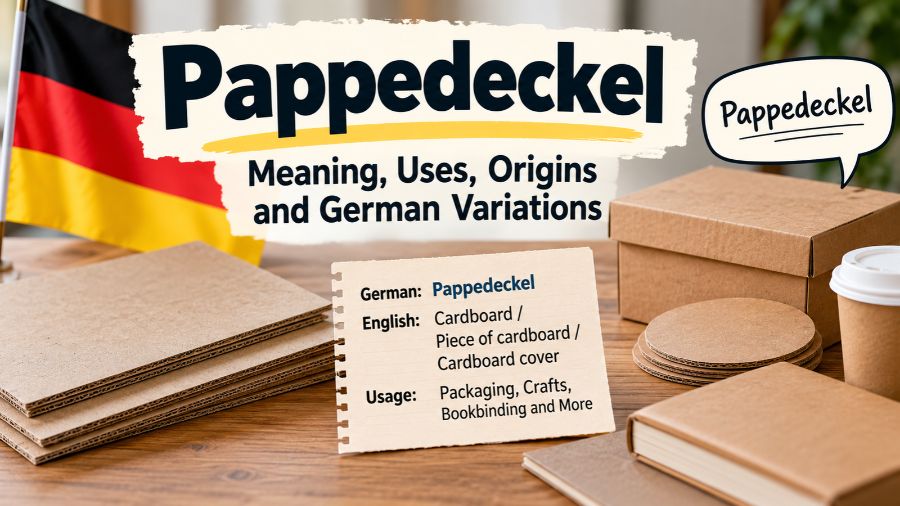
Pappedeckel is a regional or dialect-associated German expression connected with cardboard and related materials. The closest established dictionary forms are Pappdeckel and Pappendeckel, both referring to a piece of cardboard or stiff paper-based material. Depending on the situation, the intended English translation might be cardboard, a piece of cardboard, a cardboard cover, or a lid made from cardboard. The word does not automatically describe a particular manufactured product, standardized packaging component, or material specification. Its meaning becomes clearer when the surrounding sentence, the physical object, and the speaker’s regional language are considered together.
The Meaning of the Word in English
Translating Pappedeckel into English requires attention to context rather than relying on a single fixed equivalent. When someone discusses the material itself, cardboard or paperboard may be appropriate. When the word refers to a flat piece used to cover, support, or protect something, a piece of cardboard may be more natural. In packaging situations, cardboard cover or cardboard lid may fit if the object actually performs that function. These translations describe related but different things, so choosing the correct expression depends on what the speaker means rather than the spelling alone.
The German Words Behind Pappedeckel
The related word Pappdeckel combines Pappe, meaning cardboard or a stiff paper-based material, with Deckel, meaning lid or cover. This construction helps explain why English translations sometimes emphasize a cardboard cover rather than the material alone. The recognized alternative Pappendeckel belongs to the same word family and is documented in German dictionaries. Pappedeckel is encountered in regional language usage, including forms associated with Alemannic dialects. These similarities make the expressions understandable in related contexts, but they do not establish that every spelling has exactly the same regional distribution or meaning.
The Origin and Linguistic Background of Pappedeckel
The linguistic background of Pappedeckel is best understood through its relationship to German words for cardboard and covering objects. German frequently forms compound nouns by joining two existing words, allowing speakers to describe objects through their materials, functions, or physical characteristics. The standard form Pappdeckel follows this pattern by combining the idea of cardboard with the idea of a lid or cover. Pappendeckel is another established form, while Pappedeckel and similar spellings occur in regional language varieties. The available dictionary evidence supports this relationship, but it does not establish one definitive historical origin or a precise date when the regional form first appeared.
How Regional German Influences Spelling
German is spoken across several countries and regions, and its vocabulary includes numerous local expressions that differ from standard written German. Dialects may preserve older words, change pronunciation, or introduce variations in spelling when spoken language is represented in writing. Pappedeckel illustrates why a word encountered in a regional conversation may not match the headword found in a major dictionary. Related forms include Pappdeckel, Pappendeckel, Pabbedeggel, and Babbedeckel, although their distribution and usage are not identical everywhere. Recognizing these variations helps readers investigate unfamiliar words without assuming that every alternative spelling represents a completely different object.
Is Pappedeckel a Standard German Word?
Pappedeckel is not the principal standard dictionary spelling for the cardboard-related meaning. Duden records Pappdeckel and Pappendeckel, defining the terms in relation to a piece of cardboard. Regional language references also document Pappedeckel and similar dialect forms. This distinction matters for writing, translation, and search engine research because a person searching for a regional spelling may find more authoritative definitions under its standard relatives. For formal German writing, the appropriate standard expression should generally be selected according to the intended meaning. In a quotation, dialect discussion, or regional article, retaining the original spelling may be more appropriate.
Common Uses of Pappedeckel and Related Cardboard Terms
Cardboard is used in packaging, storage, crafts, bookbinding, and many other practical activities. Consequently, words associated with cardboard can appear in descriptions of numerous everyday objects. A Pappedeckel-related expression might refer to a flat board, a covering piece, or another cardboard component, depending on the sentence. However, the word alone does not establish a product’s thickness, composition, durability, coating, or intended application. These characteristics must be determined from the object itself or its technical description. Understanding this distinction prevents an ordinary material-related word from being mistaken for a specific industrial product category.
Cardboard Packaging and Covers
Cardboard and paperboard are common materials for creating packaging components that protect, separate, organize, or cover products. A cardboard cover can shield an object from dust, while a fitted lid can help close a box or container. Flat cardboard inserts may also provide support during storage and transportation. These applications illustrate why a cardboard-related term can have several practical interpretations. Nevertheless, not every cardboard component is a lid, and not every package uses the same type of board. When interpreting Pappedeckel in a packaging description, the most accurate translation should reflect the component’s actual shape and function.
Bookbinding and Paper Crafts
Stiff paper-based materials are useful in bookbinding because they can provide structure to covers and other supporting components. They are also used in craft projects, school activities, model-making, templates, and protective backing. In these contexts, an English translation such as board, stiff cardboard, or a piece of cardboard may be clearer than cardboard lid. The appropriate wording depends on the object being described and the conventions of the particular craft or trade. Pappedeckel itself does not guarantee that a material is suitable for archival bookbinding, professional models, or any other specialized purpose; those decisions require information about its physical properties.
Household Storage and Everyday Applications
Cardboard pieces can serve simple purposes around the home, including separating stored items, protecting surfaces, organizing small objects, and providing temporary backing. Reusing suitable cardboard can also reduce the need to purchase additional disposable materials for basic tasks. However, a piece of cardboard should not automatically be treated as waterproof, heat-resistant, food-safe, or strong enough to support heavy objects. Its performance depends on the material, thickness, construction, and surrounding conditions. When Pappedeckel appears in a household context, the surrounding description usually provides more useful information about its intended purpose than the word itself.
Pappedeckel vs. Pappdeckel vs. Pappendeckel
The spellings Pappedeckel, Pappdeckel, and Pappendeckel are related, but readers should understand the distinction between a standard dictionary form and a regional variant. Pappdeckel and Pappendeckel are established German dictionary entries associated with a piece of cardboard. Pappedeckel is found in regional usage and may be encountered in dialect writing or informal discussions. Their meanings overlap, particularly when cardboard is involved, but regional expressions can carry additional meanings that are not obvious from a standard definition. For translation, the best approach is to identify the intended object or expression first and then choose the English equivalent that fits the context.
When Should You Use Pappdeckel?
Pappdeckel is a useful choice when writing standard German and referring to a piece of cardboard in the sense documented by German dictionaries. It is especially appropriate when the context involves an ordinary physical object rather than a dialect expression. The word can also appear in descriptions involving covers or packaging, provided that the surrounding sentence makes the intended meaning clear. Writers working on German product descriptions should use the term that accurately describes the supplied item instead of assuming that every cardboard component has the same name. For technical or commercial communication, a more specific product description may be necessary.
When Does Pappendeckel Make Sense?
Pappendeckel is another recognized German form related to Pappdeckel. It can appear in German-language texts, regional usage, and dictionary searches. Readers may encounter it when looking up unfamiliar vocabulary or interpreting historical and contemporary writing. The existence of this alternative spelling does not mean that the word identifies a different material or a unique product by default. As with Pappdeckel, the precise translation depends on the context. When consistency matters, writers should choose the spelling appropriate to their intended audience, follow the conventions of the publication, and avoid switching between forms without a clear reason.
Why Pappedeckel May Appear in Regional Searches
Someone searching for Pappedeckel may be investigating a regional expression rather than a standard German vocabulary item. Regional dictionaries can preserve words that are uncommon in formal writing but remain meaningful within particular communities. In some southwestern German dialect references, related forms such as Pabbedeggel and Babbedeckel are associated with cardboard packaging, and some local usages also refer informally to a driver’s license. That additional meaning is regional rather than universal. Therefore, it would be misleading to interpret every occurrence of Pappedeckel as a driver’s license or to assume that every German speaker recognizes that usage.
Does Pappedeckel Have a Meaning Beyond Cardboard?
Yes, related regional expressions can carry meanings beyond the literal cardboard-related interpretation. One documented example is the use of certain Alemannic and neighboring dialect forms as informal terms for a Führerschein, the German word for a driver’s license. This usage depends on regional vocabulary and conversational context. It should not be presented as the primary meaning of Pappedeckel throughout the German-speaking world. A discussion about packaging strongly suggests a material-related interpretation, while a conversation about driving or official documents may justify investigating a dialect meaning. The speaker’s location and the surrounding sentence are important clues when the intended meaning is uncertain.
Understanding the Driver’s License Connection
The connection between a cardboard-related expression and a driver’s license may seem unusual to someone who knows only standard German vocabulary. However, regional language can develop informal labels for objects and documents that differ from their official names. Some local expressions involving Pappedeckel-related forms are recorded as colloquial references to a driving licence. The official German term remains Führerschein, which is the appropriate choice in formal documents and ordinary standard German communication. The regional expression should be interpreted as informal vocabulary rather than a technical term used universally by licensing authorities, driving schools, or government agencies.
How Context Helps Identify the Intended Meaning
Context is the most reliable way to distinguish between a literal material reference and a regional expression. If a sentence mentions a box, book cover, package, or craft project, the cardboard interpretation is likely to be relevant. If it discusses driving, a traffic stop, or a person carrying official documents, a regional reference to a driver’s license may deserve consideration. Neither interpretation should be assumed solely from the isolated word. Checking the source region, the complete sentence, and the type of text can prevent inaccurate translation. This is particularly important for subtitles, dialect literature, local news, and conversations transcribed from speech.
Environmental Considerations When Using Cardboard
Cardboard is widely used because it can be lightweight, practical, and suitable for many packaging and storage applications. Paper-based materials may also be recyclable through appropriate collection systems, depending on their composition and local recycling rules. However, cardboard is not automatically environmentally preferable in every situation. Its overall impact depends on how it is produced, transported, used, reused, and disposed of. Coatings, adhesives, contamination, and mixed-material construction can also affect whether a particular item is accepted for recycling. The word Pappedeckel does not specify any of these characteristics, so environmental claims must be based on the actual product rather than its name.
Reuse and Recycling
A clean, undamaged cardboard piece may be suitable for reuse as protective packaging, a storage divider, or craft material. Reuse can extend the useful life of a product before disposal becomes necessary. When reuse is no longer practical, the item may be recyclable if local facilities accept its material and condition. Food contamination, moisture, plastic laminates, and other coatings can affect the appropriate disposal method. Consumers should therefore check local waste-management guidance rather than assuming that every cardboard object belongs in the same recycling stream. These considerations apply to cardboard products generally, not specifically to every item described as Pappedeckel.
Choosing the Right Material for the Job
Selecting cardboard requires more information than identifying its general material category. Thickness, stiffness, moisture exposure, weight requirements, and intended use can all influence performance. A lightweight board suitable for a craft project may be unsuitable for supporting a heavy object or protecting fragile goods during transportation. Similarly, packaging intended to contact food may require materials that meet applicable food-contact requirements. Pappedeckel does not communicate those technical specifications by itself. Buyers and manufacturers should use product descriptions and supplier documentation to establish whether a particular cardboard component meets the functional, safety, and environmental requirements of its intended application.
How to Research Pappedeckel Accurately Online
Searching for Pappedeckel can produce different types of results because the term is associated with standard German vocabulary, regional spellings, and articles explaining its meaning. A useful research approach starts with the exact term and then compares results with established dictionary entries for Pappdeckel and Pappendeckel. Regional dictionaries can provide additional context when a dialect meaning is suspected. For packaging or industrial applications, product specifications are more useful than general language explanations. Separating linguistic evidence from commercial claims helps readers avoid treating an informal expression as a standardized technical classification or assuming that an unrelated website defines the word authoritatively.
Using German Dictionaries
Established German dictionaries are a sensible starting point for checking spelling, grammatical gender, plural forms, and standard definitions. They can also clarify relationships between related words. Regional language dictionaries provide a complementary resource when the spelling is associated with a particular dialect or geographic area. Comparing these resources can help identify whether a term is standard, regional, colloquial, or an alternative spelling. For a reliable translation, readers should prioritize sources that clearly explain the term’s usage rather than relying solely on short summaries, autogenerated definitions, or websites that repeat one another without providing independent linguistic evidence.
Identifying the Correct Search Intent
The search intent behind Pappedeckel can vary. Some people want a translation, others want to understand a regional expression, and some may be searching for a cardboard product. An article that covers the word’s definition, spelling variants, and contextual meanings is therefore more useful than one that assumes a single interpretation. Readers looking to purchase packaging should also search for the specific product type, dimensions, material, and intended use. Those studying German should focus on dictionary definitions and regional examples. Matching the research approach to the actual question reduces confusion and helps readers find information that addresses their needs.
Conclusion
Pappedeckel is a regional German expression associated primarily with cardboard and related paper-based materials, while Pappdeckel and Pappendeckel are established dictionary forms. Depending on context, the intended meaning may be a piece of cardboard, a cover, or a packaging component, and some regional relatives also have informal meanings connected with a driver’s license. Understanding the spelling, surrounding sentence, and regional usage is essential for accurate interpretation. Whether researching German vocabulary, translating a local expression, or identifying a packaging material, readers should distinguish linguistic meaning from product specifications and use the context to determine the most appropriate interpretation.
Also read: Blackout Social: The History, Meaning and Impact of Digital Activism
FAQs
1. What does Pappedeckel mean in English?
Pappedeckel generally refers to cardboard or a piece of cardboard in regional German usage. Depending on context, related terms may mean cardboard cover or lid.
2. Is Pappedeckel the correct German spelling?
Pappedeckel occurs in regional usage, while Pappdeckel and Pappendeckel are established dictionary forms. The most suitable spelling depends on context and intended audience.
3. Is Pappedeckel a product or a company?
Pappedeckel is primarily a German word associated with cardboard-related meanings. The term alone does not identify a particular company, manufacturer, or standardized product.
4. Can Pappedeckel mean a driver’s license?
Some related regional German expressions are used informally for a driver’s license. This meaning is dialect-specific and should not be assumed in every conversation.
5. What is the difference between Pappedeckel and Pappdeckel?
Pappdeckel is an established standard German form for a piece of cardboard, whereas Pappedeckel is associated with regional usage and related dialect expressions.
6. Is Pappedeckel used in cardboard packaging?
It may appear in discussions involving cardboard and packaging, but the word does not specify thickness, coating, strength, or suitability for any particular packaging application.