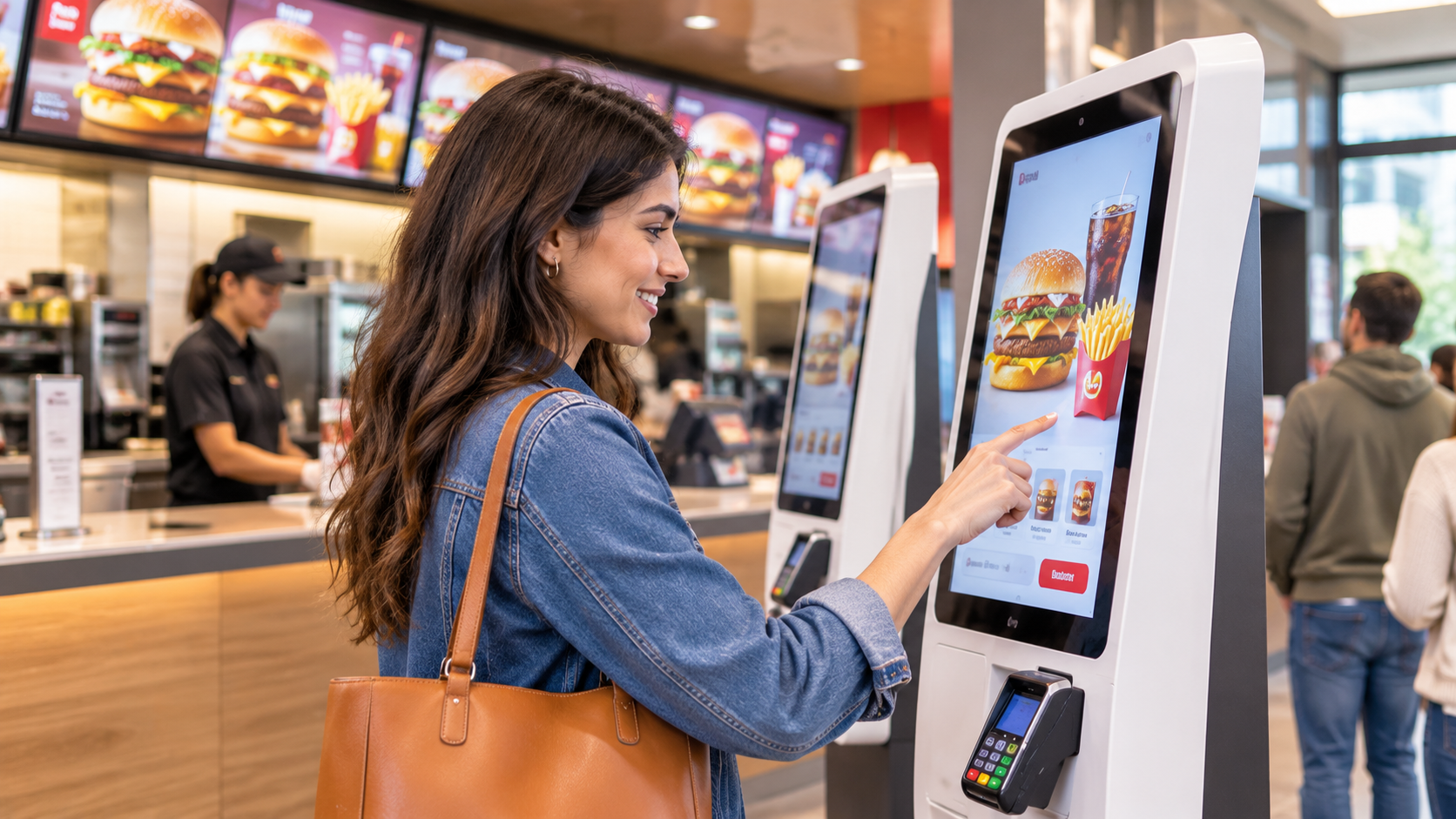
Fast food has always moved quickly. But how customers actually order their food – that part is changing too, and faster than a lot of people expected. Self-service kiosks used to feel like something only the big chains experimented with. Now they’re just kind of everywhere. For anyone running a quick-service restaurant and wondering whether to make the leap, it helps to understand what’s actually driving all of this.
From Cashier Counters to Digital Screens
For a long time, ordering fast food meant standing in line and talking to someone behind a counter. That worked fine for decades. But labour costs have climbed, and customers have gotten used to doing things themselves – booking flights, checking in at airports, buying groceries without speaking to anyone. Fast food was always going to follow.
The major chains moved first, rolling out kiosks across hundreds of locations, and smaller operators are catching up as the hardware gets cheaper. It’s not purely a cost play, either. People’s expectations around service have shifted. Speed and control matter more to a lot of customers than a bit of small talk at the register.
Why Restaurants Are Embracing Kiosks
The labour savings are real, and restaurant owners know it. But that’s not the whole story. When you cut down the time it takes to process an order, your lines move faster – which matters most during a lunch rush when every minute counts. There’s also the upselling angle, and it’s subtler than it sounds. A kiosk can prompt someone to add a larger drink or throw in a side without any of the awkwardness that comes from a staff member asking the same thing out loud. Customers tend to respond better to it.
Order accuracy improves too. A lot of mistakes at the counter come down to miscommunication – someone mishears something, or there’s noise, or the order just gets punched in wrong. A digital order removes most of that. And every order generates data: what’s selling, when the rush hits, how people are customising their meals. That kind of information is hard to collect through a traditional till. Even smaller things, like the rise of tip prompts at the till, are giving owners a practical way to support staff pay without depending on a cash-tipping habit that’s already fading.
What Customers Gain From Self-Ordering
For customers, the obvious win is skipping the line. But there’s more to it. A kiosk lets you take your time – scroll through the menu, check what’s actually in something, swap ingredients without feeling like you’re holding everyone up. For anyone who finds counter ordering a bit stressful, a touchscreen just removes the whole dynamic.
Payment is easier too. Most kiosks handle cards, contactless, mobile wallets. Fewer people are carrying cash these days, and kiosks generally make it simpler to pay the way you actually want to.
Where Fast Food Ordering Is Headed Next
The technology keeps moving. Loyalty programs and mobile apps are being woven into kiosk systems more and more, so customers can earn points, pull up past orders, and reorder without thinking much about it. AI is starting to show up in some systems – recommendations based on what you’ve ordered before or what time of day it is. Whether that lands well with customers probably depends on how obvious it is.
Most chains aren’t replacing staff entirely. The more common model is a mix: kiosks handling the standard orders, employees focused on helping people who need it, fixing problems, and managing anything that falls outside what the screen can handle. That balance seems to work. And kiosks are spreading beyond the dining room too – supporting pickup windows, delivery orders, things that simply weren’t part of the picture a few years ago.
What This Means for Your Business
This isn’t a trend that’s going to quietly reverse itself. Self-service kiosks have changed the way fast food actually runs, from how orders are placed to how staff time gets used to how data flows through the business. For owners thinking about the investment, the case is fairly straightforward: lower costs, fewer errors, and an experience that fits how a lot of customers want to shop and eat. Getting in earlier rather than later probably still matters, while there’s still room to get it right.
READ ALSO: Smart Ways to Use a Business Credit Line Without Overspending