
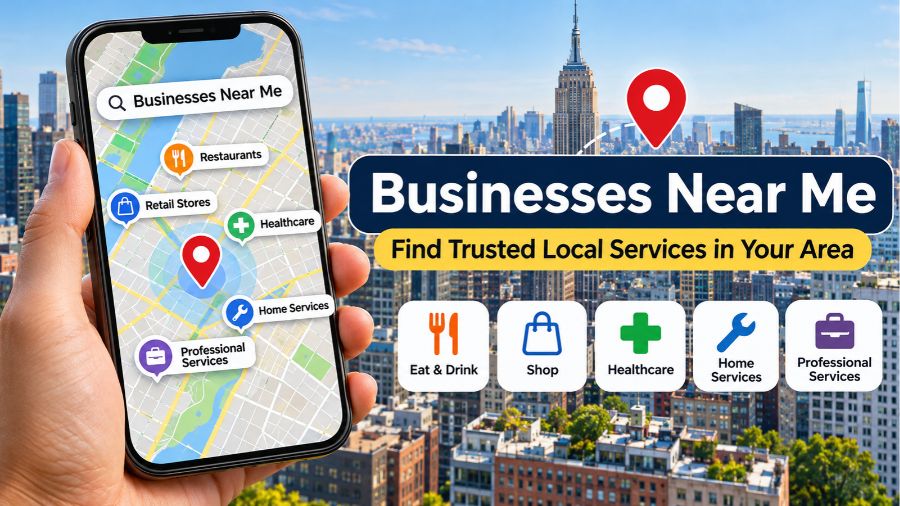
What Does Businesses Near Me Mean?
Businesses Near Me is a location-based search phrase used by people looking for companies and services within a convenient distance of their current location or a selected area. These searches typically have local commercial or transactional intent because users are often preparing to visit a business, request a quotation, make an appointment, or purchase a product. Search engines use available location information and the wording of a query to identify potentially relevant businesses. For example, someone searching for businesses near them in New York City may discover restaurants in Manhattan, healthcare providers in Brooklyn, retail stores in Queens, or professional service companies in the Bronx. Results vary depending on the search platform, location settings, business information, and availability of relevant listings.
Types of Businesses You Can Find Near Your Location
Local business searches cover almost every major industry, making it easier to discover providers for personal, household, and professional requirements. The most useful results depend on the specific service someone needs, the distance they are willing to travel, and whether the business operates from a physical location or serves customers remotely.
Restaurants, Cafes, and Food Businesses
Restaurants, coffee shops, bakeries, takeaway outlets, and catering companies are among the common businesses people search for when exploring nearby options. Location-based searches help customers discover dining establishments, review menus, check opening hours, and compare customer feedback. In a large city such as New York, consumers can explore different dining options across neighborhoods, including Manhattan, Brooklyn, Queens, and Staten Island. Checking recent reviews, available menu information, and reservation requirements can make it easier to choose an establishment that meets personal preferences.
Healthcare and Dental Clinics
Healthcare searches help people identify nearby medical practices, dental clinics, pharmacies, diagnostic centers, and other healthcare providers. These searches can be particularly important when someone needs an appointment or wants to locate a provider offering a particular service. Consumers should verify professional credentials, licensing where applicable, accepted insurance, and treatment availability before choosing a healthcare provider. Online reviews may offer information about customer experiences, but they should not replace professional qualifications or independent medical judgment.
Home Improvement and Repair Services
Home service businesses include plumbing companies, electricians, HVAC technicians, painters, flooring contractors, landscaping providers, cleaning services, and remodeling specialists. These providers help homeowners and property managers maintain, repair, and improve residential or commercial properties. When searching for local contractors, customers should compare service descriptions, insurance coverage, relevant licenses, written estimates, and previous project experience. For larger projects, obtaining multiple quotations can help establish whether proposed prices and work schedules are reasonable.
Retail Stores and Shopping Businesses
Retail businesses include clothing shops, supermarkets, electronics stores, furniture retailers, hardware stores, beauty supply shops, and specialty outlets. Local searches help customers identify nearby stores and determine whether they stock the products they need. Store information may also include opening hours, parking availability, delivery services, and customer reviews. Contacting a retailer before visiting is useful when purchasing specific products that may have limited availability.
Professional and Business Services
Professional service providers include accountants, attorneys, consultants, marketing agencies, insurance brokers, real estate agents, and financial advisers. These businesses support individuals, entrepreneurs, and established organizations with specialized services. Customers should evaluate relevant qualifications, industry experience, service agreements, professional registrations, and pricing arrangements before entering into a business relationship.
How to Find Businesses Near Me Online
Finding local companies has become easier because several digital platforms organize business information around geographical locations. However, different platforms provide different types of information, so using more than one source can help consumers develop a better understanding of their available options.
Google Search and Google Maps
Google Search and Google Maps are widely used tools for discovering local businesses. Users can enter a general phrase such as businesses near me or search for a specific service, such as plumbers near me or restaurants near me. Google can display business profiles containing addresses, phone numbers, opening hours, photographs, customer reviews, and directions when that information is available. Google explains that local search results are influenced mainly by relevance, distance, and prominence. Relevance measures how closely a business matches the search, distance considers its location relative to the searcher, and prominence relates to how well-known the business is. These factors help explain why the closest company does not always appear first.
Online Business Directories
Online business directories provide another way to discover companies by industry, location, or service category. Some directories focus on general business listings, while others specialize in professional services, restaurants, healthcare, or home improvement. These platforms may provide contact details, business descriptions, customer ratings, and other company information. Consumers should check when listings were last updated because outdated addresses, discontinued services, and incorrect phone numbers can make directory information unreliable.
Social Media Platforms
Social media platforms can help users discover independent businesses and local service providers that may have limited visibility through traditional directories. Business pages often contain photographs, service descriptions, customer comments, announcements, and contact information. Recent posts can also provide clues about current operations and customer engagement. However, a social media presence alone does not establish that a company is properly licensed, insured, or professionally qualified.
Business Websites
A company’s official website is often one of the most useful sources for confirming its services and operating details. Websites may explain service areas, pricing structures, business qualifications, project portfolios, contact methods, and appointment procedures. Customers should compare website information with other available records when making important purchasing decisions, particularly when hiring contractors or selecting regulated professional services.
How to Choose Reliable Local Businesses
Finding a nearby company is only the first step. Selecting a dependable provider requires evaluating service quality, transparency, experience, and suitability for the intended requirement. A business with an attractive online profile may not necessarily be the best choice, so consumers should consider several factors before committing to a purchase or agreement.
Check Customer Reviews and Ratings
Customer reviews can provide useful information about communication, punctuality, product quality, pricing transparency, and after-sales support. Reading several recent reviews is generally more informative than relying on a single rating. Consumers should also consider how businesses respond to complaints and whether feedback describes specific experiences. Extremely positive or negative reviews should be assessed carefully because online feedback may not always represent the complete customer experience.
Verify Business Credentials and Licensing
Certain industries require professional qualifications, registrations, permits, or operating licenses. Requirements differ between industries and jurisdictions, so customers should check the relevant government or professional authority before hiring a provider. In New York, for example, official city and state resources can help consumers investigate certain licensed businesses and their registration information. This is particularly important when selecting healthcare providers, contractors, financial professionals, and other regulated service providers.
Compare Prices and Service Quality
Price comparisons can help customers understand the expected cost of a product or service. However, the cheapest quotation is not necessarily the best value. Differences in materials, warranties, labor, service scope, and additional charges can affect the final cost. Requesting written estimates and comparing what each provider includes can help prevent misunderstandings and unexpected expenses.
Confirm Contact Information and Availability
Accurate contact information makes it easier to communicate with a business and arrange appointments. Customers should verify phone numbers, physical addresses, email addresses, and operating hours before visiting. For service providers, it is also important to confirm whether they cover the required neighborhood and whether additional travel or emergency charges apply.
Benefits of Finding Businesses Near Your Location
Local business discovery offers practical advantages for consumers and communities. It can reduce the time needed to identify suitable providers, simplify communication, and create opportunities to support companies operating within the surrounding area. The benefits depend on the type of business, the quality of available information, and the customer’s individual requirements.
Saves Time and Travel
Choosing a conveniently located business can reduce travel time and make appointments, shopping trips, and service visits easier to organize. This is particularly useful when people need frequent services, such as grocery shopping, vehicle maintenance, medical appointments, or household repairs. However, convenience should be balanced against service quality and professional suitability.
Supports Local Businesses
Purchasing products and services from neighborhood companies can help maintain local commercial activity. Independent retailers, restaurants, contractors, and professional service providers contribute to the variety of services available within communities. Choosing a local provider may also create opportunities for more direct communication and ongoing customer relationships.
Makes Comparing Providers Easier
Online search platforms allow customers to examine several businesses without visiting every location individually. Available reviews, photographs, business descriptions, and contact information can help people create a shortlist before making a decision. This improves convenience, although the accuracy and completeness of online information should always be considered.
Improves Access to Specialized Services
Local searches can help people discover providers offering specific products or professional services that may otherwise be difficult to identify. For example, someone looking for a specialist electrician, an emergency plumber, or a particular type of dental treatment can narrow the search using relevant service terms and location details.
Finding Businesses Near Me in New York City
New York City provides a useful example of how location-based business discovery works in a large metropolitan area. The city consists of five boroughs: Manhattan, Brooklyn, Queens, the Bronx, and Staten Island. Each borough contains different neighborhoods, commercial districts, independent retailers, and professional service providers. Searching with a specific borough, neighborhood, or ZIP code can produce more geographically relevant results than using a broad citywide search.
Businesses in Manhattan
Manhattan contains major commercial districts, shopping destinations, restaurants, professional offices, and financial service providers. People searching in this borough may look for retail stores, corporate services, healthcare facilities, hospitality businesses, and professional consultants. Narrowing a search to a particular neighborhood can help identify more convenient options.
Businesses in Brooklyn and Queens
Brooklyn and Queens offer a broad range of neighborhood businesses, including independent shops, restaurants, healthcare practices, home service companies, and professional providers. Consumers can use neighborhood names or ZIP codes to make searches more specific. This can be especially helpful when comparing businesses that serve different parts of these large boroughs.
Businesses in the Bronx and Staten Island
The Bronx and Staten Island also have local retail establishments, restaurants, repair companies, healthcare providers, and professional services. Searching within these boroughs can help residents identify businesses that are easier to reach without unnecessary travel across the city. Customers should confirm service coverage because some companies operate across multiple boroughs while others serve only selected neighborhoods.
Using Official New York Business Resources
New York City provides official resources that can help consumers and business owners investigate certain companies and business-related requirements. The NYC Online Directory of Certified Businesses allows users to search for businesses holding relevant city certifications, including minority-owned, women-owned, locally based, and emerging business enterprise certifications. The New York City business regulations index also provides information about relevant licenses, permits, and regulatory requirements. These resources serve specific purposes and should not be confused with complete directories of every operating business in the city.
Common Mistakes to Avoid When Searching for Local Businesses
Online business discovery is convenient, but inaccurate listings and misleading information can create problems. One common mistake is choosing a provider based entirely on a high star rating without examining the actual reviews or confirming professional qualifications. Another is assuming that a business marked as open online is necessarily accepting customers or appointments at that moment. Listings may contain outdated operating hours, incorrect addresses, or discontinued services. Consumers should also avoid making large advance payments without understanding the agreement, checking the provider’s identity, and reviewing applicable consumer protections. For expensive projects, written quotations, clear payment terms, and documented service expectations are particularly important.
How Businesses Can Improve Their Visibility in Local Searches
Local search visibility is important for companies that depend on customers within a particular geographical area. Business owners can improve the quality of their online presence by maintaining accurate company information, clearly describing their services, and making it easy for potential customers to contact them. Google’s published guidance identifies relevance, distance, and prominence as the main considerations behind local search results, although businesses cannot directly control every ranking factor.
Maintain an Accurate Google Business Profile
A complete and verified Google Business Profile helps customers understand what a company offers and where it operates. Businesses should provide accurate contact details, appropriate categories, operating hours, service descriptions, and relevant photographs. Information should be updated whenever business circumstances change. Accurate details can also reduce customer confusion and unnecessary enquiries.
Build a Consistent Local SEO Strategy
Local search engine optimization involves improving a company’s website and online presence for searches connected to its services and geographical area. Useful practices include creating detailed service pages, publishing relevant location-specific information, maintaining consistent business details, and earning genuine mentions from reputable websites. Content should explain actual services and service areas rather than creating repetitive pages for locations where the business does not operate.
Encourage Genuine Customer Feedback
Customer reviews can help prospective clients evaluate a business before contacting it. Companies should encourage honest feedback through appropriate customer communication and respond professionally to both positive and negative experiences. Reviews should never be fabricated or manipulated because misleading feedback damages consumer trust and may violate platform policies.
Create a Useful Mobile-Friendly Website
Many people search for nearby services using smartphones, making mobile usability important for local businesses. A useful website should load efficiently, display contact details clearly, explain available services, and make appointment or quotation enquiries straightforward. Well-organized service information also helps search engines understand the company’s offerings.
The Future of Local Business Search
Local business discovery continues to evolve as search engines, digital maps, mobile applications, and artificial intelligence tools become more integrated into everyday purchasing decisions. Consumers increasingly expect search platforms to understand detailed requirements, such as finding an emergency repair service, locating a specialist provider, or identifying a business with particular accessibility features. AI-powered search experiences may make it easier to summarize business information and compare available options, but the reliability of those summaries depends on the underlying information. Accurate company profiles, updated websites, authentic customer feedback, and transparent service descriptions will remain important. Businesses that maintain trustworthy digital information are better positioned to help potential customers understand what they offer, regardless of how search technology develops.
Conclusion
Businesses Near Me searches provide a convenient way to discover local companies, compare professional services, and identify suitable providers within a preferred area. Google Search, Google Maps, online directories, social media, and official government resources all offer different ways to investigate local businesses. However, selecting the right provider requires more than checking distance or customer ratings. Verifying credentials, reviewing service details, comparing quotations, and confirming availability can help consumers make informed decisions. For businesses, accurate online information, genuine customer feedback, and useful local content remain important foundations for building visibility and trust in an increasingly digital marketplace.
Also read: Marko Oolo: An Influential Estonian Investor Building Financial Literacy
FAQs
1. How do I find businesses near me?
Use Google Search or Google Maps and enter a business category with your location to discover nearby companies, addresses, reviews, and available contact information.
2. Is Google Maps useful for finding local businesses?
Yes, Google Maps displays business locations, directions, operating hours, photographs, customer reviews, and other available details to help users explore local options.
3. How can I check whether a local business is legitimate?
Verify its registration or professional license where applicable, check its official contact information, examine independent reviews, and confirm its physical or operating address.
4. Can I find businesses near me in New York City?
Yes, search by borough, neighborhood, ZIP code, or service category to discover businesses across Manhattan, Brooklyn, Queens, the Bronx, and Staten Island.
5. Why do different businesses appear in local search results?
Search platforms consider factors such as search relevance, geographical distance, business prominence, available listing information, and the user’s location settings.
6. How can a small business appear in nearby searches?
Small businesses can improve local visibility by maintaining accurate business profiles, collecting genuine reviews, publishing useful local content, and keeping contact information updated.