
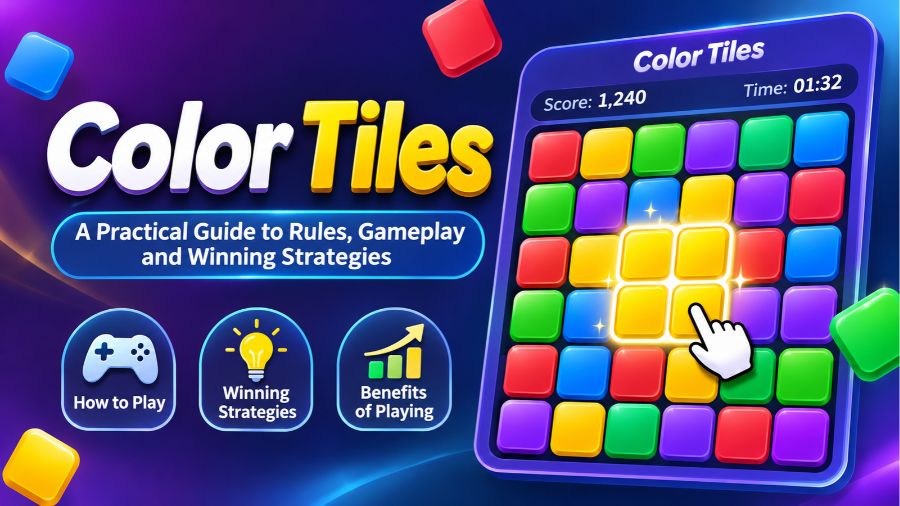
Color Tiles is a popular name associated with colourful puzzle games that challenge players to match, connect, slide, and remove tiles from a playing board. These games combine simple controls with strategic thinking, making them accessible to beginners while offering interesting challenges for experienced puzzle enthusiasts. Whether someone wants to play a colour-matching game in a browser, solve a daily sliding puzzle, or improve their score, understanding the different versions of Color Tiles can make the experience more enjoyable. This guide explores how the games work, their rules, gameplay mechanics, strategies, benefits, and the differences between available online and mobile versions.
What Is Color Tiles?
Color Tiles refers to a category of casual puzzle games built around coloured square tiles arranged on a grid. Although several independently developed games use this name, their central idea is similar: players interact with coloured pieces to complete objectives, clear matching groups, or solve increasingly challenging board layouts. Some versions focus on identifying matching colours in neighbouring positions, while others require players to slide multiple tiles in specific directions to connect groups. The appeal comes from combining visual recognition with logical decisions. Unlike complicated strategy games, most colour tile puzzles can be understood within a few minutes, making them suitable for short gaming sessions on computers, tablets, and smartphones.
How Does the Color Tiles Game Work?
The gameplay depends on the particular version being played, but most variations use a square grid containing coloured pieces and empty spaces. Players interact with the board by clicking, tapping, swiping, or using keyboard controls. The objective may involve removing matching colours, creating groups of connected tiles, or completing a board before running out of moves. Some games introduce fixed obstacles that restrict movement, while others use time limits to increase difficulty. Understanding the rules before making a move is important because different versions calculate matches and rewards differently. Recognising these differences helps players avoid mistakes and develop strategies suited to the actual puzzle.
Matching Colours and Clearing Tiles
In traditional colour-matching versions, players identify neighbouring tiles that share the same colour and remove them according to the game’s matching rules. Certain games allow groups to disappear when enough identical tiles connect, while others check the nearest coloured pieces in horizontal and vertical directions. For example, the Color Tiles HD game published by GameSaien uses a different approach in which players select empty spaces to clear matching neighbouring tiles. Its documented gameplay includes 200 coloured tiles and a 120-second scoring period. These mechanics demonstrate why players should check the instructions of their chosen version instead of assuming every Color Tiles game follows identical rules.
Sliding Tiles Across the Board
Sliding versions introduce another layer of strategy because moving one piece or an entire group can change the arrangement of the board. In some implementations, directional controls move multiple available tiles simultaneously until they encounter another tile, an obstacle, or the board’s edge. Players must predict where pieces will stop and whether their new positions will create a matching group. Some independently developed versions require four or more identical colours to connect before they disappear. Successful moves may also restore movement opportunities, depending on the game’s reward system. This makes planning more important than simply moving tiles randomly.
Different Versions of Color Tiles
One important detail about this keyword is that Color Tiles does not identify a single universal game or publisher. Several browser games and mobile applications use similar names but offer different experiences. For example, GameSaien’s Color Tiles HD uses a timed neighbouring-colour matching mechanic, whereas newer browser-based sliding puzzles focus on connecting groups of matching tiles. Some independent websites also provide daily challenges, multiple difficulty levels, and leaderboard features. Players should check the developer, platform, instructions, and game description before choosing a version. This distinction is particularly important when searching for an official game because an independent website or application should not automatically be considered affiliated with another publisher.
Browser-Based Color Tiles Games
Browser-based Color Tiles games allow players to access puzzle experiences through a compatible web browser without necessarily installing additional software. Depending on the website, the game may offer a timed challenge, a daily puzzle, or a series of increasingly difficult levels. Some versions support keyboard controls, mouse clicks, and touchscreen interactions, allowing people to play on different devices. Independent websites such as ColorTiles.vip and ColorTilesGame.online illustrate the different approaches developers have taken to the same general puzzle concept. However, their rules are not identical, so players should read the instructions displayed on each website before starting.
Mobile Color Tiles Applications
Mobile applications provide another way to enjoy colour-based tile puzzles. One example is Color Tiles HD by GameSaien, available through Google Play. Its gameplay uses a 200-tile board, neighbouring colour matching, and a timed scoring system. Mobile versions can provide touch-friendly controls, saved progress, sound settings, and achievement features depending on the application. However, features vary between developers, and not every game using the Color Tiles name offers the same functionality. Before installing an application, users should review its developer information, compatibility, permissions, advertisements, and recent updates to understand what they are downloading.
Best Strategies for Playing Color Tiles
Improving at Color Tiles requires more than recognising identical colours. Players need to understand how each action affects the remaining board and whether a move creates useful opportunities for future matches. In timed games, quick visual scanning can help identify possible combinations without wasting valuable seconds. In sliding puzzles, the best approach is usually to consider the final position of several tiles before choosing a direction. Players should also pay attention to empty spaces, fixed obstacles, and available moves. Developing a consistent decision-making process helps reduce unnecessary actions and makes difficult levels easier to approach.
Study the Entire Board Before Moving
Looking at the complete board before selecting a move can reveal opportunities that are difficult to notice when focusing on individual tiles. Players should identify matching colours, empty spaces, blocked positions, and possible movement routes. In a sliding puzzle, a direction that initially appears unhelpful might bring several identical tiles together. In a timed matching game, checking multiple directions can reveal a combination that removes more than one tile. Taking a brief moment to understand the layout can prevent mistakes and help players make more effective decisions throughout the game.
Prioritise Larger Matching Groups
When a particular version rewards larger matching groups, creating bigger combinations can be more useful than immediately clearing the smallest available match. A group of connected tiles may open additional spaces and create opportunities for subsequent moves. However, the reward system matters. If a game provides the same movement bonus regardless of the number of tiles removed, waiting for a larger group may not always be worthwhile. Players should understand how points, moves, and bonuses are calculated before deciding which combinations deserve priority. This approach makes strategy more effective and prevents unnecessary delays.
Use Obstacles to Your Advantage
Some sliding puzzle versions include fixed obstacles that cannot be moved or removed. Rather than treating these positions as entirely negative, players can use them as boundaries that influence how other tiles travel across the board. Obstacles may help create organised groups or prevent pieces from moving into unwanted positions. Understanding the available movement space is particularly important when a board becomes crowded. A successful strategy involves using the layout to guide matching colours into useful positions while avoiding moves that separate pieces needed for a future combination.
Benefits of Playing Color Tiles
Colour-based puzzle games provide an accessible form of entertainment that combines visual interaction with logical problem-solving. Players regularly identify patterns, compare positions, remember previous moves, and consider the possible consequences of their decisions. These activities make the games engaging for people who enjoy short mental challenges. They can also provide a relaxing alternative to more demanding entertainment because the basic controls are generally easy to understand. However, enjoying a puzzle game should not be confused with receiving a proven medical or cognitive benefit. The experience is best understood as recreational mental activity rather than a guaranteed method of improving intelligence, memory, or concentration.
Pattern Recognition and Logical Thinking
Recognising repeated colours and identifying possible combinations are central parts of Color Tiles gameplay. Players need to compare different positions and determine which arrangement can produce a successful match. Sliding puzzles add another reasoning challenge because a move can affect several pieces simultaneously. This encourages players to consider possible outcomes instead of relying entirely on immediate reactions. Repeated exposure to these mechanics provides opportunities to practise visual pattern recognition and logical decision-making within the game itself.
Entertainment During Short Breaks
Many Color Tiles games are designed around short sessions, making them convenient for people who want entertainment without committing to a lengthy gaming experience. Timed modes provide a quick challenge, while daily puzzles offer a structured activity that can be completed whenever convenient. Browser-based versions are particularly accessible because some can be played without creating an account or downloading an application. Nevertheless, availability and advertising policies depend on the individual platform. Players should choose reputable websites and take breaks when gaming begins to interfere with other activities.
Challenges and Limitations of Color Tiles Games
Despite their straightforward design, colour tile puzzles can become challenging when boards contain multiple colours, restricted movement routes, or limited opportunities. A seemingly simple action can create an arrangement that makes future combinations difficult. Timed versions add pressure because players must balance accuracy with speed. Another limitation is that the same search term can lead to several unrelated games, creating confusion about rules and official availability. Some browser versions may also contain advertisements, require an internet connection, or have limited mobile compatibility. Understanding these limitations helps players select an appropriate version and avoid unrealistic expectations.
Why Some Levels Become Difficult
Difficulty often increases when the board contains more colours, larger layouts, and fixed obstacles. Players may have fewer opportunities to connect identical tiles, especially when useful pieces are separated by other colours or blocked positions. Limited moves can make these situations more demanding because every unsuccessful action reduces the remaining opportunities to complete the level. The best response is to slow down, examine the board, and identify how different movements affect the available combinations. Random actions may occasionally produce a successful result, but deliberate planning is generally more reliable.
Accessibility and Colour Recognition
Because these games depend heavily on distinguishing colours, some versions may be difficult for players with colour vision deficiencies. Similar shades can become harder to recognise when tiles are displayed close together or under different screen conditions. Developers can improve accessibility by including symbols, patterns, numbers, or alternative visual indicators alongside colours. Some implementations already provide additional markings or colour-blind-friendly settings. Players should check the available accessibility options and adjust display brightness or screen settings when necessary. These features can make colour-based puzzles easier to understand without changing their central gameplay mechanics.
How to Choose a Safe Color Tiles Game Online
Choosing a reliable platform is important when searching for Color Tiles online. Since multiple independent websites use similar names, players should verify the website address and check whether the developer provides clear information about the game’s ownership and rules. A legitimate-looking game page does not automatically establish a connection with Google or another well-known company. Users should also avoid downloading unfamiliar files, sharing unnecessary personal information, or granting unrelated browser permissions simply to access a puzzle. For mobile applications, reviewing the official app-store listing and developer details can help users make more informed installation decisions.
The Future of Colour-Matching Puzzle Games
Colour-based tile puzzles remain part of a broader casual gaming category that continues to offer opportunities for experimentation. Developers can introduce new board layouts, daily challenges, progressive difficulty, improved touch controls, and alternative matching systems without making the basic concept difficult to understand. Accessibility features can also make these experiences more inclusive by allowing players to distinguish tiles through shapes or symbols instead of colour alone. Browser technology and mobile gaming provide different ways to distribute these experiences, although individual developers determine which features their products support. The future direction of Color Tiles will therefore depend on the creativity, technical decisions, and audiences of the developers creating individual versions.
Conclusion
Color Tiles represents an accessible and engaging collection of colour-based puzzle experiences built around matching, sliding, and clearing tiles. Although different versions use different rules, they share an emphasis on visual recognition, logical decisions, and thoughtful gameplay. Understanding the mechanics of a particular version is essential for developing effective strategies and avoiding unnecessary mistakes. From timed browser challenges to mobile applications and daily sliding puzzles, players have several ways to explore this style of entertainment. Choosing a clearly identified, reliable version and approaching each board with a little planning can make the experience more enjoyable and rewarding.
Also read: Classroom Center: Features, Online Games, Chromebook Access and Safety Guide
FAQs
1. What is Color Tiles?
Color Tiles is a casual puzzle game concept in which players match, connect, or remove coloured pieces to complete different board-based challenges.
2. Is Color Tiles free to play?
Many browser-based Color Tiles games are free to access, although individual websites and mobile applications may include advertisements or optional purchases.
3. Can I play Color Tiles on mobile?
Yes, many versions support mobile browsers or dedicated applications, allowing players to interact with coloured tiles using touchscreen controls.
4. Does Color Tiles have the same rules everywhere?
No, different developers create different versions. Some use timed matching mechanics, while others feature sliding tiles, connected groups, and limited moves.
5. Is Color Tiles an official Google game?
Not every website using this name is affiliated with Google. Players should verify the publisher and avoid assuming independent versions are official products.
6. How can I improve my Color Tiles score?
Study the board, identify matching colours, avoid unnecessary moves, and prioritise combinations that create useful opportunities for subsequent actions.