Imagine a week with nothing worth dressing up for: a morning at the office, an afternoon working from home, a neighborhood dinner, a few errands between appointments. A pair of tailored pants hangs untouched through all of it, waiting for an invitation impressive enough to justify wearing it. The problem may not be excessive formality. It may be that the pants were chosen for an occasion rather than for the life that happens between occasions.
Start With the Days You Actually Dress For
Consider a hypothetical man whose calendar alternates between desk work and short visits to clients. He likes the idea of dressing more thoughtfully, but his most frequent destination is a chair, not a reception. His starting point should be those ordinary hours. What does he wear in the morning when he has five minutes to get ready? Which shirts come back from the laundry and go straight into rotation? These habits are more informative than an aspirational photograph.
The point of looking at a week is not to assign a different outfit to every day. It is to identify the conditions that keep returning. Perhaps he spends long stretches seated, takes a brisk walk at lunch, and leaves his jacket at the office. Pants chosen around those circumstances need to make sense without a matching coat. They also need to feel acceptable when he has stopped thinking about how he looks.
There will be days outside that range. A formal celebration may call for something else, and a dirty household project certainly might. Letting one pair have limits makes the decision easier. Instead of asking whether it can travel everywhere, ask whether it has a convincing place in the part of the week that currently sends you back to the same familiar clothes. Frequency, here, matters more than imagined versatility.
Let Your Everyday Shoes Set the Direction
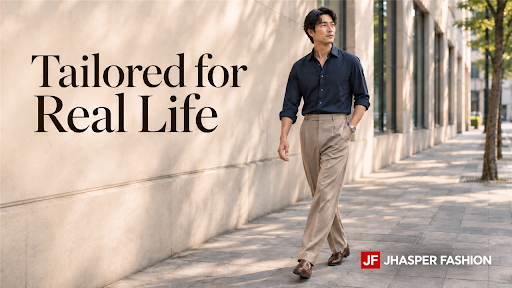
Shoes bring that imagined week into focus. The loafers you actually walk in are a better reference than dress shoes you tolerate for an hour. Their shape and visual weight affect how the bottom of the pants looks: a narrow opening can sit awkwardly against a substantial shoe, while extra fabric may gather differently over a lower profile. These are relationships to examine together, not reasons to prescribe one hem width to everyone.
Bring the shoes into the conversation before the length is settled. A tailor can see where the fabric meets them and discuss the amount of break, meaning the fold that forms as the hem touches the shoe. A still photograph might suggest one preference; watching the pants move as you walk may suggest another. Neither a completely clean line nor a deeper fold is automatically the right answer for an ordinary working week.
The rest of the wardrobe deserves the same honesty. If the shirts you reach for are soft and casually worn, pants with a strongly ceremonial character may remain difficult to use. That does not require abandoning tailored clothing. It means considering the whole impression before choosing details in isolation. A small selection of familiar clothes can reveal more than a long list of theoretical combinations, especially when those clothes have already earned their place in your routine.
Choose Comfort You Can Live With
Comfort is easiest to describe through a particular moment. A waistband that feels unobtrusive while standing may feel different after lunch at a desk. A pocket that looks neat when empty may be less agreeable with your usual keys inside. During a fitting, explain those ordinary circumstances instead of treating discomfort as the unavoidable cost of a cleaner silhouette. Sit normally, then stand and notice what you feel rather than immediately correcting the fabric with your hands.
Room is part of that conversation, but simply asking for everything to be looser may miss the issue. Pressure at the waist and resistance through the upper leg are different sensations. A tailor needs to know where movement becomes distracting, as well as what shape you enjoy seeing in the mirror. You do not need the vocabulary of pattern cutting to say that the pants feel comfortable standing but restrictive when you settle into a chair.
Fabric should enter the discussion with those needs already established. Fiber names alone cannot settle questions of warmth, durability, or care; the particular cloth and the way the garment is made matter too. Handle the options, ask about their intended use, and consider the care each requires. An attractive pair that demands a routine you will not maintain is unlikely to become an everyday choice, however appealing it looked on the first visit.
Turn a Week of Habits Into a Tailoring Brief
By now the brief can be modest and specific: pants for seated work, short walks, familiar loafers, and shirts you already wear, with enough room to move without a silhouette you find shapeless. Bring the shoes and, if practical, one representative shirt. Describe the week in plain language, including where the pants will not be used. That gives the discussion boundaries rather than leaving the tailor to interpret the word versatile on your behalf.
A conversation with a custom menswear provider such as Jhasper Fashion can then center on those pants and their intended use, rather than an abstract wardrobe overhaul. The useful material is already yours: recurring appointments, preferred shoes, hours spent sitting. You can talk about a tailored garment without presenting yourself as a more formal dresser than you are.
The eventual test comes on a morning without an event attached to it. Do you reach for the pants because they fit the day, or do you put them back until something special happens? A successful choice need not transform your whole wardrobe. It can simply close the distance between clothing you admire and clothing you use, giving one ordinary part of the week a little more consideration without turning it into an occasion.