
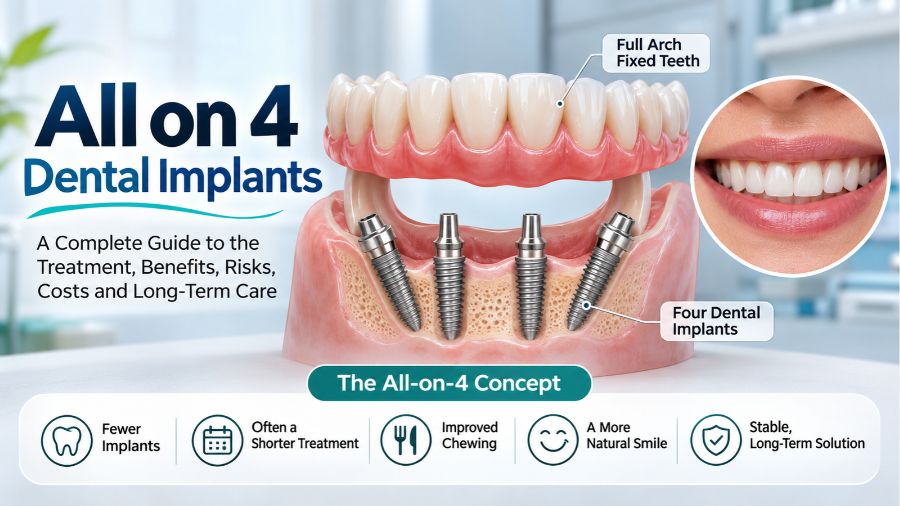
All on 4 Dental Implants offer an advanced solution for people who have lost most or all of their natural teeth and want a fixed, natural-looking replacement. This treatment uses four strategically positioned dental implants to support a complete arch of artificial teeth, potentially reducing the need for extensive bone grafting and multiple individual implants. It has become an important option in modern restorative dentistry because it can improve chewing function, appearance and everyday comfort. Understanding how the procedure works, who qualifies, its advantages, potential complications, recovery process and long-term costs can help patients make informed decisions about full-mouth tooth replacement.
What Are All on 4 Dental Implants?
All on 4 Dental Implants are a full-arch tooth replacement technique in which four titanium dental implants support a complete set of fixed replacement teeth in either the upper or lower jaw. Unlike traditional dentures, which rest on the gums and can move during eating or speaking, this restoration is secured to implants placed inside the jawbone. The treatment generally uses two implants positioned vertically near the front of the jaw and two posterior implants placed at an angle to maximize the use of available bone. A fixed dental bridge connects the implants and replaces the missing teeth. The approach is particularly relevant for patients who have extensive tooth loss, advanced dental damage or insufficient bone in certain areas for conventional implant placement. However, the number and positioning of implants must be determined through individual clinical assessment rather than following a fixed formula for every patient.
How Does the All on 4 Dental Implant Procedure Work?
The All-on-4 procedure combines surgical implant placement with carefully planned prosthetic rehabilitation. It begins with an examination of the patient’s teeth, gums, bite and jawbone, followed by imaging to assess bone volume and important anatomical structures. If the patient qualifies, the dentist develops a surgical and restoration plan that determines implant positions, the design of the replacement teeth and the expected treatment timeline. During surgery, any teeth that cannot be preserved may be removed before the implants are placed. The four implants are positioned to provide support across the dental arch, with the posterior implants often angled to improve their distribution. In suitable cases, a temporary fixed bridge can be attached on the day of surgery or shortly afterward. The implants then undergo osseointegration, a biological process in which bone gradually bonds with their surfaces. Once healing and stability have been assessed, the temporary restoration can be replaced with the definitive prosthesis.
Why Are Two Posterior Implants Angled?
The angled placement of the two rear implants is one of the defining characteristics of the All-on-4 approach. This positioning can help avoid anatomical structures such as the maxillary sinuses in the upper jaw and the inferior alveolar nerve in the lower jaw. It can also increase the anterior-posterior spread of implant support and reduce the length of the unsupported portion of the dental bridge, known as the cantilever. By making better use of available bone, this configuration may reduce the need for certain bone augmentation procedures. Nevertheless, implant angulation must be planned carefully to ensure appropriate mechanical support, prosthetic access and long-term function.
What Is Immediate Loading?
Immediate loading refers to attaching a temporary dental restoration to newly placed implants within a short period, sometimes on the same day as surgery. It can allow suitable patients to leave the clinic with fixed provisional teeth rather than waiting several months without a fixed restoration. However, immediate loading is not appropriate in every case. The implants must achieve sufficient primary stability, and the patient’s bone quality, medical circumstances, bite forces and surgical conditions must support the approach. Patients who do not meet these requirements may need a delayed-loading protocol to protect the implants during healing.
Who Is a Suitable Candidate for All on 4 Dental Implants?
All on 4 Dental Implants may be appropriate for adults who have lost most or all of their teeth, have severely damaged teeth that cannot reasonably be restored, or experience significant difficulties with conventional removable dentures. Patients with advanced periodontal disease may also be considered after the infection and gum condition have been properly assessed and managed. Another important group includes individuals with reduced bone volume in the posterior jaw who may benefit from strategically angled implants. However, having missing teeth alone does not automatically make someone eligible. The dentist must evaluate the available bone, gum health, oral hygiene, bite alignment and general medical history. Conditions such as uncontrolled diabetes, active gum infections, heavy smoking and certain medications can increase treatment risks or affect healing. Patients with a history of teeth grinding may also require additional protective measures. A comprehensive assessment helps determine whether All-on-4, another implant-supported restoration or conventional dentures would provide the most appropriate result.
Key Benefits of All on 4 Dental Implants
One of the main advantages of All on 4 Dental Implants is that four strategically positioned implants can support an entire fixed dental arch, avoiding the need to place an individual implant for every missing tooth. The fixed restoration can provide improved stability compared with conventional removable dentures, particularly during eating and speaking. The angled posterior implants may make it possible to use existing bone more efficiently and reduce the need for extensive grafting in selected patients. Another potential benefit is the shorter overall treatment pathway when immediate loading is clinically appropriate. The replacement teeth can also be designed to improve smile appearance, tooth proportions and lip support. Because the restoration is attached to implants rather than relying entirely on the gums, patients may experience greater confidence during everyday activities. However, these benefits depend on suitable patient selection, accurate surgical planning, high-quality prosthetic work and consistent maintenance. The treatment should be viewed as a long-term rehabilitation commitment rather than a one-time cosmetic procedure.
All on 4 vs All on 6 Dental Implants
All-on-4 and All-on-6 are two approaches to replacing an entire dental arch with an implant-supported fixed restoration. The main difference is the number of implants used to support the replacement teeth. All-on-4 uses four implants, while All-on-6 uses six, potentially providing additional support and allowing implant forces to be distributed across more points. All-on-4 may be attractive when anatomical conditions favour a four-implant configuration or when avoiding additional surgical procedures is important. All-on-6 may be considered when sufficient bone is available and the treatment plan benefits from additional implant support. Research comparing the approaches has reported broadly similar implant survival outcomes in many study populations, although results vary according to follow-up periods, implant positioning, prosthetic design and patient characteristics. A 2026 systematic review and meta-analysis of 55 studies also reported comparable overall outcomes, while highlighting the limitations created by differences between studies. The choice should therefore depend on clinical findings rather than assuming that more implants always produce a better result.
Materials Used for All on 4 Dental Implant Restorations
The material used for the final dental bridge affects its appearance, durability, maintenance requirements and overall treatment cost. The restoration generally includes a supporting framework or implant connection system combined with artificial teeth and surrounding gum-coloured material where necessary. Acrylic teeth attached to a metal framework are commonly used in provisional and definitive restorations because they can offer a practical balance between weight, repairability and cost. Porcelain-fused-to-metal and zirconia restorations are other options, depending on the patient’s requirements and the dentist’s prosthetic plan. Monolithic zirconia is valued for its strength and natural-looking appearance, although its design and opposing tooth contact require careful consideration. Material selection should account for bite forces, available restorative space, aesthetic expectations, ease of cleaning and the possibility of future repairs. Patients should also ask whether the quoted treatment includes the temporary bridge, definitive prosthesis and any future maintenance.
Risks and Possible Complications of All on 4 Dental Implants
Although All-on-4 is an established implant rehabilitation approach, it involves surgery and carries biological and mechanical risks. Implant failure can occur when an implant does not integrate properly with the surrounding bone or loses stability later. Infection, inflammation and peri-implantitis may develop around implants, potentially causing progressive bone loss if not managed. Mechanical problems can include loose prosthetic screws, fractured artificial teeth, damaged veneering material and breakage of the supporting restoration. Some patients may experience temporary swelling, bruising, discomfort or changes in speech following surgery. Nerve injury and sinus-related complications are less common but important surgical considerations, particularly when implant placement is close to sensitive anatomical structures. The likelihood of complications varies with medical history, oral hygiene, smoking habits, bone conditions, implant positioning and prosthetic design. Careful treatment planning, appropriate surgical techniques and regular professional monitoring can help reduce avoidable risks, although no implant treatment guarantees permanent success.
Implant Failure and Osseointegration Problems
Osseointegration is the process through which the jawbone bonds with the surface of a dental implant, creating the stability required to support replacement teeth. If this biological connection does not develop adequately, the implant may become mobile or fail to integrate. Factors such as poor bone quality, excessive loading during healing, infection, smoking and certain medical conditions can contribute to unsuccessful integration. If an implant fails, the dentist must investigate the underlying cause before considering replacement or an alternative restoration plan. Treatment may involve allowing the area to heal, managing infection or reassessing the available bone.
Peri-Implantitis and Bone Loss
Peri-implantitis is an inflammatory condition affecting the tissues surrounding a dental implant and is associated with progressive loss of supporting bone. It can develop when bacterial plaque accumulates around implants, particularly when cleaning is inadequate or previous periodontal disease increases the patient’s risk. Early inflammation may be manageable, but advanced disease can threaten implant stability. Regular examinations, professional cleaning and effective home care are essential for detecting problems before they become more serious. Patients should seek professional advice if they notice bleeding, swelling, persistent discomfort or changes around their implant-supported teeth.
Prosthetic Damage and Maintenance Issues
The artificial teeth and supporting components of an All-on-4 restoration experience repeated forces during chewing and speaking. Over time, these forces can contribute to tooth wear, material fractures, screw loosening or damage to the supporting framework. Teeth grinding and an unbalanced bite may increase mechanical stress. Some problems can be repaired without replacing the entire restoration, but the cause should be identified to prevent repeated damage. A properly designed prosthesis, appropriate bite adjustments and regular dental reviews are important for long-term performance.
Recovery and Healing After All on 4 Dental Implant Surgery
Recovery after All-on-4 surgery varies according to the number of extractions, surgical complexity, implant stability and individual healing response. Swelling, bruising, mild bleeding and discomfort are common during the initial recovery period, although their severity differs between patients. The dental team may recommend prescribed medication, a soft-food diet and specific oral hygiene instructions during early healing. Patients who receive immediate temporary teeth must avoid placing excessive pressure on the implants while osseointegration takes place. This usually means avoiding hard, sticky or difficult-to-chew foods and following the clinician’s recommended dietary restrictions. The healing process commonly takes several months before the final restoration is fitted, although the exact timeline depends on clinical progress. Follow-up appointments allow the dentist to assess the gums, implants, bite and temporary restoration. Increasing pain, persistent bleeding, fever, unusual discharge or significant swelling should be reported promptly rather than treated as normal recovery symptoms.
How to Maintain All on 4 Dental Implants Long Term
Long-term success depends on more than the original surgery because implant-supported teeth require ongoing cleaning and professional supervision. Patients should brush at least twice daily using an appropriate toothbrush and clean carefully beneath the bridge with suitable floss, interdental brushes or a water irrigator. The area where the restoration meets the gums deserves particular attention because food debris and bacterial plaque can collect around the supporting components. Professional implant maintenance appointments should be scheduled according to individual risk, often at intervals of two to six months. During these visits, the dental team can assess gum health, implant stability, bite conditions and the integrity of the prosthesis. Patients with previous periodontal disease, smoking habits or other risk factors may need more frequent monitoring. The restoration may also require occasional adjustments or repairs as materials experience normal wear. Consistent home care and regular clinical reviews help protect the supporting tissues and maintain comfortable function over time.
What Affects the Cost of All on 4 Dental Implants?
The cost of All on 4 Dental Implants varies considerably between countries, dental clinics and individual treatment plans. The final price depends on the implant system, surgical complexity, prosthetic materials and the experience of the clinical team. Additional expenses may arise from extracting damaged teeth, treating gum disease, obtaining CBCT scans, providing sedation or performing necessary bone grafting. The type of temporary and permanent restoration also makes a difference, with different framework and tooth materials carrying different costs. Patients considering treatment in Pakistan or abroad should request a written quotation that clearly explains what is included. It is important to establish whether the price covers four implants, abutments, temporary teeth, the final bridge, follow-up appointments and any necessary repairs. A lower initial quotation may not represent better value if essential treatment stages or aftercare are excluded. Comparing complete treatment plans is more useful than choosing a clinic based only on its advertised starting price.
Is All on 4 Better Than Traditional Dentures?
All-on-4 and traditional dentures serve the same broad purpose of replacing missing teeth, but they work in different ways. Conventional dentures rest on the gums and can be removed for cleaning, while All-on-4 restorations are fixed to implants and remain in the mouth during everyday activities. Implant-supported teeth may provide greater stability and chewing confidence for suitable patients, particularly those who struggle with loose lower dentures. However, traditional dentures do not require implant surgery and may be more accessible for people who cannot undergo surgical treatment or prefer a non-surgical option. They can also be easier to modify when changes occur in the gums or jawbone. All-on-4 requires adequate surgical planning, ongoing implant maintenance and a greater initial financial commitment. The best option depends on oral health, medical circumstances, personal preferences and long-term expectations. A dental professional can explain the benefits and limitations of both approaches before treatment begins.
Future Developments in Full-Arch Dental Implant Treatment
Full-arch implant dentistry continues to evolve through improvements in digital planning, imaging, surgical guides and restorative materials. Three-dimensional imaging allows clinicians to examine jaw anatomy and plan implant positions with greater detail before surgery. Digital impressions and computer-aided design and manufacturing can help produce accurately fitted temporary and permanent restorations. Guided implant surgery may also assist with transferring a digital treatment plan into the clinical setting, although its advantages depend on case selection and the accuracy of the entire workflow. Developments in zirconia and other restorative materials are expanding options for patients who require durable and aesthetically pleasing fixed teeth. Research is also examining how implant number, positioning, loading protocols and maintenance influence long-term outcomes. These developments may improve treatment planning and patient care, but they do not eliminate the need for clinical judgment. Individual anatomy, biological healing and prosthetic requirements will continue to determine which treatment approach is most appropriate.
Conclusion
All on 4 Dental Implants provide an established option for replacing an entire upper or lower arch with fixed, implant-supported teeth. By using four strategically positioned implants, the approach can restore chewing function and dental appearance while potentially reducing the need for extensive bone augmentation in selected patients. However, successful treatment requires careful assessment, suitable implant positioning, appropriate prosthetic materials and realistic expectations about healing and maintenance. All-on-4 is not automatically the best choice for every patient, and alternatives such as All-on-6, conventional implants and removable dentures should also be considered. Understanding the benefits, limitations, costs and possible complications helps patients approach full-arch dental rehabilitation with better knowledge and make decisions based on their individual oral health needs.
Also read: DC Metro Map: Complete Guide to Washington DC Metro Lines, Stations and Routes
FAQs
1. How long do All on 4 Dental Implants last?
All-on-4 implants can function for many years, but their longevity depends on bone health, oral hygiene, smoking habits, prosthetic maintenance and regular professional examinations.
2. Can you get permanent teeth on the same day as All-on-4 surgery?
Some suitable patients receive temporary fixed teeth on surgery day, but the definitive restoration is usually fitted after sufficient healing and implant integration.
3. Is the All-on-4 dental implant procedure painful?
The procedure is performed with anaesthesia, so surgical discomfort is controlled during treatment. Swelling and soreness can occur afterward and are generally manageable with prescribed care.
4. Can people with bone loss receive All-on-4 dental implants?
Some patients with reduced jawbone volume qualify because angled implants use available bone strategically, although advanced bone loss may require additional procedures or alternative treatment.
5. What foods should you avoid after All-on-4 implant surgery?
Patients generally need to avoid hard, crunchy and sticky foods during early healing, following their dentist’s instructions before gradually returning to normal eating.
6. Do All-on-4 dental implants require special cleaning?
Yes, patients must clean beneath the fixed bridge using appropriate brushes, floss or water irrigators and attend regular professional maintenance appointments.