
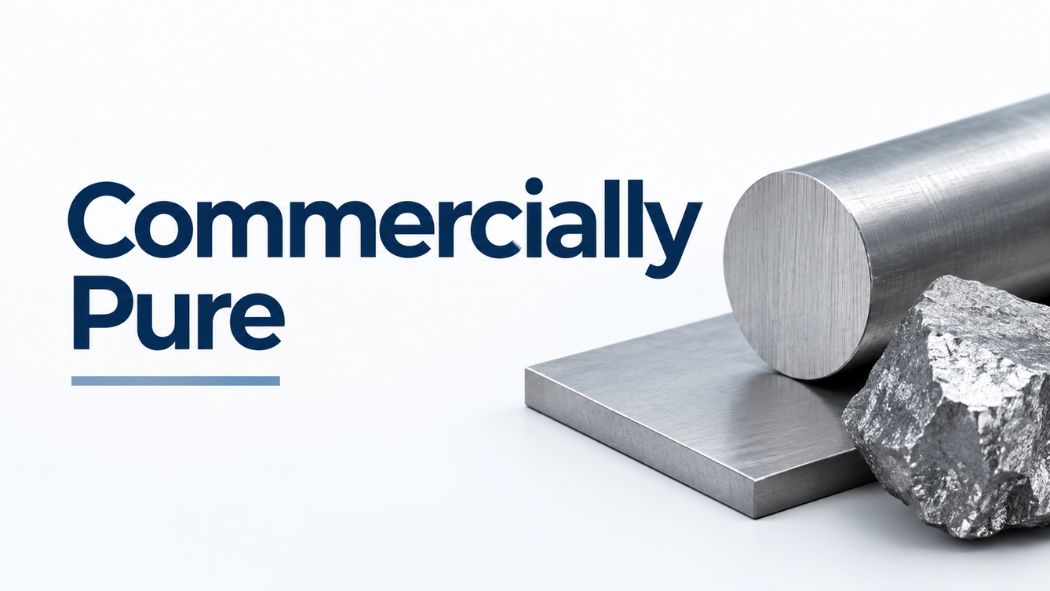
Commercially Pure refers to a material that has been refined to a high level of purity while still containing small amounts of naturally occurring or controlled impurities. The term is widely used in metallurgy, manufacturing, engineering, and materials science, especially when discussing metals such as titanium, aluminum, copper, and magnesium.
The phrase can sometimes be misunderstood because commercially pure does not mean that a material is completely free from other elements. Instead, it indicates that the material meets an established commercial specification for purity and composition. The remaining elements are normally present in limited quantities and may even influence important properties such as strength, hardness, ductility, and corrosion resistance.
Understanding what commercially pure means is useful when selecting materials for industrial, medical, construction, or manufacturing applications. The right grade can make a significant difference in performance, durability, cost, and ease of processing.
What Does Commercially Pure Mean?
Commercially pure describes a material that contains a very high percentage of its primary element without being intentionally alloyed with large amounts of other elements. Small quantities of impurities or residual elements can still be present, but they remain within defined limits established by relevant material standards.
For example, commercially pure titanium contains mostly titanium along with controlled amounts of elements such as oxygen, iron, carbon, nitrogen, and hydrogen. These elements may occur naturally during processing or be deliberately controlled because they influence the final characteristics of the metal.
The exact meaning of commercially pure depends on the material being discussed. A commercially pure titanium grade has different composition limits from commercially pure aluminum or commercially pure magnesium. Therefore, the term should always be considered together with the specific grade and applicable material standard.
Properties of Commercially Pure Materials
One of the most important characteristics of commercially pure materials is their relatively simple chemical composition. Because they contain little or none of the alloying additions found in conventional alloys, their behavior can be easier to understand and predict within their intended applications.
Commercially pure materials can also offer useful combinations of corrosion resistance, ductility, formability, thermal properties, or electrical conductivity. However, their performance is not automatically superior to that of alloys. In many applications, alloys are specifically designed to provide greater strength, wear resistance, heat resistance, or other specialized characteristics.
The properties also vary significantly between grades. For instance, different commercially pure titanium grades can have different levels of strength and ductility because of controlled differences in elements such as oxygen and iron. This is why engineers generally select a specific grade rather than simply specifying a material as commercially pure.
Commercially Pure Titanium Grades
Commercially pure titanium is one of the best-known examples of this material classification. CP titanium is commonly divided into Grades 1, 2, 3, and 4, with each grade offering a different balance of strength, ductility, and formability.
Grade 1 is generally the softest and most ductile of the commercially pure titanium grades. Its high formability makes it suitable for applications where shaping is important. Grade 2 provides a useful balance of strength, corrosion resistance, and formability and is widely used for general industrial applications.
Grade 3 offers greater strength than Grade 2, while Grade 4 provides the highest strength among the commonly recognized commercially pure titanium grades. The choice between these grades depends on factors such as mechanical loading, manufacturing requirements, corrosion conditions, and the desired level of formability.
Commercially Pure vs Alloyed Materials
The main difference between commercially pure and alloyed materials is the amount and purpose of additional elements. In a commercially pure material, the primary element makes up most of the composition, while the remaining elements are generally present in relatively small and controlled quantities.
An alloy, on the other hand, is intentionally produced by combining the base metal with significant quantities of one or more additional elements. These alloying elements are introduced to modify properties such as strength, hardness, toughness, heat resistance, or corrosion behavior.
Commercially pure titanium provides a useful example. Ti-6Al-4V, commonly known as Grade 5 titanium, contains aluminum and vanadium as intentional alloying elements. It therefore has substantially different mechanical characteristics from commercially pure titanium and is selected for applications where higher strength is required.
Common Applications of Commercially Pure Materials
Commercially pure materials are used in many industries because their particular combination of properties can make them practical for demanding environments. Commercially pure titanium, for example, is valued for its corrosion resistance and relatively low density compared with many structural metals.
Titanium grades are used in equipment exposed to corrosive environments, chemical processing systems, heat exchangers, marine applications, and certain medical products. Their resistance to many forms of corrosion makes them particularly useful when long service life is important.
Other commercially pure metals also have specialized applications. Commercially pure aluminum is commonly used where low weight, corrosion resistance, and good electrical or thermal conductivity are important. Commercially pure copper is valued for its excellent electrical and thermal conductivity, making it useful in electrical and industrial applications.
Advantages and Limitations of Commercially Pure Materials
A major advantage of commercially pure materials is that they can provide predictable properties without the complexity associated with heavily alloyed compositions. Depending on the material, they may also offer excellent corrosion resistance, good ductility, or strong electrical and thermal performance.
Commercially pure titanium is particularly useful when corrosion resistance and formability are more important than maximum mechanical strength. It can perform effectively in environments where other metals may experience significant corrosion, which can help reduce maintenance requirements over the service life of a component.
There are also limitations to consider. Commercially pure materials are not always the strongest option available, and an engineered alloy may perform better when high mechanical loads, elevated temperatures, or severe wear are involved. Material selection should therefore be based on the actual operating conditions rather than the word “pure” alone.
How to Choose the Right Commercially Pure Grade
Choosing a commercially pure material starts with understanding the requirements of the application. Engineers typically consider operating temperature, mechanical loads, corrosion exposure, manufacturing method, expected service life, and applicable industry standards before selecting a grade.
For titanium, the required balance between strength and ductility is particularly important. A highly formable Grade 1 material may be appropriate for one application, while Grade 4 may be selected when greater strength is required. Grade 2 is often considered when a balanced set of properties is needed.
Cost and availability also matter. A technically suitable grade may not be the most practical choice if it is difficult to source or requires an unnecessarily expensive manufacturing process. Comparing material specifications, certification requirements, and supplier availability helps ensure that the selected commercially pure grade is appropriate for both performance and budget.
Why Material Standards Matter
Material standards are important because they establish measurable requirements for chemical composition, mechanical properties, dimensions, testing, and other characteristics. Without standardized specifications, the term commercially pure could be interpreted too broadly and create uncertainty for manufacturers and buyers.
When purchasing commercially pure metal, buyers should identify the exact grade and applicable standard rather than relying only on a general description. Certification and material test reports can also help confirm that the supplied material meets the required specification.
This is especially important for aerospace, medical, chemical processing, and other regulated or safety-sensitive applications. A material that looks correct may still fail to meet the required chemical or mechanical limits, so documentation and traceability can be just as important as the material’s appearance.
Conclusion
Commercially Pure is a practical material classification rather than a claim of absolute chemical purity. It generally describes a high-purity base material in which remaining elements are controlled within defined limits. The exact composition and properties depend on the specific material and grade.
Commercially pure titanium demonstrates why grade selection matters. Grades 1 through 4 offer different combinations of ductility and strength, allowing engineers to choose a material based on the demands of a particular application.
Whether the material is titanium, aluminum, copper, or another metal, understanding its specification is essential. Looking at the exact grade, chemical composition, mechanical properties, standards, and intended application provides a much clearer picture than simply choosing a material labeled commercially pure.
Also read: Ann Hsieh: The Inspiring Journey of an HP Engineer and Content Creator
FAQs
Is commercially pure the same as 100% pure?
No. Commercially pure materials contain a very high proportion of the primary element but can include controlled amounts of other elements and impurities.
What is commercially pure titanium?
Commercially pure titanium generally refers to unalloyed titanium grades such as Grades 1, 2, 3, and 4, which contain controlled levels of residual elements.
Which commercially pure titanium grade is strongest?
Among the commonly recognized CP titanium grades, Grade 4 generally has the highest strength, while Grade 1 offers the greatest ductility.
Is commercially pure titanium corrosion resistant?
Yes. Commercially pure titanium is known for strong corrosion resistance and is used in many chemical, marine, industrial, and other demanding environments.
Is commercially pure better than an alloy?
Not necessarily. Commercially pure materials and alloys are designed for different requirements, so the appropriate choice depends on factors such as strength, corrosion resistance, ductility, temperature, and cost.